The Practical Guide to Choosing and Installing a 2 Person Outdoor Hot Tub Spa
Home / News / The Practical Guide to Choosing and Installing a 2 Person Outdoor Hot Tub Spa
November 04, 2026
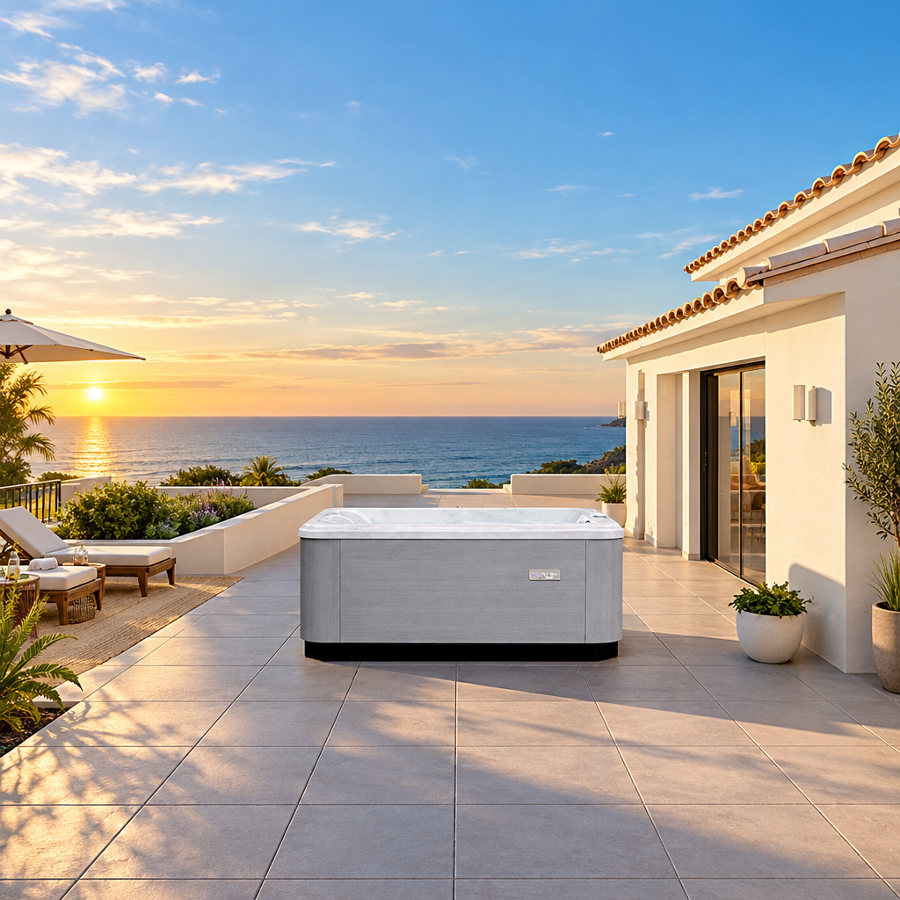
Investing in a 2 person outdoor hot tub spa turns underused domestic spaces into dedicated wellness retreats without the expansive footprint demanded by standard residential plunge pools. Compact hydrotherapy installations solve a common architectural challenge for modern properties: delivering warm, immersive soaking on restricted balconies, private urban courtyards, and modest suburban decks. Unlike large entertainment tubs built for social gatherings, a dedicated 2 person outdoor hot tub spa prioritizes focused massage, a smaller water volume, and efficient use of space for regular individual or shared relaxation.
Selecting the right unit requires balancing spatial boundaries against mechanical requirements. Every decision, from electrical planning to structural load evaluation, affects whether your spa operates smoothly or becomes a persistent maintenance headache. This practical guide covers the engineering realities, site preparation steps, and ergonomic designs of compact spas, using the manufacturer’s listed specifications as reference points for your investment.
Understanding the 2 Person Outdoor Hot Tub Spa Category
What Defines a Purpose-Built Two-Person Compact Spa?
A dedicated two-person spa is more than a downsized family tub with fewer seats. Its shell, seating, and equipment are planned around two bathers from the start. Where large multi-person tubs spread pumping capacity across many jets and seats, a compact unit can direct its jets toward fewer seating positions, with the layout designed to provide focused massage around the back and shoulder areas.
Unlike temporary inflatable tubs or deep soaking bathtubs, a permanently installed acrylic spa usually includes built-in filtration, heating, and controls, so the water stays filled and treated between uses. Many models also include insulation and freeze protection, but these details vary between products. Confirm insulation, freeze protection, and cold-climate guidance in the specific model’s technical documentation before planning year-round outdoor use.
Who Benefits Most from a Two-Person Configuration?
Homeowners and property managers often find that larger spas sit empty for long stretches while still holding and heating a large volume of water. A two-person profile directly serves couples, solo athletes recovering from training, and empty nesters seeking quiet daily soaking without heating water for seats nobody uses.
Boutique vacation rentals and guest villas also gain practical advantages. Small-footprint tubs reduce the water to manage between guest bookings, fit restricted patio space, and discourage oversized gatherings while still offering a well-regarded hospitality amenity.
Space Optimization vs. Bather Capacity Realities
Compact spas introduce genuine physical trade-offs that buyers must acknowledge before purchase. In an interior designed strictly for two adults, there is no extra perimeter bench for children or unexpected guests to perch on during warm summer afternoons. The trade-off, however, can yield better body support. By skipping extra transitional seating, designers can shape longer reclined positions that let two bathers stretch out without awkward leg positioning or bumping into each other.
Spatial Planning and Structural Feasibility
Calculating Footprint Beyond Product Dimensions
A frequent installation mistake is measuring only the exterior shell and assuming the spa will operate comfortably in that exact footprint. A rectangular model such as the VS-201C has listed exterior dimensions of 1,750 mm in length, 1,150 mm in width, and 750 mm in height. Operational clearance, however, demands a broader perimeter.
You must account for practical human movement and hardware around the installation perimeter:
Cover Clearance: Allow the swing clearance specified by the cover-lifter manufacturer, since lifter designs differ in how far they extend behind the tub.
Step Placement and Access: Leave an unobstructed, non-slip path in front of the entry point so bathers can step in and out safely, especially with wet feet at night.
Service Access: Follow the VS-201C installation manual for clearance around the equipment panel, keeping pumps, controls, and plumbing reachable for routine servicing.
Evaluating Balcony and Deck Load Capacities
Placing any outdoor hot tub on an elevated deck or residential balcony demands careful structural evaluation. A compact rectangular spa seems light when delivered empty, but water is heavy. One liter of water weighs approximately one kilogram, so the filled spa can create a substantial concentrated load.
Consider the total mass of the system during use. The dry weight of the shell, frame, and cabinet skirt forms the baseline. To this, add the water weight when filled to the normal operating level, plus the combined body weight of two adult bathers. On a balcony, this load is concentrated on a small area of the supporting structure. Never install a spa on elevated timber decking or cantilevered balcony slabs without written sign-off from a licensed structural engineer.
Delivery Paths and Architectural Access Planning
Many deliveries run into trouble during the final stretch from the curbside truck to the backyard pad. Because acrylic hot tubs are rigid, one-piece structures, they cannot bend around tight masonry corners or squeeze through narrow side-yard gates.
Inspect your path of travel methodically before scheduling arrival. Measure every gate, doorway, turn, and overhead obstruction against the delivery company’s required tipped dimensions and handling plan. Check overhead clearance against low-hanging gutters, air-conditioning compressors, and utility meters. If the destination is a high-rise balcony or an enclosed rooftop, arrange crane positioning or freight elevator access well in advance.
Engineering and Specification Breakdown: Evaluating the VS-201C
Core Mechanical and Electrical Specifications
Evaluating a compact spa requires looking past cosmetic shell colors to examine the mechanical configuration underneath. The VS-201C combines one 3 kW heater, one 2 HP water pump, and one 0.35 HP circulation pump, with a manufacturer-listed power-supply specification of 4.5 kW. Note that motor horsepower is not the same as electrical input, so your electrician should work from the unit’s nameplate rather than adding figures from a brochure.
Engineering Specification
Listed Value
Practical Note
Exterior Dimensions (Metric)
1,750 × 1,150 × 750 mm
Compact rectangular profile; verify delivery access with the supplier
Exterior Dimensions (Imperial, as listed)
6′ × 45″ × 30″
Approximate; 1,750 mm is about 68.9 inches
Seating Configuration
2 Loungers
Reclined seating for two adult bathers
Jet Count
15 Jets
Massage layout aimed at the back and shoulders
Water Pump
1 × 2 HP
Drives the massage jets
Circulation Pump
1 × 0.35 HP
Moves water through filtration and sanitation components
Heater Output
1 × 3 KW
Heats the spa water
Power Supply
4.5 KW
Manufacturer-listed specification; circuit design depends on nameplate and local code
Control System
KL2022 Smart Keypad
Adjusts water temperature, jets, and lighting
Cabinet Skirt
Aluminum-Plastic Skirt
Available in Platinum or Midnight
Shell Colour
Porcelain
Acrylic shell in the Porcelain colour option
The Ergonomics of Dual Facing Loungers
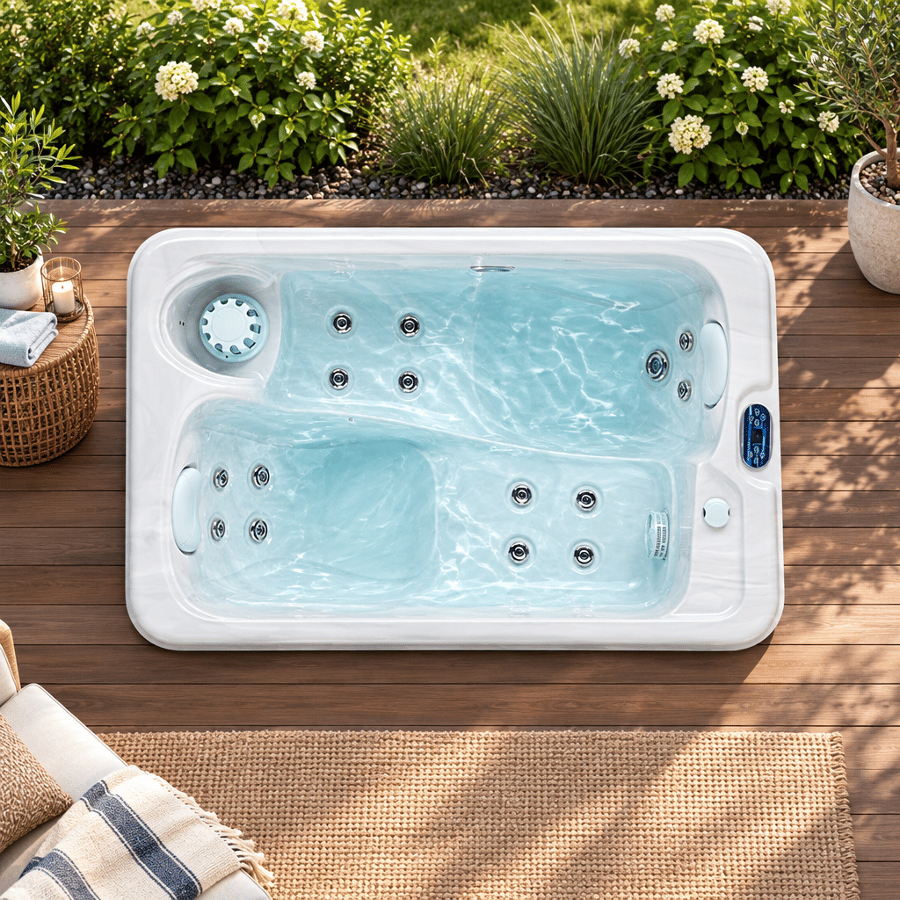
Seating layout governs everyday comfort in a small spa. Many micro-tubs place bathers on upright bench seats, which can leave the shoulders above the waterline on cold evenings. The VS-201C instead arranges two contoured loungers in an opposing orientation, so each bather has a full-length reclined position.
According to the product data, these lounge seats are contoured to fit the curves of the body, allowing two bathers to recline in relaxation. Cushioned headrests support the head and neck while you lie back. In practice, a reclined posture helps keep more of the upper body in warm water than an upright bench does, which makes a noticeable difference on cool nights.
The tub also includes integrated Bluetooth speakers, according to the manufacturer. For a couple using the spa as a quiet evening routine, music or a podcast from a paired phone can replace the need for a separate outdoor speaker near the water.
Hydrotherapy Jet Dynamics and Back Massage Architecture
The raw count of jet nozzles says little about how a massage will feel. Jet intensity depends on the pump, the plumbing layout, the jet design, the water level, and the operating mode. A tub advertising forty jets may feel weaker than one with fewer, better-placed jets.
The manufacturer pairs one 2 HP water pump with 15 jets in the VS-201C. Its Comfort Back Massage feature uses rotating jets positioned along the backrest, which the product data describes as delivering continuous water streams to soothe tight muscles along the spine and shoulders. If you sit at a desk all day, those are usually the areas that feel stiffest by evening.
Cabinet Architecture and Weather Resistance
Outdoor spas face sun, rain, and winter frost year after year. Natural timber skirts look warm but generally need periodic sealing or staining to stay in good condition outdoors. For this reason, many buyers now prefer synthetic or composite cabinet materials that need less routine refinishing.
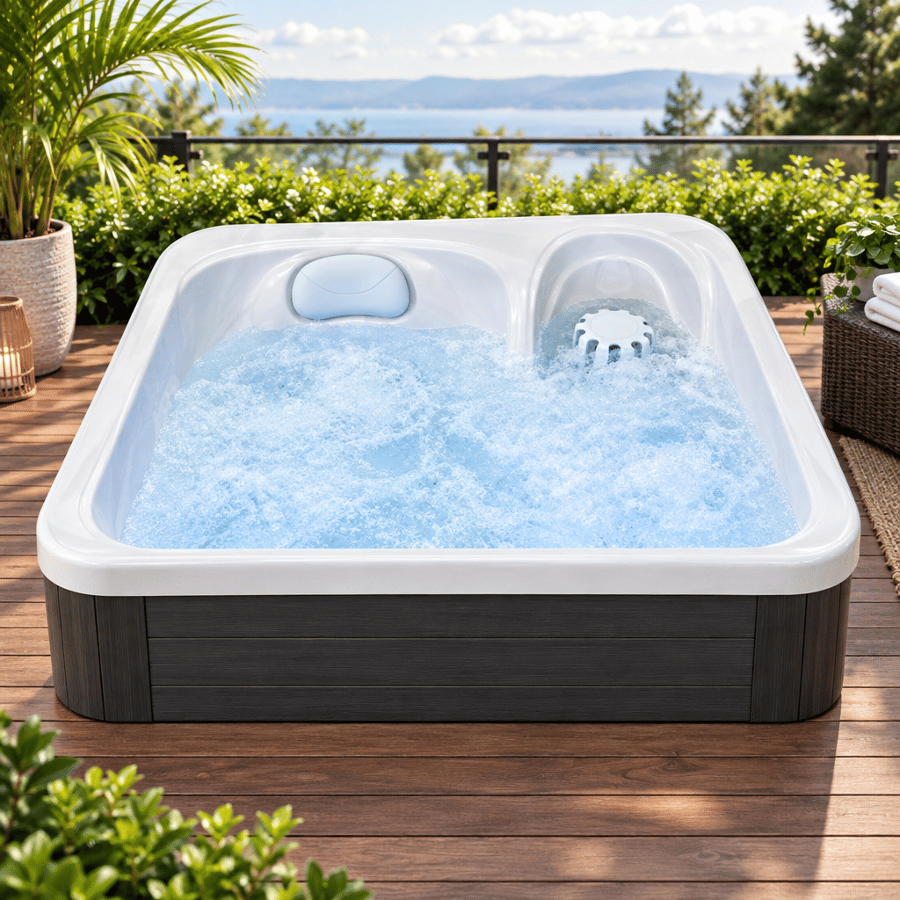
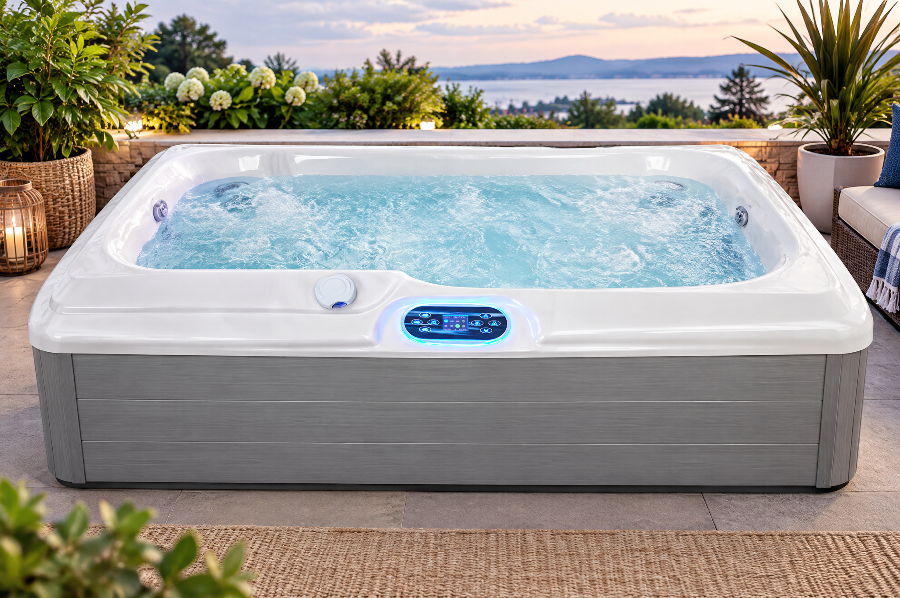
The VS-201C has an acrylic shell in the Porcelain colour option and an aluminum-plastic cabinet skirt in Platinum or Midnight. For long-term care of the skirt and shell, follow the manufacturer’s cleaning guidance and avoid harsh abrasives. Ask your supplier what the warranty covers for cabinet and shell finishes, since that document defines what the manufacturer will stand behind.
Utility, Electrical, and Drainage Site Preparation
Dedicated Electrical Circuit and GFCI Protection
Safe electrical delivery is the most important technical step of hot tub ownership. With a listed 4.5 kW power supply, a 3 kW heater, and a 2 HP massage pump, this unit should never run from an extension cord or a shared household outlet.
Follow these electrical safety steps during preparation:
Hire a Qualified Electrician: All outdoor spa wiring must comply with the electrical code adopted in your area.
Verify the Supply Requirements: The electrician must determine the required voltage, phase, wiring method, circuit rating, overcurrent protection, and conductor size from the model nameplate and local code.
Install GFCI Protection: The spa circuit requires ground-fault circuit-interrupter protection to reduce shock hazards near water.
Place a Disconnect Correctly: Install a readily accessible disconnect within sight of the spa, located according to the local code. Under NEC provisions, the maintenance disconnect is generally at least 1.5 m horizontally from the spa unless an exception applies.
Avoid Temporary Extension Cords: High current through undersized cords causes heating, voltage drop, possible motor damage, and fire risk.
Drainage Planning and Water Evacuation Strategy
At intervals set by the manufacturer and your water test results, you will need to drain and refill the spa. A two-person spa holds less water than larger units, but draining should still be planned so the discharge does not damage your surroundings. Do not run hot, chemically treated water onto garden plants, turf, or porous retaining walls. Instead, follow your local wastewater and chemical-disposal rules, which may also specify testing or treating the water first. Discharge only to a location expressly permitted by your local authority or utility, since sending treated spa water into stormwater drains is prohibited in many areas.
Ventilation and Surface Leveling for Semi-Enclosed Spaces
If your installation sits inside a semi-enclosed breezeway, loggia, or screened porch, moisture needs attention. Warm spa water evaporates into the surrounding air, and that humidity can condense on cool walls and encourage mold if nothing clears it.
Position the spa where cross-breezes can carry humid air away, or install an outdoor-rated exhaust fan. Just as important, install the spa on a solid, level, adequately supported base, such as a reinforced concrete slab or a properly prepared paver surface. Follow the manufacturer’s foundation tolerances, since an uneven base can stress the shell and cabinet.
Water Sanitation and Daily Maintenance Realities
Understanding Multi-Stage Sanitation Systems
Hot tub marketing often highlights advanced sanitation features, so buyers should understand what each component does. The VS-201C uses what the manufacturer calls a Hassle-Free Clean Water System, which combines multi-layer filtration, ozone oxidation, and UV sanitation.
Each stage plays a different role in water care:
Multi-Layer Filtration: Captures hair, debris, and suspended particles as water circulates.
Ozone Oxidation: Adds ozone to the circulating water to help break down organic contaminants such as oils and residues.
UV Sanitation: Exposes water passing through the equipment to ultraviolet light, which is used to inactivate microorganisms.
These systems may supplement filtration and chemical treatment, but they do not eliminate the need to maintain the manufacturer’s required chlorine or bromine residual. Ozone and UV act only on water passing through the equipment. They leave no sanitizer in the tub itself to deal with germs introduced by bathers.
Establishing a Reliable Residential Chemical Routine
Keeping spa water hygienic requires a consistent testing habit. Because a two-person spa holds a relatively small volume, each bather adds more contaminants per liter than they would in a swimming pool, and the water chemistry shifts faster as a result.
Use these reference points, together with the manufacturer’s guidance, to keep water safe and clear:
Routine Water Testing: Test sanitizer and pH at least twice per day, and more often when the spa is heavily used. Always follow the product and local health guidance for the specific sanitizer.
Free Chlorine Residual: Maintain a free chlorine residual of at least 3 parts per million (ppm), or a bromine residual between 4 and 8 ppm.
pH Range: Keep pH within the manufacturer’s and applicable health-guidance range, commonly 7.0 to 7.8 for hot tubs. As pH rises, chlorine becomes less effective, especially above 8.0, while low pH can irritate eyes and corrode metal components. Scaling risk depends on overall water balance, including calcium hardness, alkalinity, and temperature.
Total Alkalinity: Keep total alkalinity in a stable range, commonly 80 to 120 ppm, to limit sudden pH swings.
Cover Care, Thermal Efficiency, and Energy Retention
Evaporation is a significant source of heat loss in an outdoor spa. Leaving a hot tub uncovered outdoors makes the 3 kW heater run more often to hold temperature, which raises your electricity bill.
A well-fitted, insulated cover that seals over the acrylic lip reduces heat and water loss. It also keeps out leaves, dust, and wildlife. If your cover has a vinyl skin, clean and condition it according to the cover manufacturer’s instructions to slow sun damage.
Bather Safety and Operational Guidelines
Water Temperature Thresholds and Exposure Limits
Warm water feels good on stiff joints and sore muscles, but heat needs respect. In hot water, blood vessels near the skin widen to shed heat, and blood pressure can drop. Standing up quickly after a long soak is when many people feel lightheaded.
The CDC advises that hot tub water temperatures should not exceed 104°F (40°C). Many people find a lower setting, such as 98°F to 100°F (about 36.5°C to 38°C) on the KL2022 keypad, more comfortable for longer soaks. Treat any session length as general advice rather than a fixed rule, follow the manufacturer’s guidance, and leave the water immediately if you feel dizzy, nauseated, faint, or overheated.
High-Risk Group Cautions and Health Protocols
Some people face higher risks in hot water. Pregnant women should be cautious, as elevated body temperature during early pregnancy can affect fetal development, so consulting an obstetrician before use is essential.
Children younger than five should not use hot tubs. Older children require constant adult supervision to reduce drowning and entrapment risks, and any use must follow the manufacturer’s age and temperature restrictions. Anyone taking cardiovascular medication or managing a circulatory condition should get a doctor’s clearance before starting a regular hot tub routine.
Comparative Decision Matrix: Two-Person vs. Multi-Seat Hot Tubs
Footprint and Structural Load Trade-Offs
Choosing between a compact 2 person outdoor hot tub spa and a conventional 5-to-6-person family model comes down to available space and structural capacity. A small rectangular spa fits into areas where a large square tub cannot go.
The VS-201C occupies roughly 2.0 square meters of floor area based on its listed dimensions, while many large multi-seat models need well over 4 square meters. A large tub also holds far more water, so its filled weight usually calls for a substantial concrete slab. That makes upper-floor terraces and lightweight timber decks difficult or impossible without structural upgrades.
Hydrodynamic Efficiency and Water Volume
Water volume shapes heating costs, chemical use, and how long the tub takes to warm up. A compact spa generally uses less water than a larger model. Actual heating time, energy use, and chemical demand, however, depend on water volume, insulation, cover performance, ambient conditions, and how often the spa is used.
Water changes follow the same logic. Draining and refilling a smaller tub generally takes less time and less water than doing the same for a large family spa, which makes routine maintenance easier to keep up with.
Lifestyle Alignment: Solitude vs. Entertaining
Your choice should match your everyday routine rather than rare social occasions. If you plan to host weekend neighborhood parties, a two-person unit will feel restrictive. If your goal is daily recovery, quiet evening conversation with a partner, or a solo soak under the stars, a two-person spa fits that routine well. You get a private spot that fits modern living spaces and holds less water to look after than an oversized tub.
Pre-Purchase Buyer’s Verification Checklist
Critical Inquiries for Suppliers and Contractors
Before finalizing your purchase order, work through these questions with your spa dealer and contractor, and get the answers in writing:
Foundation Compliance: Is the planned surface flat, stable, and rated for the combined filled weight of the unit and its bathers?
Electrical Capacity: Has your licensed electrician confirmed that your electrical service can support the spa’s nameplate requirements and the circuit protection local code requires?
Warranty Coverage: What are the warranty terms for the shell structure, surface finish, plumbing, equipment, and the KL2022 control system?
Service Clearances: Does your site plan provide the equipment-panel access required by the installation manual?
Replacement Filters: Can you easily source the specific filter cartridges this model uses, locally or online?
Final Pre-Delivery Verification Steps
Avoid delivery-day surprises with a physical walk-through of the installation path:
Measure every gate, archway, and door frame against the supplier’s tipped-delivery measurements and the spa’s listed 1,750 × 1,150 × 750 mm dimensions.
Clear hoses, downspout extensions, outdoor furniture, and overhanging branches from the planned path.
Confirm that the concrete foundation or reinforced deck has fully cured and passed any required local inspections.
Make sure the GFCI protection and disconnect are installed, grounded, and inspected before the crane or delivery crew sets the spa in place.
Frequently Asked Questions (FAQs)
Can a 2 person outdoor hot tub spa be installed on an apartment balcony?
Possibly, but only after a licensed structural engineer and the building or property authority confirm that the installation is permitted and the balcony can safely support the filled spa, bathers, and equipment. You also need written approval from your homeowners association or property management, and a permitted way to drain the water during maintenance. Structural capacity, building approval, electrical requirements, waterproofing, delivery access, and local permitting may make installation impossible even when an engineer is consulted.
What are the exact dimensions and clearances required for the VS-201C?
The VS-201C has listed exterior dimensions of 1,750 mm in length, 1,150 mm in width, and 750 mm in height, which converts to approximately 68.9 × 45.3 × 29.5 inches. The manufacturer also lists these dimensions separately as 6′ × 45″ × 30″, but that six-foot length is inconsistent with the metric value, so confirm the installation drawing before planning delivery or placement. For operational clearances, follow the VS-201C installation manual for equipment-panel access and the cover-lifter manufacturer’s requirements for swing space behind the tub.
Does ozone and UV sanitation eliminate the need for chlorine?
No. Ozone and UV systems treat water as it passes through the equipment, but neither leaves a sanitizer residual in the tub water. You still need to maintain free chlorine (at least 3 ppm) or bromine (4 to 8 ppm), or the residual specified by the manufacturer, to protect bathers.
What electrical supply is needed to run a 4.5 kW hot tub system?
The VS-201C lists a 4.5 kW power supply, but the right electrical connection depends on the model’s nameplate, your local line voltage, and the adopted electrical code. A licensed electrician must verify the required voltage, phase, wiring method, circuit rating, and GFCI protection, and install a disconnect in a code-compliant location.
How often should the water in a two-person spa be drained and changed?
Drain and refill according to the manufacturer’s schedule, and also whenever the water cannot be balanced or stays cloudy, foamy, or odorous. Smaller spas may need more frequent water replacement, because the bather load is high relative to the water volume.
Conclusion: Making an Informed Investment in Compact Outdoor Wellness
A well-planned 2 person outdoor hot tub spa brings warm-water relaxation, back massage, and modern design into a space-efficient footprint. Models like the VS-201C, with 15 jets, two contoured loungers, and multi-stage water treatment, show what to look for on a compact specification sheet. The long-term experience, though, depends just as much on the work around the tub: a properly supported base, a code-compliant electrical installation, and a steady water care routine. Get those right, and your 2 person outdoor hot tub spa can serve as an everyday place to unwind right outside your door.
Victoria Star Swim Spa offers the perfect balance between exercise and relaxation, whether you want to swim for fitness or relax in the spacious seating.
Victoria Star Swim Spa offers the perfect balance between exercise and relaxation, whether you want to swim for fitness or relax in the spacious seating.