Best Swim Spa for the Money: How to Evaluate Value, Costs, and Fit
Home / News / Best Swim Spa for the Money: How to Evaluate Value, Costs, and Fit
November 07, 2026
Finding the best swim spa for the money requires looking past promotional brochures and steep showroom discount tags. A swim spa represents a substantial investment in household wellness, offering an aquatic environment suitable for endurance swimming alongside the physical comfort of dedicated hydrotherapy seating. When shoppers evaluate the best swim spa for the money, they need an objective assessment of mechanical layout, thermal design, structural requirements, and overall ownership responsibilities over time.
Investing in aquatic equipment involves purchasing a complex mechanical assembly that operates outdoors through changing weather, high hydraulic loads, and regular chemical balancing. Making a sound purchase requires understanding the practical trade-offs between counter-current propulsion, split heating arrangements, cabinet insulation, and site preparation. By relying on published specifications and conservative planning rather than broad promotional assertions, you can identify an installation that delivers dependable service and genuine utility for your household.
What “Best for the Money” Really Means in Aquatic Fitness
Match the Machine to Your Daily Routine
True value exists only when equipment features match your daily lifestyle and physical goals. A competitive swimmer or endurance athlete needs a steady, wide water flow that supports stationary swimming without pushing their stroke off center. Conversely, a multi-generational household or someone managing joint stiffness often prioritizes relaxed seating, gradual interior steps, and targeted massage jets over high-velocity current.
Paying for specialized performance capabilities that remain unused adds unnecessary capital expense, just as selecting an underpowered counter-current system can limit swimming routines. Outlining your household’s primary aquatic fitness and relaxation expectations before comparing technical sheets ensures your funds target the features you use most.
Account for Total Cost of Ownership Over Purchase Price
The purchase invoice represents only the initial portion of a swim spa’s total lifetime expenditure. Operating an outdoor body of water entails regular electricity consumption, site engineering, delivery crane arrangements, seasonal sanitizing supplies, and periodic equipment maintenance.
Because these recurring operational expenses vary based on climate, local utility tariffs, run-time schedules, and bather loads, prospective buyers should collect formal written estimates for electrical work and crane placement before placing an order. Structural insulation and a dense, well-fitted thermal cover help reduce heat loss to the surrounding atmosphere, though overall operating bills will always reflect local weather and temperature settings.
Rely on Verifiable Product Specifications
Comparing wellness equipment requires looking closely at published technical data rather than relying on general marketing claims. Promotional brochures may highlight lifestyle themes, but engineering parameters dictate how an aquatic unit actually runs day to day.
Prospective buyers should systematically verify documented attributes: individual pump horsepower ratings, dedicated circulation pump wattage, heater kilowatt capacities, and certified filtration stages. Cross-referencing these manufacturer-provided specifications gives you a factual baseline for comparing models and confirming serviceability.
Swim Spa vs. Traditional Pool and Hot Tub
When a Swim Spa Makes Practical and Financial Sense
Traditional in-ground swimming pools require considerable backyard surface area, lengthy excavation schedules, and ongoing chemical upkeep. In contrast, a swim spa consolidates aquatic training and soaking into a self-contained acrylic vessel designed for outdoor placement.
While water volume influences heating schedules, the actual time required to reach a specific water temperature depends directly on heating element capacity, starting water temperature, outdoor ambient conditions, and the quality of the thermal cover. For properties where lot lines, terrain constraints, or local ground conditions make full in-ground excavation difficult or impractical, an above-ground or semi-recessed swim spa provides an accessible alternative for home aquatic training.
Space, Installation, and Upkeep Trade-offs
While a swim spa offers versatile benefits, it is not an identical replacement for an expansive open pool. Lap swimming in a swim spa requires adapting to a stationary counter-current stream, which eliminates turns but demands stroke alignment within the jet path.
Feature
Traditional In-Ground Pool
Standalone Hot Tub
Dual-Zone Swim Spa
Footprint Required
Large yard footprint (varies by design)
Compact square footprint (typical for patios)
Elongated rectangular footprint (model-specific)
Year-Round Usability
Dependent on local climate and heating setup
Year-round capable, depending on climate and cover
Potentially usable year-round; verify model specifications and local installation conditions
Installation Timeline
Multi-week civil excavation and construction
Fast placement onto prepared pad
Delivery and placement method varies by access and site
Primary Function
Open recreational swimming and play
Social soaking and hydrotherapy
Counter-current training and hydrotherapy
Water Volume
Substantial multi-thousand gallon capacity
Limited volume for seating wells
Intermediate volume for swim lane and lounge
The Core Engineering Criteria That Dictate Value
Swim-Current Design and Swimming Space
A swim spa’s athletic utility depends directly on the stability and width of the water current it generates. Basic systems that route water through standard narrow hydrotherapy orifices can produce localized turbulence, forcing the swimmer to exert excess energy fighting lateral wash.
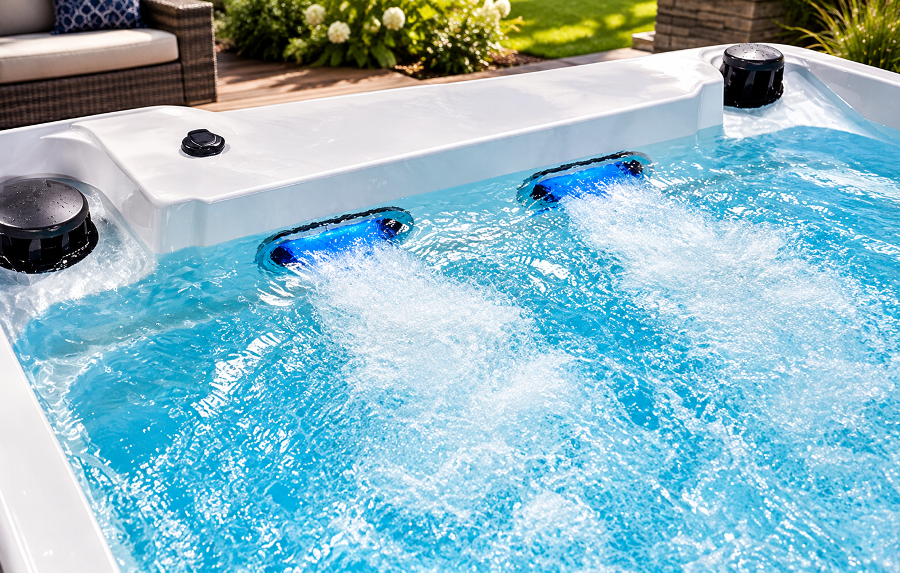
More capable configurations utilize enlarged counter-current nozzles or specialized propulsion systems paired with adjustable flow valves to deliver a current intended to support stationary swimming. When evaluating these systems, it is advisable to test the flow in person whenever possible and confirm the mechanical adjustment range with the seller. Lane dimensions also matter, as taller swimmers require adequate clearance between current outlets and the rear perimeter to complete full kick cycles without contacting steps.
Seating Layout, Jet Variety, and Ergonomics
If hydrotherapy is a priority, do not evaluate a spa solely by its total jet count. A unit with an unusually high number of small nozzles fed by an undersized pump will deliver diffuse, gentle bubbling rather than firm, targeted water flow.
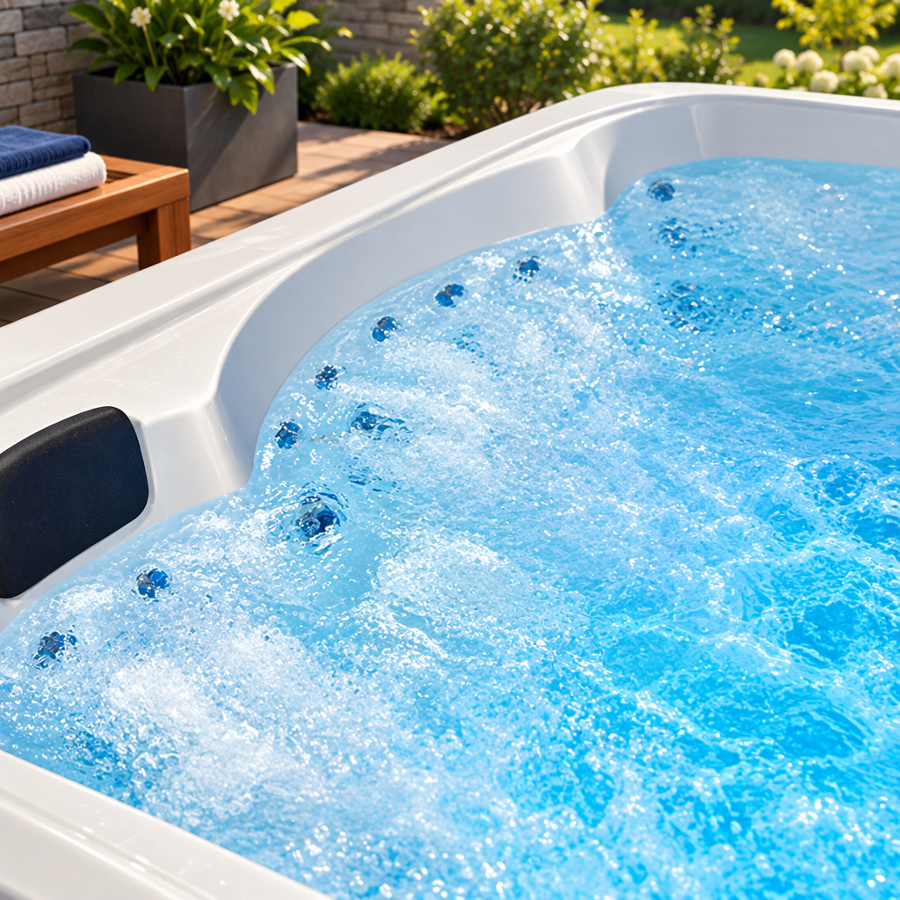
Look for ergonomic, body-contoured seating stations equipped with diverse jet styles. Directional nozzles allow users to angle streams toward muscle groups along the back, while wide-dispersion fittings distribute water pressure across broader seating sections. Having individual diverter controls lets you adjust hydraulic pressure across specific seats without altering water delivery to other areas of the spa.
Multi-Stage Water Filtration and Treatment
Maintaining sanitary, balanced water in a warm aquatic environment requires dedicated, continuous filtration. Relying solely on manual chemical doses can lead to cloudy water and skin irritation.
Modern water management systems combine physical filtration—such as cartridge filters and sand media—with automated purification technologies like ozone injection and ultraviolet (UV) germicidal irradiation. While ozone and UV neutralize organic pathogens and break down chloramines, routine manual water testing for free disinfectant and pH remains essential for biological safety.
Insulation, Thermal Retention, and Power Efficiency
Heating thousands of gallons of water outdoors requires substantial electrical energy. Units built with perimeter insulation trap ambient pump heat inside the cabinet, creating a thermal barrier that reduces heater cycling.
Check the heater’s kilowatt output relative to water volume. Dual-zone spas, which separate the swimming lane from the hot tub lounge, often feature dedicated equipment layouts to accommodate the differing hydraulic and thermal needs of both compartments.
Evaluating a Real-World Dual-Zone Model: Victoria Star VS-M1001
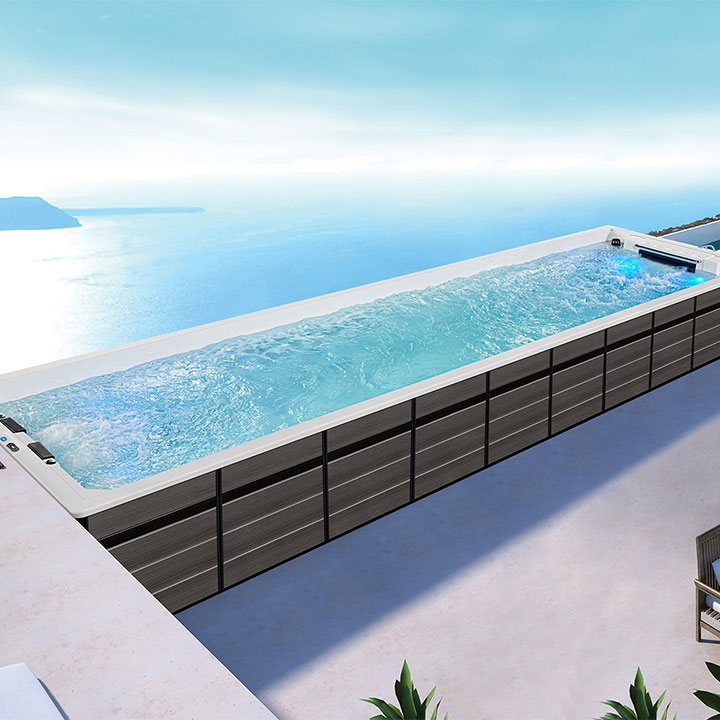
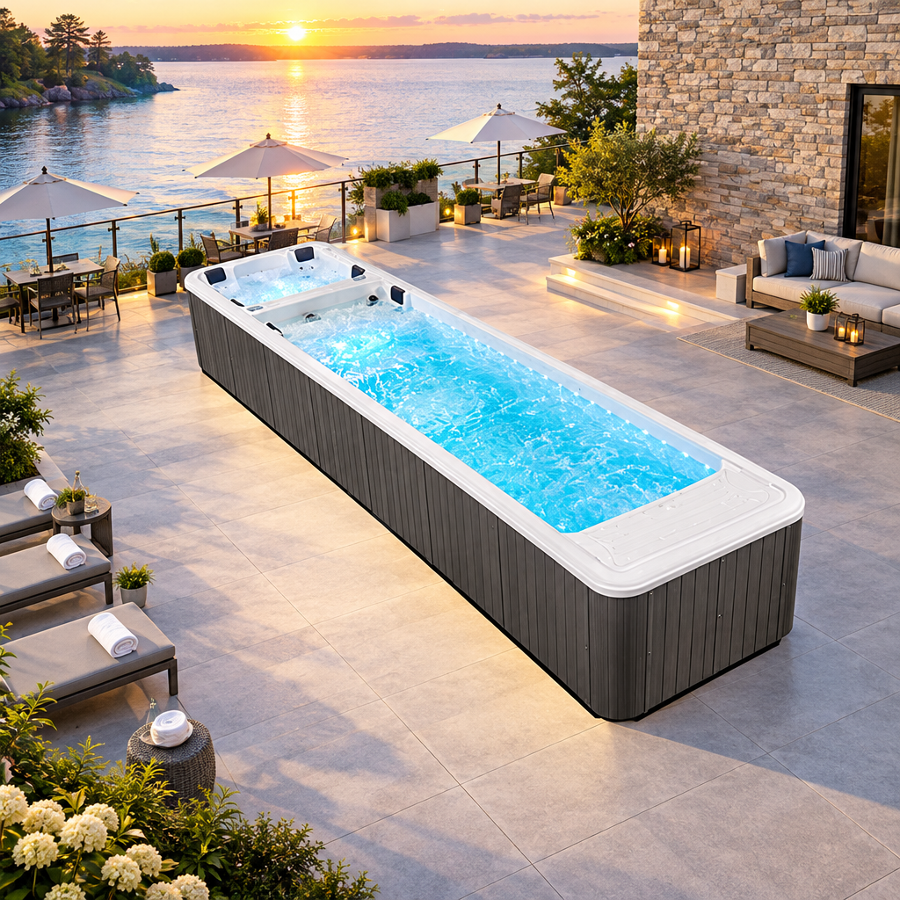
To see how structural specifications translate to value, we can examine an expansive dual-zone platform like the VS-M1001 swim spa, manufactured by Foshan Gaoming Shiyi Sanitary Ware Technology Co., Ltd. and offered under our Victoria Star brand.
Dimensional Profile and Multi-Person Capacity
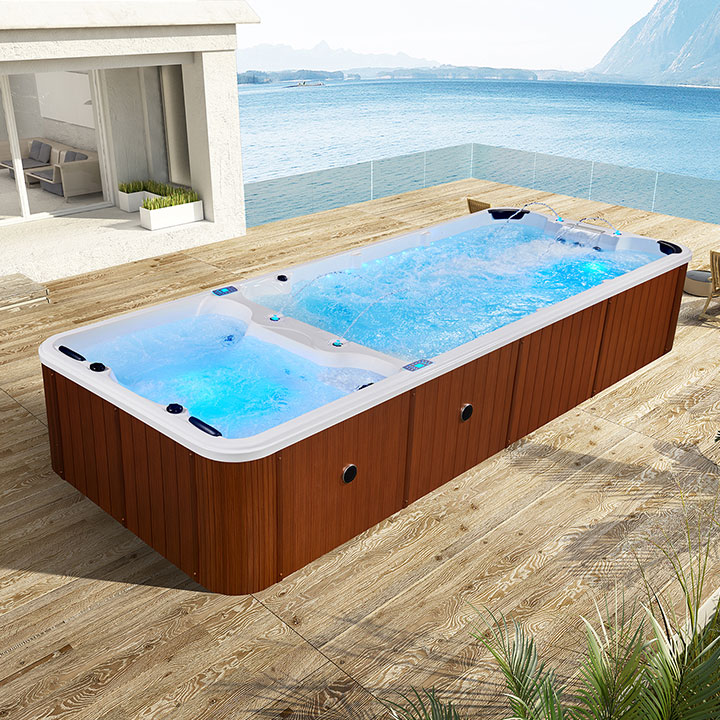
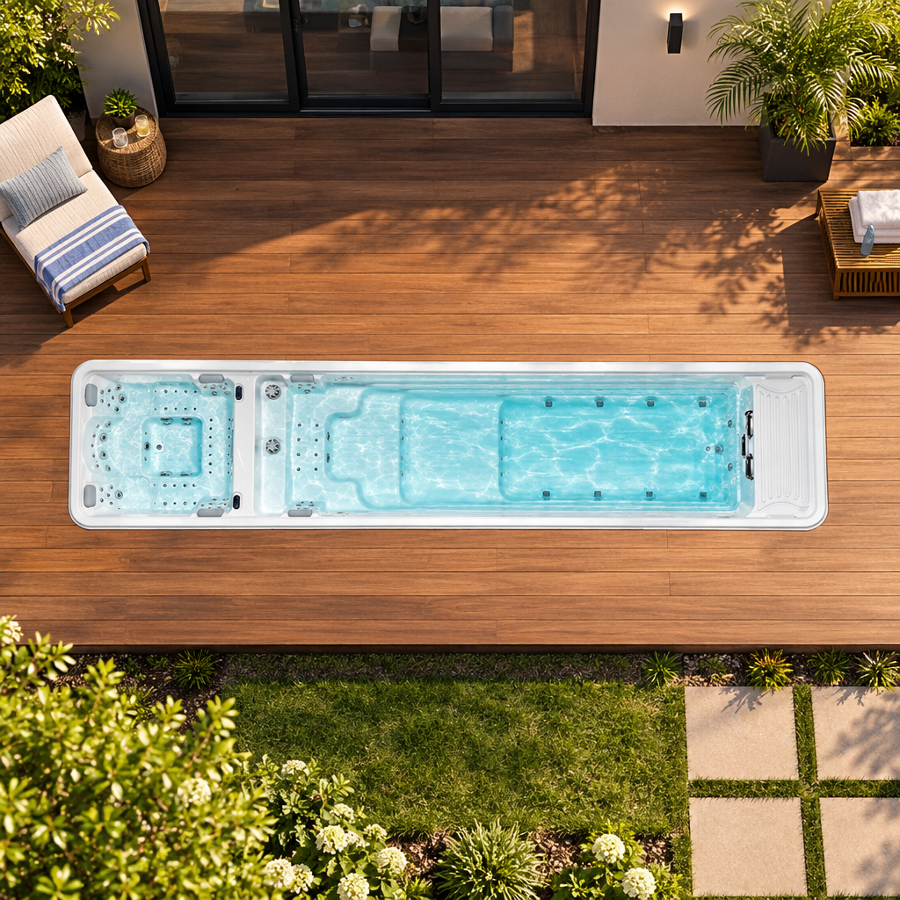
The VS-M1001 is engineered for expansive residential properties and commercial leisure amenities. It measures 10,000 mm in length, 2,200 mm in width, and 1,450 mm in height (approximately 33 feet by 87 inches by 57 inches). This generous footprint accommodates a dedicated counter-current swim corridor on one end alongside a 9-seat hydrotherapy zone on the other.
Built on a porcelain-white acrylic shell with exterior cabinetry options in Platinum or Midnight finishes, this model delivers 113 hydrotherapy jets. According to the manufacturer, the configuration provides multi-point hydrotherapy across designated back and leg massage positions, offering dedicated functional areas for both swimming exercise and seated group relaxation.
Pumping Infrastructure and Mechanical Parameters
Operating an aquatic vessel of this size requires heavy-duty internal hydraulics. The mechanical architecture incorporates multiple dedicated pumps to balance swim current resistance with multi-station hydrotherapy:
Water Pumps: 4 units rated at 3 HP plus 2 units rated at 2 HP for high-volume current flow
Circulation Pumps: 2 units rated at 1 HP plus 1 unit rated at 0.35 HP for quiet filtration
Air Blower: 1 unit rated at 0.9 HP for invigorating effervescence
Heater Assemblies: Dual 3 kW heating elements (6 kW total thermal output)
Overall Electrical Requirement: 20.25 kW total power supply rating
Digital oversight is managed by two sets of KL2022 control systems with smart keypad controls. These enable digital configuration of the vessel’s components from convenient access points. Factory amenities include an integrated Bluetooth audio system with twin AV speakers and perimeter LED lighting along the rim and underwater floor.
Clean-Water System and Thermal Engineering
The VS-M1001 utilizes a four-stage clean water purification system designed to support routine water maintenance. By integrating ozone sanitation, ultraviolet (UV) sterilization, high-efficiency cartridge filters, and sand filtration, the system traps suspended particulate matter while targeting microscopic contaminants. The manufacturer lists PU insulation to help manage temperature retention inside the cabinet structure.
Site Preparation and Installation Costs to Budget
Foundation Engineering and Substrate Requirements
An extra-large dual-zone swim spa represents immense dead weight once fully filled with water and occupied by multiple bathers. Placing a vessel of this scale onto soft turf, unreinforced patio pavers, or standard residential decking risks subsoil settling, uneven frame stress, and long-term damage to the acrylic shell.
Homeowners should always obtain specific filled-weight metrics and engineering pad requirements directly from the spa manufacturer before breaking ground. Provide a level, structurally adequate foundation that meets the spa manufacturer’s installation requirements; have alternatives such as elevated decks or custom vaults evaluated and certified by a qualified structural professional.
Dedicated Electrical Infrastructure and Safety Codes
Swim spas that combine high-volume water pumps, independent filtration loops, and multi-kilowatt heating elements require a substantial, dedicated electrical supply. The manufacturer lists a total power supply rating of 20.25 kW for the VS-M1001, underscoring the necessity of properly engineered utility capacity.
Rather than making assumptions about existing circuit breaker margins, consult the manufacturer’s technical installation manual and hire a licensed electrician. An electrician must verify your property’s main service panel headroom, calculate wire gauges for distance and voltage drop, pull local permits, and install certified ground-fault circuit-interrupter (GFCI) disconnects compliant with regional safety codes.
Delivery Access, Crane Logistics, and Municipal Clearances
Transporting an oversized spa into a residential backyard requires meticulous logistical planning. You cannot wheel a 33-foot vessel through a standard side garden gate.
Some installations require hiring a specialized crane service to hoist the spa over the roofline or fence onto the prepared pad, while properties with broad vehicular access may utilize flatbed trailers and specialized dollies. You must verify overhead utility lines, tree canopies, street parking permits, and neighborhood setbacks before scheduling final delivery.
A Practical Step-by-Step Selection Checklist
When cross-shopping swim spa models to secure the best swim spa for the money, follow this systematic evaluation process:
Establish Household Priorities: Determine whether your household’s primary focus is vigorous athletic endurance, recreational family play, or daily physical relaxation.
Calculate All-Inclusive Delivery Costs: Ask each dealer to separate the spa’s retail price from crane rigging, freight transport, and insulated safety cover costs.
Assess Subpanel Electrical Capacity: Have an electrician inspect your residential service panel and consult the model’s installation manual to determine appropriate wire gauge, breaker sizing, and service requirements.
Audit Internal Equipment Brands: Check that the spa uses widely serviceable plumbing fittings, recognizable digital topside controllers, and standard pump frame sizes.
Review Comprehensive Warranty Terms: Read the fine print regarding acrylic surface delamination, plumbing joint leaks, electrical parts coverage, and authorized mobile technician service networks.
Request Verified Engineering Drawings: Review manufacturer schematics detailing plumbing access doors, drain valve locations, and equipment bay orientations to avoid costly site layout errors.
Frequently Asked Questions
Is a swim spa cheaper to maintain than a swimming pool?
Operating and maintenance costs depend heavily on climate, bather load, temperature settings, and local utility rates. While a swim spa typically holds less water volume than a full-sized in-ground pool—which can mean fewer balancing chemicals and less water to heat—overall expenses vary, and homeowners should obtain local utility estimates rather than assuming universal savings.
How much space should I leave around the swim spa perimeter?
As a general planning guideline, leaving approximately 3 feet (about 0.9 to 1 meter) of clear access around cabinet panels helps facilitate maintenance. However, buyers should always consult the specific installation manual for the exact service clearance required around equipment bays and drainage access points.
Does a higher jet count indicate a superior swim spa?
Not necessarily. Jet count is often used as a superficial showroom metric. A spa with 60 thoughtfully engineered, high-flow jets powered by well-matched pumps delivers far better targeted massage than a unit crammed with 120 low-output nozzles fed by an overloaded, small-displacement pump.
Can UV and ozone systems completely eliminate chlorine or bromine?
No. Secondary water treatment equipment such as UV sterilizers and ozone generators helps break down organic waste and chloramines, potentially assisting water clarity, but they do not maintain an active residual sanitizer in the standing water. Spa owners must still test pH consistently and maintain a baseline free sanitizer level in accordance with manufacturer instructions and local public health guidelines.
Is an extra-large model like the VS-M1001 right for every property?
No. A 10-meter platform requires substantial backyard dimensions, robust crane access, and a powerful electrical service panel. Homeowners with smaller suburban yards or modest wellness routines may find a compact 14-to-16-foot single-zone model more practical and cost-effective.
Choosing Lasting Value for Your Home and Health
Finding the best swim spa for the money comes down to balancing structural engineering, long-term efficiency, and everyday functionality. By focusing on verified pump curves, documented thermal insulation, and honest installation costs rather than showroom hype, you secure an aquatic fitness center that will serve your home reliably for years to come.
Victoria Star Swim Spa offers the perfect balance between exercise and relaxation, whether you want to swim for fitness or relax in the spacious seating.
Victoria Star Swim Spa offers the perfect balance between exercise and relaxation, whether you want to swim for fitness or relax in the spacious seating.