The Practical Buyer’s Guide to a 2 Person Jacuzzi: Dimensions, Engineering, and Selection
Home / News / The Practical Buyer’s Guide to a 2 Person Jacuzzi: Dimensions, Engineering, and Selection
November 05, 2026
Investing in a 2 person jacuzzi often begins with a vision of personal wellness, yet navigating the market requires objective technical evaluation. Many homeowners seek a compact hot tub to convert an underutilized terrace, a master bathroom suite, or a private patio into a dedicated hydrotherapy retreat. Because interior living areas and urban outdoor plots demand strict spatial discipline, choosing a two-person spa involves much more than selecting an aesthetic shell color. You must understand how water capacity affects structural loads, how hydrotherapy jets balance with motor horsepower, and how sanitization components work together daily.
Understanding the 2 Person Jacuzzi: Brand Terminology vs. Compact Spas
Navigating retail listings can be confusing when proprietary trademarks mingle with general engineering categories. Clarity regarding product definitions protects you from misjudging equipment specifications, warranty policies, and manufacturing backgrounds. Search results for a 2 person jacuzzi mix branded whirlpool products with generic hot tubs from many makers, so the same phrase can describe very different equipment. Sorting out these labels first makes every later comparison more reliable.
Jacuzzi® as a Brand vs. Generic Two-Person Hot Tubs
In common vernacular, shoppers routinely search for a 2 person jacuzzi when referring to any self-contained, multi-jet portable hot tub designed for two adults. Technically, Jacuzzi® is a registered trademark owned by Jacuzzi Inc., which pioneered integrated whirlpool pump designs in the mid-twentieth century. Most compact spa models in residential showrooms originate from specialized global sanitary ware fabricators rather than that specific brand entity.
Recognizing this linguistic distinction allows you to focus squarely on component metrics rather than paying a brand premium. You can evaluate the thickness of the acrylic shell, the thermal rating of the cabinet insulation, and the performance curve of the water pump across diverse reputable manufacturers. True value stems from build quality, hydraulic efficiency, and long-term parts availability rather than marketing nomenclature.
The Physical Reality of Two-Person Capacity
Compact spas designed for two people typically abandon broad communal open seating in favor of tailored interior architecture. While four-person or six-person tubs provide wide bench perimeters, a compact hot tub prioritizes full body contact and precise lumbar immersion within a modest footprint. Every cubic centimeter of water must actively serve relaxation or physical relief.
When evaluating a two-person layout, examine leg wells and footwells carefully. Well-engineered small tubs feature sculpted contours that prevent bathers from knocking knees while soaking simultaneously. The shell should keep your torso properly immersed without an excessive total water volume, because every extra liter adds filled weight to the floor or deck and increases the amount of water the spa’s own heater must bring up to temperature.
Structural and Spatial Pre-Checks for Small-Footprint Spas
Before finalizing the purchase of an intimate hydrotherapy spa, verifying the installation site eliminates costly structural modifications or delivery failures. Water is remarkably heavy, and moving a rigid vessel through residential architecture presents distinct logistical hurdles. Two checks matter most: whether the floor or deck can carry the filled weight, and whether the shell can physically travel from the street to its final position. Both are easier to solve before delivery than after.
Floor Load and Structural Weight Calculation
Water weighs approximately one kilogram per liter, or 8.34 pounds per gallon, transforming an innocent spa vessel into an immense concentrated dead weight. Homeowners considering an elevated wooden deck, second-story balcony, or rooftop patio must calculate the total distributed load before positioning the equipment. This calculation must include three combined figures, which you can obtain from the manufacturer or estimate conservatively:
Dry weight of the hot tub shell, frame, and internal machinery.
Operating weight of the full water volume filled to the skimmer level.
Combined maximum weight of two adult bathers leaning back in the seats.
Dividing this total weight by the ground contact footprint gives you the load per square meter or square foot. No single figure tells you whether a residential deck or balcony is safe, because capacity depends on the framing, spans, materials, and local code. A code’s design live load also does not prove that a particular deck can carry a filled spa. Have a licensed structural engineer assess the actual spa load and support conditions whenever you install on suspended slabs, cantilevered balconies, or timber joists.
Delivery Pathways and Clearance Geometry
A rigid spa shell cannot bend, compress, or pivot through tight corners. Many delivery cancellations happen because buyers measured the patio footprint while overlooking pinch points along the transit route. You must audit the entire delivery path starting from the delivery truck tailgate directly to the foundation pad. A route that works for a sofa may still fail for a hot tub, because the shell is often carried on its side.
Measure gate widths, eave overhangs, gas meter clearances, and downspout projections along garden paths. If the unit must move through an interior hallway or doorway for a bathroom installation, verify door jamb clearances against the tub depth. Upright transport on a specialized spa dolly requires generous vertical clearance beneath roof lines, gutters, and overhead branches.
Indoor vs. Outdoor Placement: Ventilation and Drainage
An indoor hydrotherapy unit releases moisture into the room whenever the thermal cover is open. Without adequate ventilation, indoor humidity can rise quickly, leading to condensation inside wall assemblies and eventual mold growth. Plan moisture control before installation. The right exhaust or dehumidification setup depends on room size, existing ventilation, and local building requirements, so have it specified for your particular space.
Outdoor garden and courtyard environments introduce different considerations, primarily focusing on rapid drainage access and wind exposure. Ground surfaces must rest on a flat, monolithic concrete slab or engineered crushed-rock base that will not settle unevenly under constant saturation. You also need unobstructed gravity drainage paths for seasonal maintenance flushes and for rainwater, so the base never sits in standing water.
Ergonomics and Hydrotherapy: Evaluating Seating and Jet Configurations
True hydrotherapy depends on ergonomic support, targeted massage pressures, and quiet water circulation rather than sheer numbers on a marketing sheet. How your body settles into the water dictates whether your daily soak is restorative or frustrating. A tub with well-placed jets and seats that hold you in position will usually feel better than one that simply lists more features. The following sections explain what to look for in seating, jet layout, and circulation.
Dual Lounger Layouts vs. Upright Seating
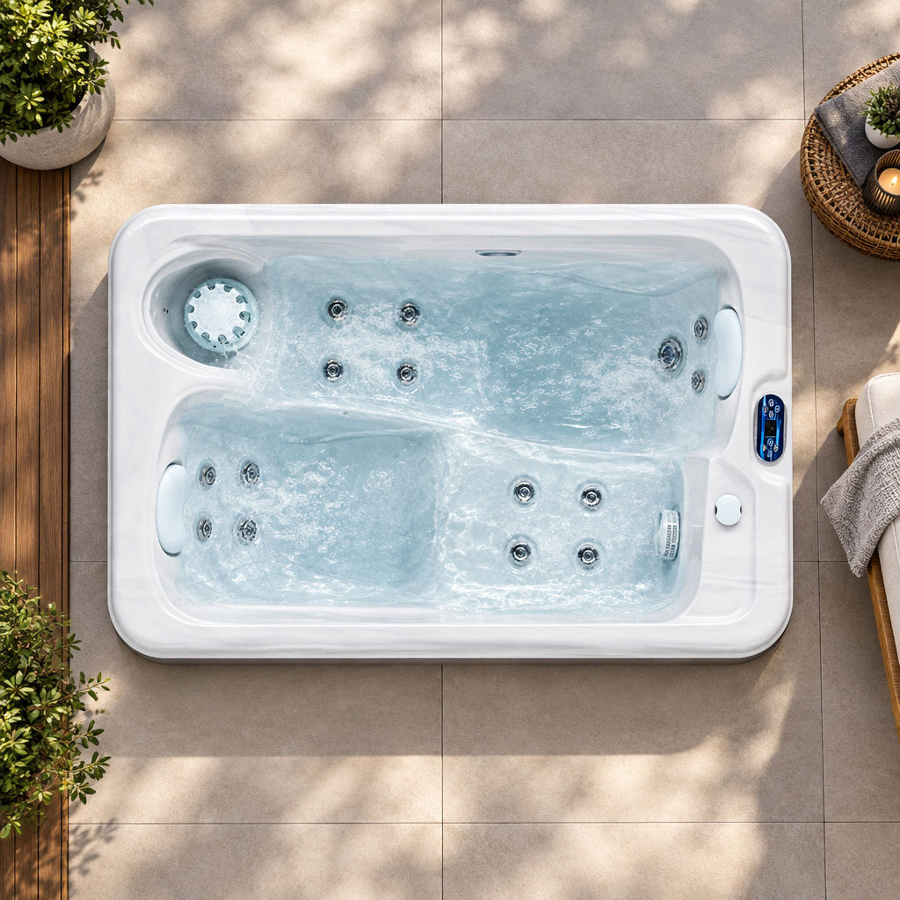
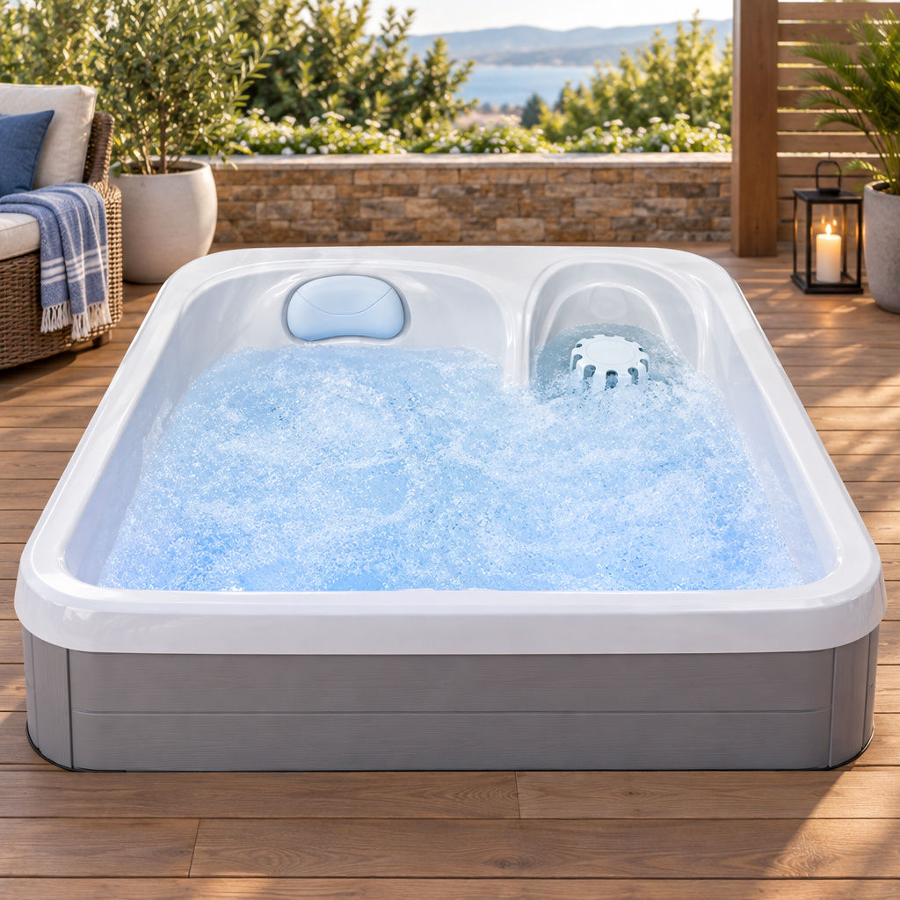
Seating geometries in compact spas generally split between bench-style upright seats and reclined loungers. Dual lounger configurations are popular in compact designs because they let both bathers recline with their legs extended, instead of sitting upright on a bench. Many people find a reclined position more relaxing for long soaks, although comfort depends on how closely the contours match your height and build.
Poorly designed loungers, however, suffer from an annoying phenomenon known as body floating. When water depth and seat angles are mismatched to human anatomy, buoyant forces can push a bather forward away from the hydrotherapy jets. High-grade shells address this by incorporating subtle knee kick-ups, molded foot stops, and textured ridges that help hold the torso in place.
Hydrotherapy Jet Engineering: Dynamics Over Raw Numbers
A common misconception in the spa market suggests that more jets automatically create a superior hydrotherapy experience. In reality, total jet count is secondary to hydraulic balance, orifice diameter, and fluid dynamics. Splitting a single pump output across too many small holes dilutes nozzle pressure down to a weak trickle. A spec sheet that lists jet count without pump size tells you only half the story.
A focused array of rotating, directional nozzles driven by adequate pump displacement delivers a firmer, more noticeable massage. Jets placed behind the shoulders, along the spine, and near the feet direct that pressure where many people carry tension. On models equipped with adjustable air controls, adding air can change the sensation from firmer water pressure to a softer, more bubbly flow.
Low-Flow Circulation and Thermal Management
Heating efficiency and acoustic peace rely heavily on how the plumbing system cycles water during passive idle periods. Tubs that rely on a noisy two-speed primary pump for ongoing filtration can disrupt late-night sleep with repetitive vibrations. A dedicated, low-wattage circulation pump addresses this, since a small motor sized for filtration usually runs more quietly than a large jet pump idling at low speed.
A dedicated circulation pump is typically used to support filtration and temperature maintenance without relying continuously on the main jet pump. How well it works depends on the spa’s plumbing layout, sensor placement, and control design. According to the product data, the VS-201C includes a separate 0.35 HP circulation pump alongside its 2 HP massage pump.
Technical Blueprint: Deconstructing a Real-World Compact Model (VS-201C)
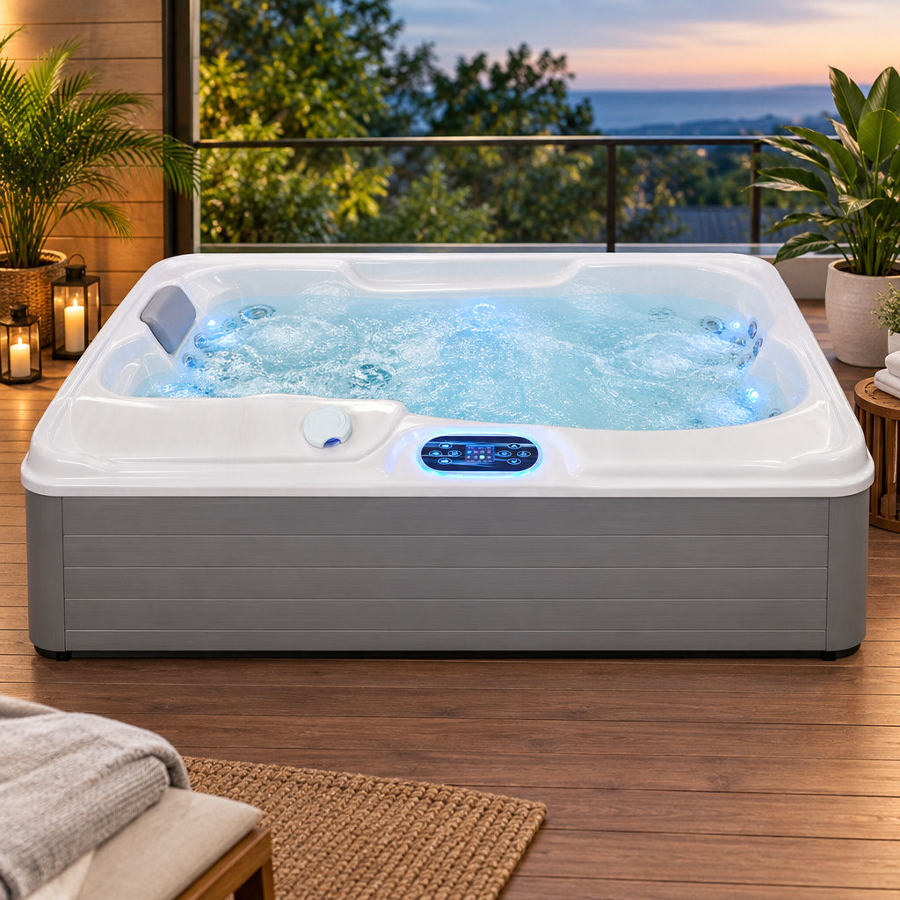
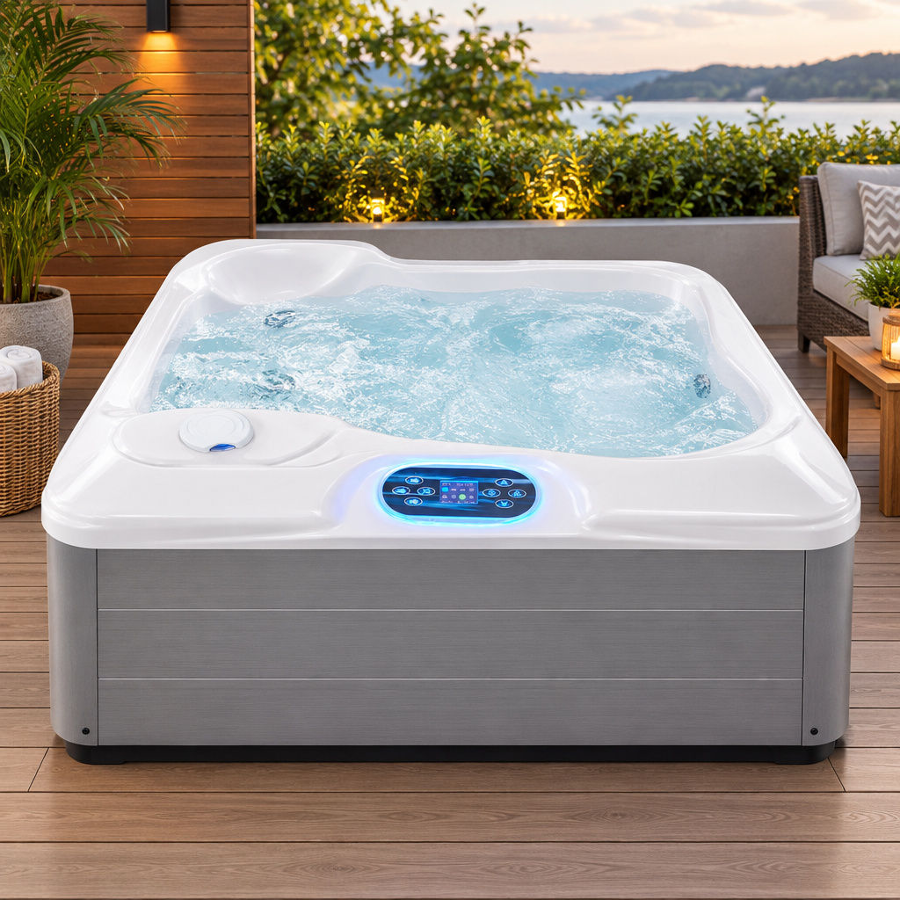
Examining an actual engineered model illustrates how spatial constraints, materials, and power requirements integrate into a functional compact spa. The Victoria Star Comfort Series VS-201C demonstrates practical engineering for modern smaller properties, and for us, precision in structural layout is key to long-term ownership satisfaction. The table below lists the specifications supplied in the product data, followed by notes on what each figure means for planning.
Technical Specification
Metric
Imperial
External Dimensions
1750 × 1150 × 750 mm
Approx. 68.9″ × 45.3″ × 29.5″
Seating Configuration
2 Loungers
2 Loungers
Total Jet Count
15 Jets
15 Jets
Control System
KL2022 Smart Keypad
KL2022 Smart Keypad
Heater Output
1 × 3 kW
1 × 3 kW
Water Pump
1 × 2 HP
1 × 2 HP
Circulation Pump
1 × 0.35 HP
1 × 0.35 HP
Power Supply
4.5 kW
4.5 kW
Cabinet Skirt
Aluminum Plastic Skirt
Aluminum Plastic Skirt
Cabinet Colours
Platinum, Midnight
Platinum, Midnight
Shell Colour
Porcelain
Porcelain
The imperial column shows a direct conversion of the metric dimensions. The product listing also quotes a rounded figure of 6′ × 45″ × 30″, and 6 feet is slightly longer than 1750 mm. When your delivery route or alcove leaves little margin, confirm the exact measurements with the manufacturer before relying on either figure.
Dimensional Footprint and Cabinet Engineering
At 1750 mm long, 1150 mm wide, and 750 mm high, the VS-201C is small enough to consider for balconies, terraces, and indoor suites. Its size alone does not guarantee a clear delivery route, though. Compare the actual transport dimensions, and the orientation the tub will travel in, with every gate, doorway, and corner along the path. The external height is 750 mm, and buyers should plan suitable access and clearance around the tub. The rectangular shape fits neatly into corners.
The product data specifies an aluminum-plastic skirt. Confirm its outdoor exposure limits, care requirements, and warranty coverage before installing the tub in a fully exposed location. Natural timber skirts typically need periodic sanding and water-repellent sealing, so a non-wood material can reduce that upkeep around garden splashback and rain. Platinum and Midnight skirt choices contrast neatly with the Porcelain acrylic basin, creating an understated modern look.
Power Requirements and Electrical Readiness
The product data lists a 4.5 kW power supply for the VS-201C, alongside a 1 × 3 kW heater, a 1 × 2 HP massage pump, and a 1 × 0.35 HP circulation pump. The supplied specifications do not state the required voltage, wiring method, or circuit protection. They also do not say whether the heater keeps running while the jet pump is on. Confirm these details in the model’s electrical documentation before planning the circuit.
Have a qualified electrician install the supply according to the manufacturer’s wiring requirements and your local electrical code, including any required ground-fault protection and disconnect. Conductor size must suit both the load and the length of the cable run to avoid voltage drop. Arranging this work before delivery means the tub does not sit empty while you wait for an electrician.
Smart Control Systems and User Experience
Daily operation centers on the KL2022 smart digital keypad set into the rim, which the product data says adjusts water temperature, jets, and lighting. The display shows the current water temperature, so you can check it before stepping in, and the control interface gives you direct adjustment of the spa’s operating modes. Integrated Bluetooth speakers let you play music or ambient sound from a phone through the spa.
Like most digital spa controllers, the system holds the water near a set temperature by calling for heat when it drops below the target. If you plan to run the tub through freezing winters, ask the manufacturer how the KL2022 handles freeze protection. Keeping the cover on between soaks also stops the heater from fighting constant heat loss.
Water Quality Management and Maintenance Realities
Keeping hot tub water balanced and clear requires understanding basic water chemistry and physical filtration. Because two-person spas hold a relatively low total water volume, organic loads from sweat, skin oils, and cosmetics affect water balance much faster than in large swimming pools. In a small tub, a skipped test or a clogged filter shows up in the water sooner, so routine checks matter more.
Multi-Stage Sanitation: Filtration, Ozone, and UV Integration
Modern small spas manage organic waste using a multi-stage approach that combines physical filtration with supplementary oxidation. The product data describes a multi-layer filtration system. Confirm the filter type, access method, cleaning interval, and replacement specification in the owner’s manual, since these details vary across models. Keeping the filter clean maintains water flow and prevents debris from circulating through the plumbing.
The VS-201C product data describes a combination of multi-layer filtration, ozone oxidation, and UV sanitation as its Hassle-Free Clean Water System. Ozone oxidizes dissolved bather waste, while UV light inactivates microorganisms passing through the treatment chamber. These stages can lower sanitizer demand, but they work only as in-line supplements.
Public Health Guidelines and Chemical Sanitization
Public health agencies, including the Centers for Disease Control and Prevention (CDC), point out that ozone and UV systems treat water only as it circulates through their chambers. They do not leave a protective residual sanitizer in the bulk water inside the footwell or seating areas. You therefore still need to maintain an active sanitizer residual at all times:
Keep free chlorine at no less than 3 ppm, or bromine at no less than 4 ppm. CDC guidance on preventing Legionella in hot tubs gives control ranges of 3–10 ppm for chlorine and 4–8 ppm for bromine.
Maintain pH between 7.2 and 7.8, which helps the disinfectant work effectively and is gentler on skin and eyes.
Keep the water no hotter than 104°F (40°C).
Total alkalinity is not part of CDC’s hot-tub disinfection guidance, but it buffers pH against sudden swings. When alkalinity is too low, pH can drift quickly after each soak or chemical addition. When it is too high, pH becomes hard to adjust. Follow the target range given by your spa or water-treatment product manufacturer, and where the manufacturer’s instructions or local rules are stricter than general guidance, follow them.
Test disinfectant concentration and pH at least twice daily, and more often during heavy use, as CDC recommends for residential pools and hot tubs. Test strips or a digital photometer make each check quick, and you should follow the test kit manufacturer’s directions for timing and reading results. Regular balancing also helps protect the heater and other components from corrosion and limits scale buildup in the plumbing.
Thermal Efficiency and Evaporative Heat Loss
When a spa is uncovered or its cover seals poorly, evaporation can become a major source of heat loss and energy use. Leaving the water exposed lets that loss continue around the clock and raises electricity consumption. A well-fitting insulated cover suitable for your spa limits evaporation and holds heat inside the vessel. Fit matters as much as thickness, because gaps at the edges let warm, moist air escape.
Inspect the cover seal regularly to ensure heat does not escape where the cover meets the acrylic rim. Keeping the insulated cover securely latched when the spa is idle prevents wind from breaking the seal. Small operational habits like this reduce standby power draw and keep your spa warm and ready whenever you want to soak.
Pre-Purchase Decision Checklist
Finalizing your purchase requires a systematic review of your property, your personal comfort, and long-term operating costs. Walking through these sequential evaluation steps helps you avoid unexpected surprises after the delivery truck arrives. Each step below draws on a section of this guide, so you can work through them in order and return to the relevant section when a question comes up.
Have a structural professional confirm load-bearing capacity under local building codes, using the total weight of the shell, full water volume, and two adults.
Trace the delivery path from driveway to foundation pad, measuring vertical clearances, gate openings, and wall corners against the tub’s actual transport dimensions.
Hire a qualified electrician to inspect your main service panel and install the circuit, protection, and disconnect required by the manufacturer’s wiring documentation and local code.
Lie down in the spa seats when wet testing to make sure the lounger lengths, headrests, and foot stops fit your body proportions comfortably.
Inspect maintenance access panels around the cabinet skirt to verify that pumps, unions, and pack electronics are easily serviceable without dismantling exterior decking.
Budget for routine maintenance, including replacement filter cartridges, water testing supplies, and periodic water changes at the interval your manufacturer recommends or the volume-based formula in the FAQ below gives.
Frequently Asked Questions (FAQs)
Is a 2 person jacuzzi suitable for installation on an apartment balcony?
Balcony installation requires careful structural planning. A 1750 × 1150 mm footprint may physically fit on many private terraces, but the footprint alone cannot tell you whether the structure can carry the combined weight of the shell, water, and two bathers. Balcony capacity varies with construction and local code. Before installation, get a site-specific assessment and written approval from a licensed structural engineer, and check any building or condominium rules.
What is the difference between a 110V plug-and-play tub and a hardwired 220V/380V system?
A 110V plug-and-play spa connects to a standard dedicated outlet, but its limited electrical capacity often requires compromises. Many 110V control packs cannot run the heater and the jet pump on high speed at the same time, so the water can cool during long massage sessions. Higher-voltage hardwired spas generally have more capacity to run components together, but the behavior depends on the specific control pack and supply. For any model, including the VS-201C with its listed 4.5 kW power supply, check the electrical documentation for voltage, amperage, and whether the heater runs while the jets are on.
Does an ozone or UV system eliminate the need to add sanitizing chemicals?
Ozone and UV units do not eliminate the need for sanitizing chemicals. Both technologies treat water only as it passes through their chambers, leaving no residual protection in the main tub. You must still maintain at least 3 ppm free chlorine or at least 4 ppm bromine, alongside a pH of 7.2 to 7.8, to control bacterial growth on the walls and in the plumbing.
Can two tall adults fit comfortably in a compact dual-lounger spa?
Fit depends on the usable interior dimensions of the loungers and on both bathers’ proportions, not on the external footprint alone. A 1750 mm outer length includes the shell walls and cabinet, so the reclining length available inside is shorter, and the supplied product data does not list it. Before buying, both intended users should wet-test the spa together, checking that headrests, knee contours, and foot positions suit each person and that legs do not crowd each other when both recline.
How often should the water be changed in a compact two-person spa?
Because two-person spas hold relatively little water, dissolved solids from sweat, lotions, and sanitizer residues build up faster than in large pools. No fixed interval fits every tub. CDC guidance uses a simple formula: divide the spa’s water volume in gallons by three, then divide that result by the average number of bathers per day. The answer is the approximate number of days between drain-and-refill cycles, and heavier use shortens that interval. If the manufacturer’s instructions call for more frequent water changes, follow them.
Conclusion
Selecting the right 2 person jacuzzi improves personal relaxation and home wellness, provided your purchase is grounded in practical engineering realities. By looking past surface marketing claims, verifying structural loads, checking your electrical supply, and evaluating hydraulic jet dynamics, you give your compact hot tub the best chance of delivering comfort for years to come. Durable construction materials, paired with multi-stage water treatment and a dedicated circulation pump, can turn a modest patio or indoor wellness suite into an easy-to-maintain, year-round personal retreat.
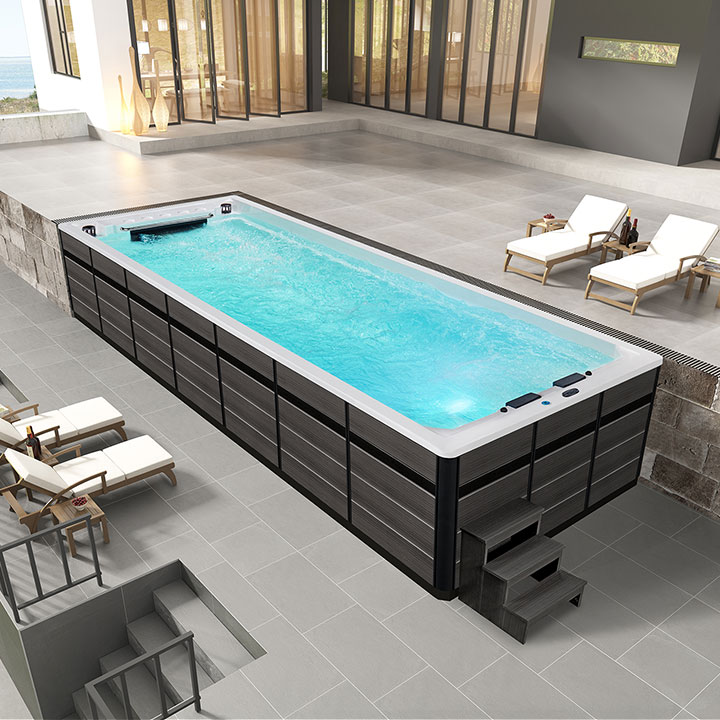
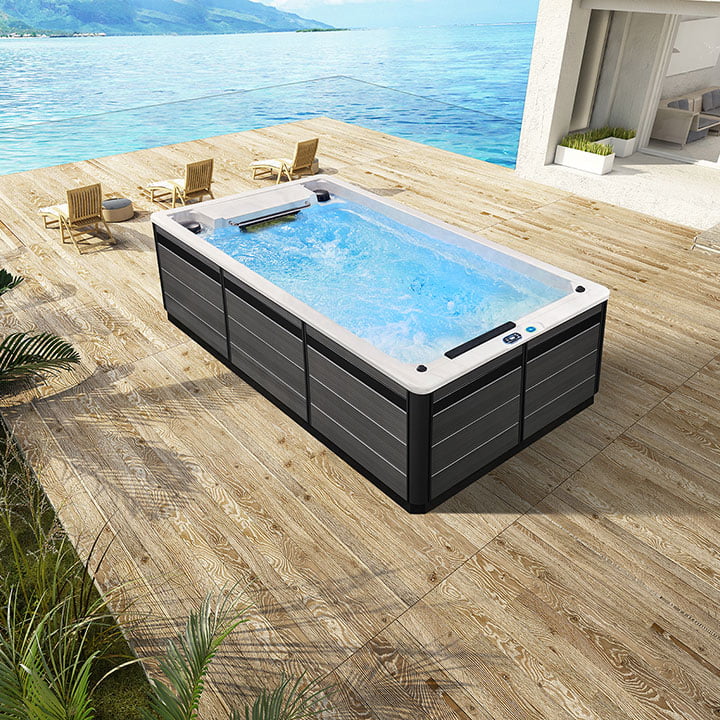
Victoria Star Swim Spa offers the perfect balance between exercise and relaxation, whether you want to swim for fitness or relax in the spacious seating.
Victoria Star Swim Spa offers the perfect balance between exercise and relaxation, whether you want to swim for fitness or relax in the spacious seating.