The Comprehensive Guide to Choosing the Best Spas for Backyard Living and Wellness
Home / News / The Comprehensive Guide to Choosing the Best Spas for Backyard Living and Wellness
November 07, 2026
Finding the best spas for backyard spaces requires balancing structural engineering, mechanical reliability, and personal physical therapy needs. A private outdoor installation turns open ground into a functional retreat for recuperation and year-round exercise. Yet, selecting an ill-fitting model often leads to unexpected foundation settling, inadequate hydrotherapy pressures, or inflated power bills.
Evaluating the best spas for backyard installations involves understanding water volumes, site clearances, and hydraulic pump power before ground preparation begins. This guide outlines spatial planning, hydraulic mechanics, water sanitation, and installation logistics so you can invest with complete technical confidence.
Understanding Backyard Spa Categories: Immersion Soaking vs. Dual-Zone Swim Spas
Backyard aquatic installations generally fall into two broad structural designs: dedicated immersion hot tubs and dual-purpose swim spas. Deciding between them depends on whether your outdoor routine prioritizes static hydromassage or active cardiovascular training within limited exterior boundaries.
Traditional Hydrotherapy Hot Tubs for Relaxation and Immersion
Traditional hot tubs concentrate primarily on warm-water immersion and hydromassage for leisure and comfort. Models vary widely in their layout, physical footprint, and interior configuration, with bather capacities spanning compact two-person tubs to multi-occupant communal units. Prospective buyers should always compare the manufacturer’s stated dimensions and capacity against their available patio area.
Their primary mechanical focus is maintaining steady thermal setpoints while circulating water through intricate manifold arrangements. While ideal for evening leisure, their compact volume limits physical exercise to stationary stretching and gentle joint mobility.
High-Performance Swim Spas for Exercise and Recovery
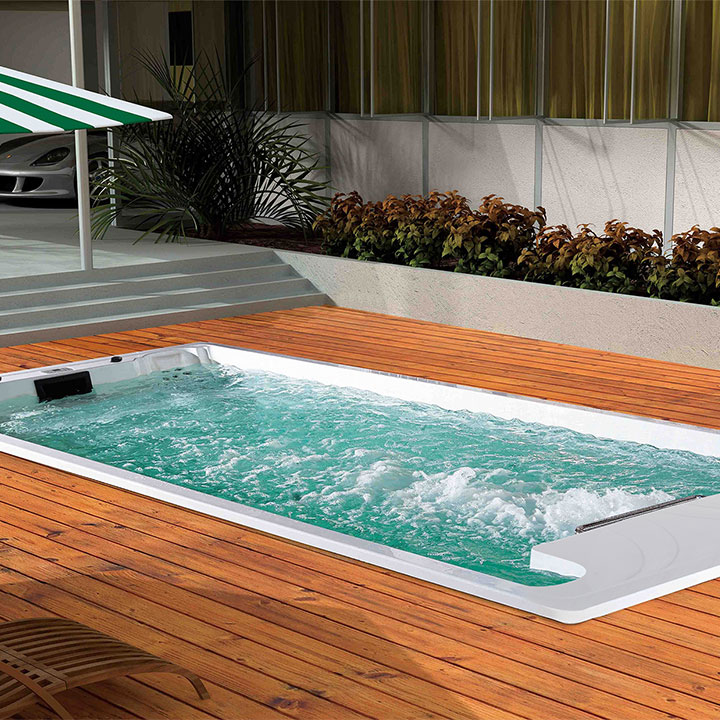
Swim spas bridge the gap between compact hot tubs and full-sized inground swimming pools by incorporating counter-current flow systems. These units measure significantly longer, providing an uninterrupted swim lane that allows continuous freestyle, breaststroke, or resistance walking.
Beyond cardiovascular training, high-performance swim spas feature integrated massage seating at the opposite end of the propulsion current. This dual-zone arrangement lets users complete swim training workouts before transitioning directly into hydro-massage seating without leaving the water.
Comparative Analysis: Choosing the Right Format for Your Space
Selecting the proper architecture depends on structural dimensions, bather goals, and electrical infrastructure. Reviewing the core operational differences helps determine which format matches your backyard layout.
Parameter
Traditional Hydrotherapy Hot Tub
Dual-Zone Swim Spa (e.g., M-503)
Primary Function
Static soaking & localized hydromassage
Counter-current swimming & hydrotherapy
Typical Footprint
Model-dependent; verify site fit
4.0 m – 6.0 m length (M-503: 5.8 m)
Water Capacity
Model-dependent (approx. 1,000 L – 1,800 L)
Large volume (M-503: 7,890 L)
Operating Weight
Verified via manufacturer specification
Verified via manufacturer specification
Dedicated Pump Power
1 to 2 pumps (model-specific)
Multiple pumps (e.g., 3 x 3 HP + 1 HP circ)
Physical Fitness Utility
Passive stretching and mobility
Resistance swimming and aquatic workouts
Engineering and Spatial Essentials Before Placement
Installing a large spa is fundamentally an architectural commitment that requires proper ground preparation. Neglecting the physics of mass and fluid dynamics can lead to unlevel shells, cracked plumbing joints, and voided manufacturer warranties.
Ground Preparation and Pad Load Calculations
A large swim spa filled with water and bathers exerts immense downforce onto its foundation. Placing such equipment on uncompacted soil, loose pavers, or unverified surfaces can result in shifting over time. To ensure long-term structural integrity, the base must strictly meet the manufacturer’s levelness and weight-bearing specifications.
Have the foundation or engineered subframe reviewed by an appropriately qualified professional when required by the design, contractor, insurer, or local authority. If integrating the unit into a raised timber deck, an independent structural professional must evaluate dynamic load capacities and design dedicated substructure footings.
Electrical Infrastructure: Voltages, Dedicated Breakers, and Amperage
Backyard spas are substantial electrical consumers that cannot operate on standard household extension cords or shared branch circuits. They require a dedicated sub-panel wired directly from the primary residential distribution board. A certified master electrician must install required ground-fault circuit interrupter (GFCI) protection and an external disconnect switch in locations compliant with locally adopted electrical codes and manufacturer instructions.
For large swim spas like the M-503, the manufacturer lists a power supply specification of 13.35 kW with multiple pumps and dual heating elements. Because operating voltage, phase requirements, total continuous amperage, and circuit sizing vary, an electrician must evaluate the electrical panel capacity and calculate exact conductor gauges before delivery.
Clearance, Accessibility, and Service Maintenance Envelopes
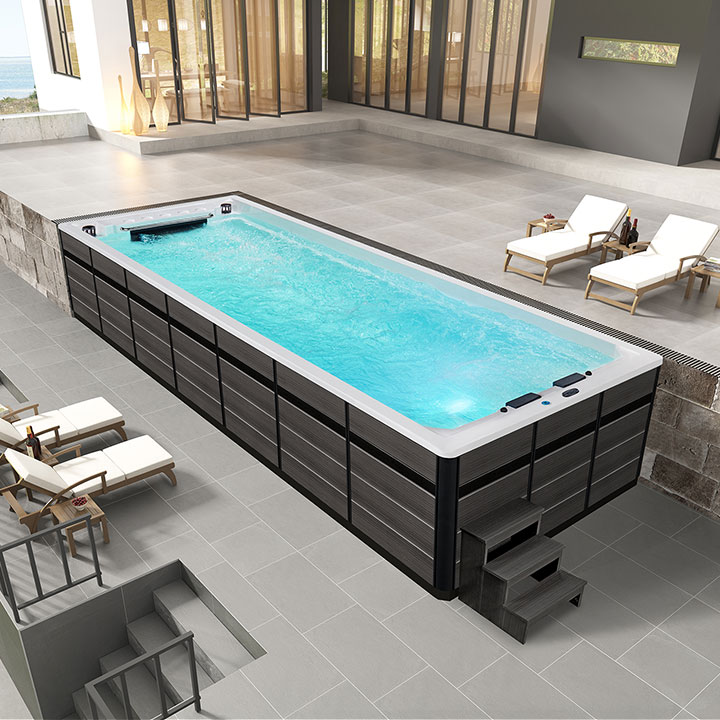
While sinking a swim spa flush into a deck looks sleek, maintenance panels must remain accessible. Pumps, heaters, diverter valves, and control pack boards require periodic inspection and servicing. If access panels are boxed in by permanent carpentry, minor pump maintenance can transform into a costly demolition project.
Homeowners must follow the manufacturer’s specified service clearances around the equipment compartment and skirting panels. Confirm these service envelopes and delivery paths with your installer before constructing permanent decking, pergolas, or privacy walls. Additionally, consult your municipal building department to determine specific barrier, self-latching gate, or safety-cover requirements applicable to your chosen spa.
Critical Features That Define the Best Spas for Backyard Installations
Evaluating competing options requires looking beneath the outer acrylic surface into the internal plumbing, insulation, and shell structures. Rather than relying on exterior styling, prospective buyers should request documented insulation data, energy consumption ratings, and decibel sound profiles from manufacturers.
Hydraulic Systems: Pumps, Flow Rates, and Manifold Distribution
The hydrotherapy experience depends less on raw jet counts and more on fluid flow dynamics. Cheap configurations split flow from an undersized motor across dozens of tiny orifices, producing weak flow rather than firm massage pressure. When assessing models, buyers should request documented plumbing schematics, pump performance curves, and flow-rate data from the supplier.
Look for dedicated circulation pumps designed for quiet continuous filtration, alongside multi-horsepower booster pumps that engage on demand for swimming resistance or hydro-massage. Verifying plumbing manifold design ensures that water velocity remains balanced across all target seating stations.
Shell Ergonomics, Jet Placement, and Pressure Control
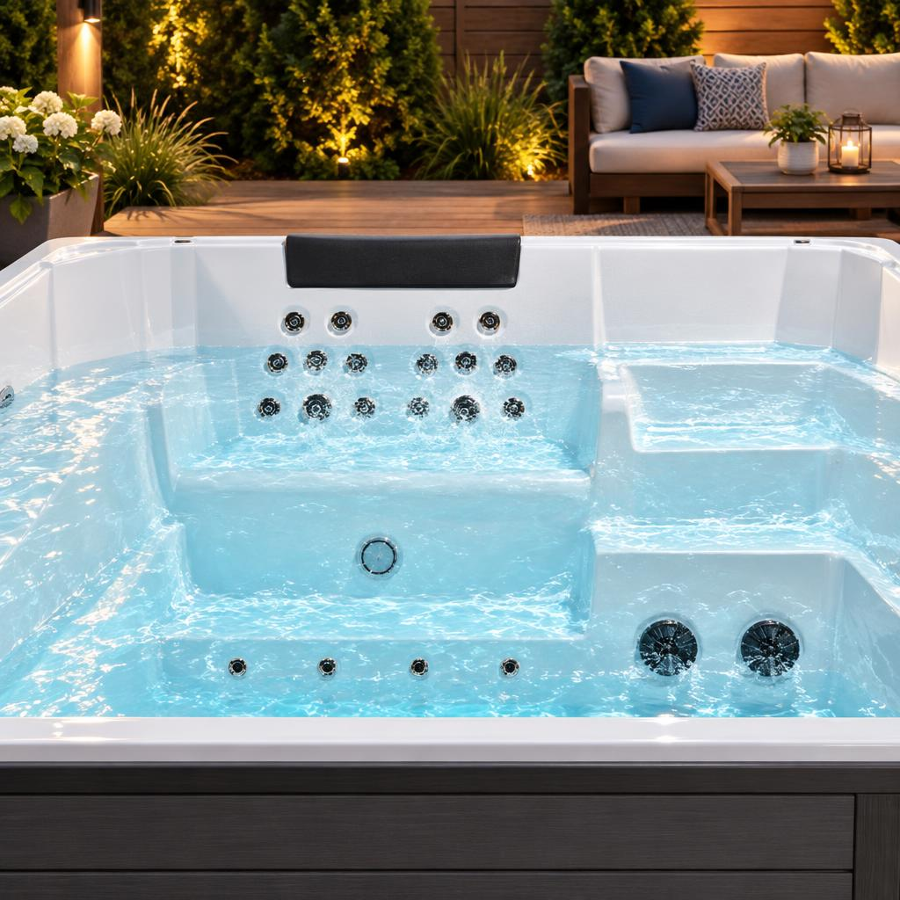
Effective spas focus on body contouring rather than scattering jets indiscriminately. Ergonomically shaped bucket seats support natural seated posture, reducing buoyancy drift when massage pumps engage. When shopping, prospective buyers should review whether jet clusters align comfortably against their back and legs.
Adjustable diverter controls allow bathers to redirect pressure across specific seating sectors. Users can concentrate mechanical output onto dedicated seating stations or soften flow for gentle soaking. Depending on the chosen spa model, individual jet faces may offer adjustable directional nozzles to tailor flow intensity to personal preference.
Insulation, Thermal Retention, and Cabinet Engineering
Heating thousands of liters of outdoor water requires serious thermal engineering, especially during winter months. Uninsulated shells radiate thermal energy into the cabinet void, driving heater elements to run continuously. Prospective buyers should confirm the insulation methods and materials specified by the manufacturer, such as perimeter thermal barriers or expanding cabinet foam.
A quality fitted thermal cover forms the primary defense against heat loss, sealing the water surface tightly against evaporation. Meanwhile, buyers should confirm that cabinet cladding materials resist local environmental conditions, moisture absorption, and UV exposure without requiring demanding seasonal refinishing.
Spotlighting the M-503 Above Ground Backyard Swim Spa
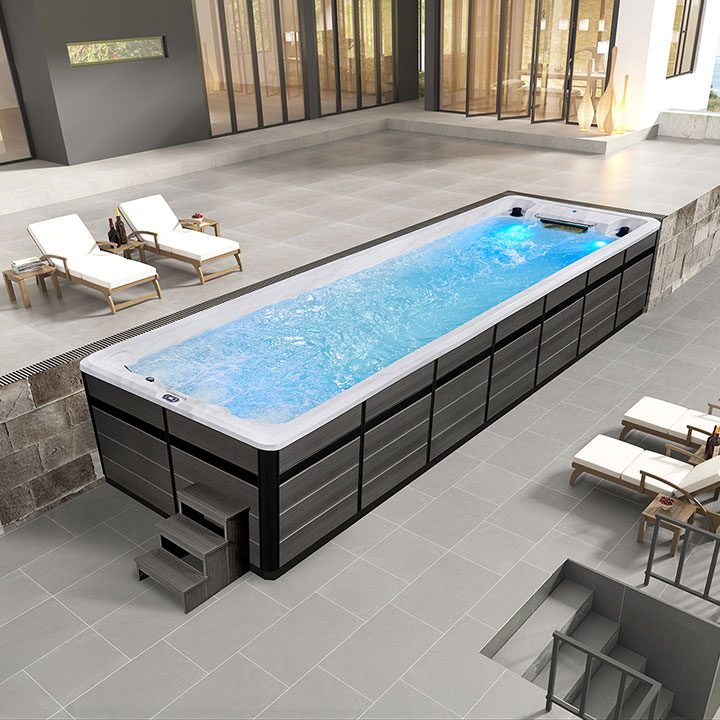
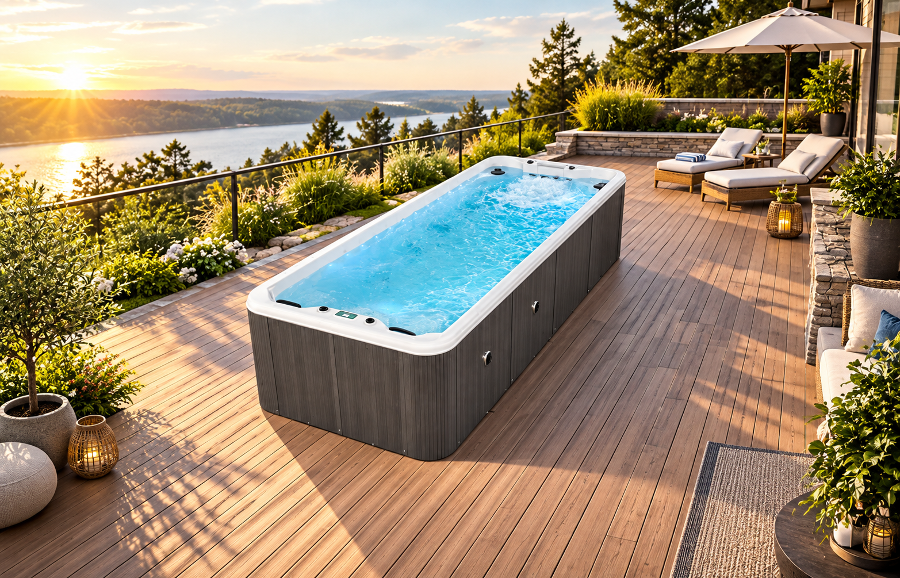
For property owners seeking an all-in-one aquatic fitness and hydrotherapy installation, the Above Ground Backyard Swim Spa M-503 demonstrates excellent multi-functional engineering. At Victoria Star, we combine product design with healing, relaxation and long-term wellness, and are committed to providing customers with high-end customized services for hot tubs and swim spas. The M-503 translates these manufacturing standards into a versatile, high-performance backyard retreat.
Architectural Footprint and Multi-Zone Internal Geometry
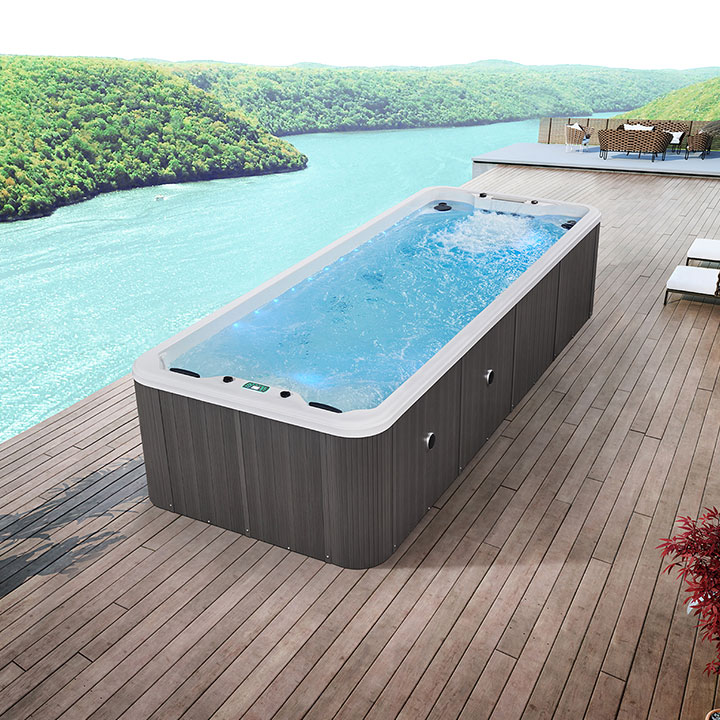
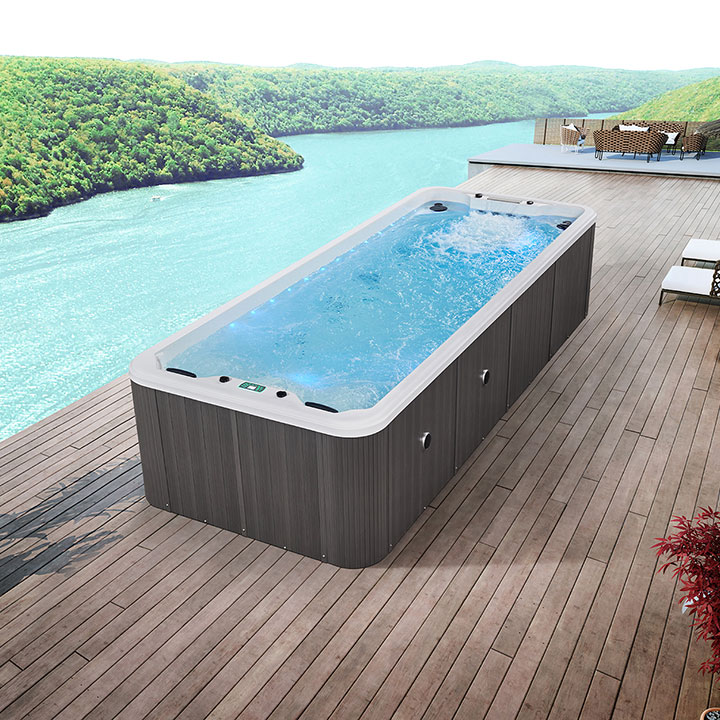
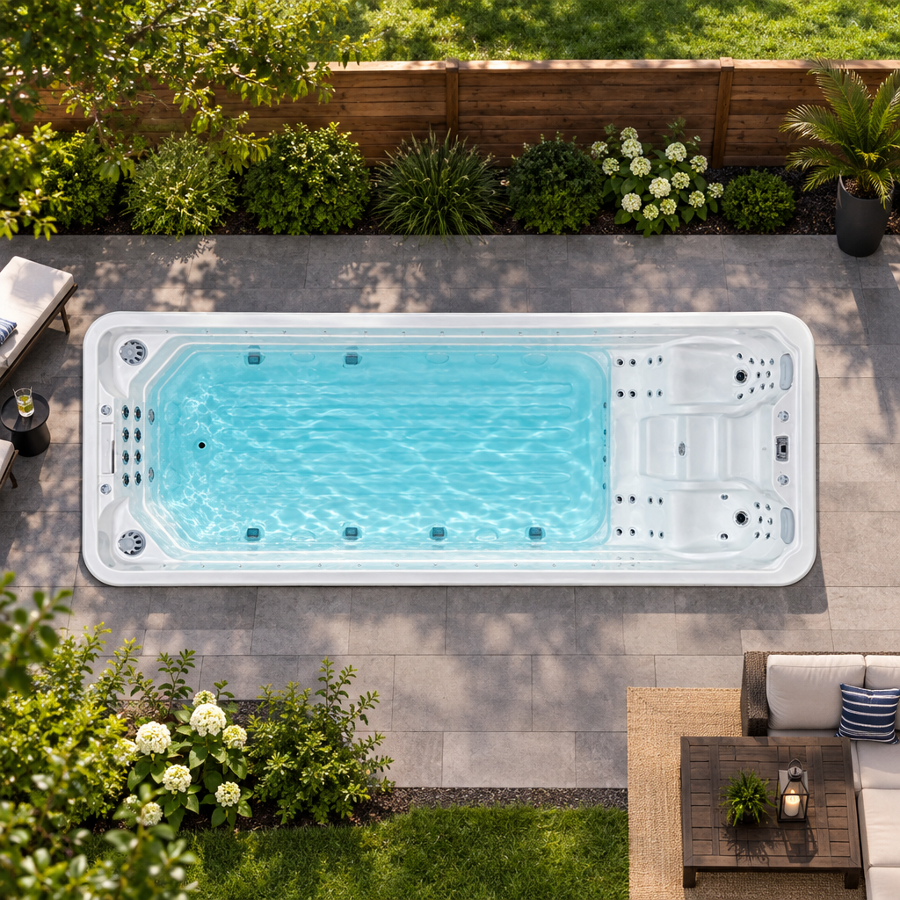
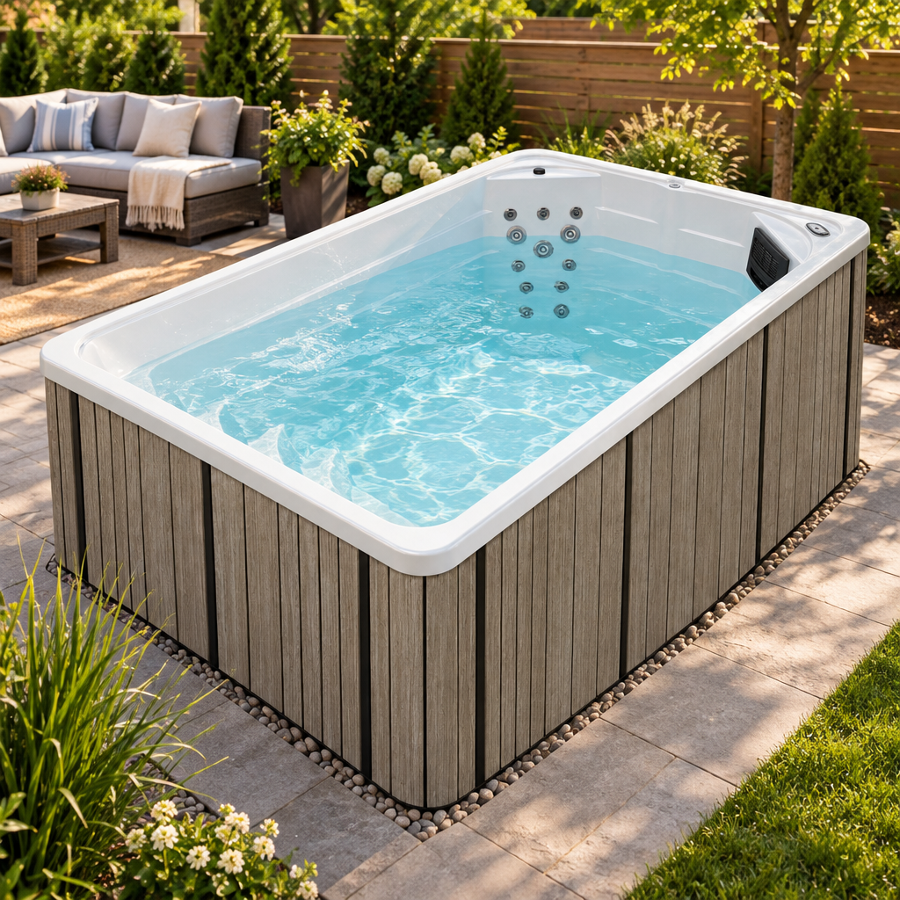
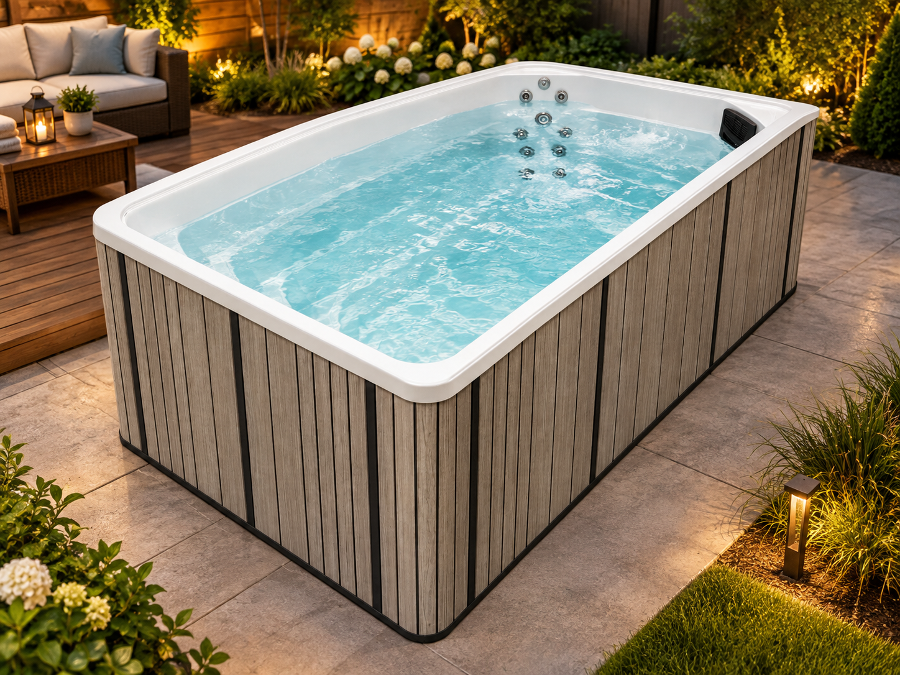
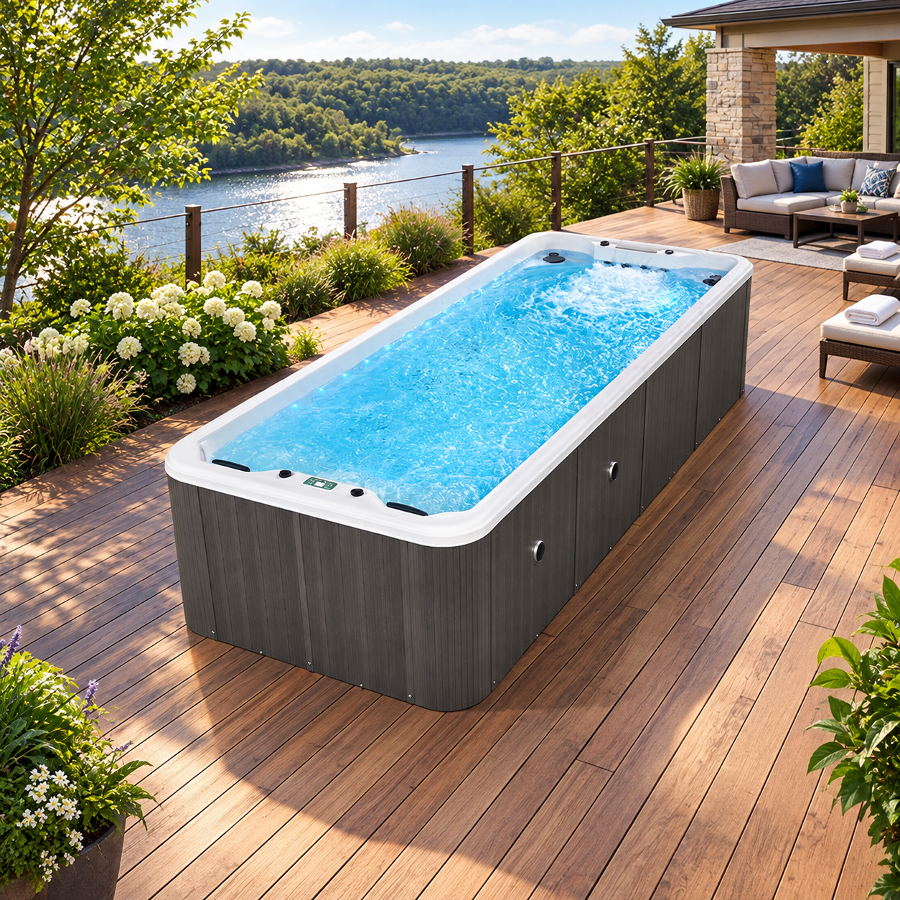
The M-503 spans 5,800 mm in length, 2,200 mm in width, and 1,250 mm in depth (19′ × 87″ × 49″). This interior holds up to 7,890 liters of water, creating an open swim lane suitable for aquatic exercise. Prospective buyers can measure the 5.8-meter footprint against their body height and swimming stroke reach to confirm spatial suitability. The manufacturer lists the interior acrylic shell in a Porcelain color finish.
At the far end of the open lane, the M-503 integrates two ergonomic hydrotherapy seats equipped with targeted massage arrays. This architectural layout separates the counter-current exercise lane from the recovery area, providing dedicated hydromassage stations for two seated bathers.
Propulsion Mechanics: Three 3 HP Pumps and 48 Focused Jets
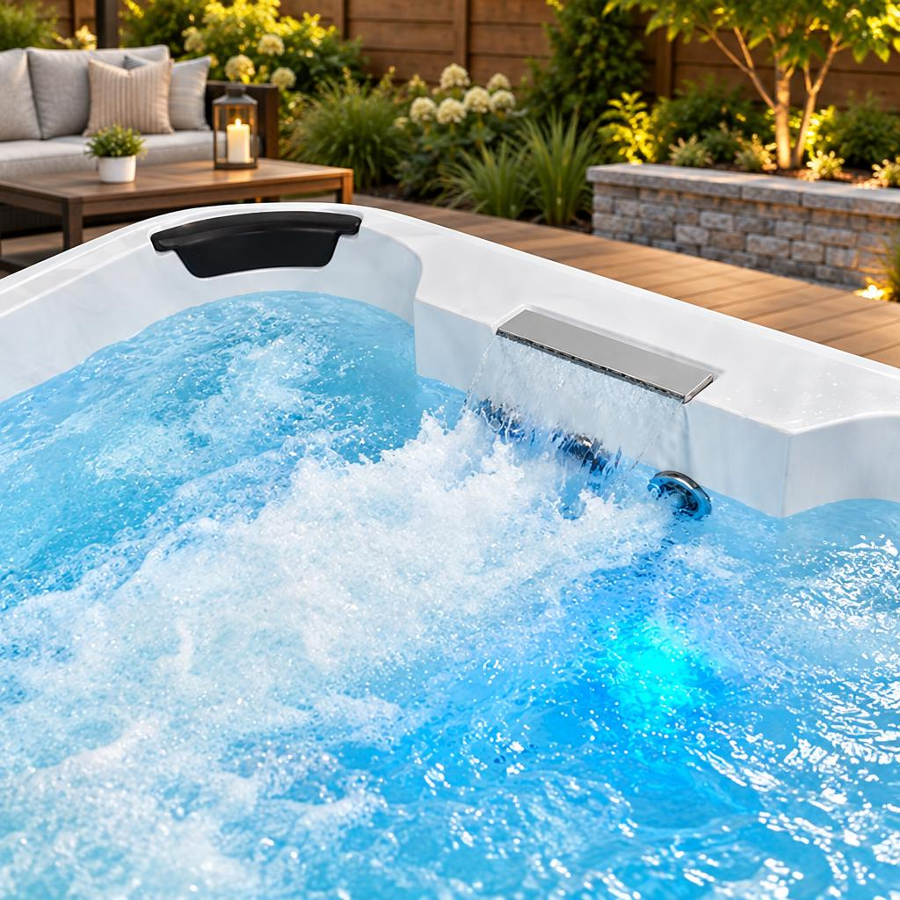
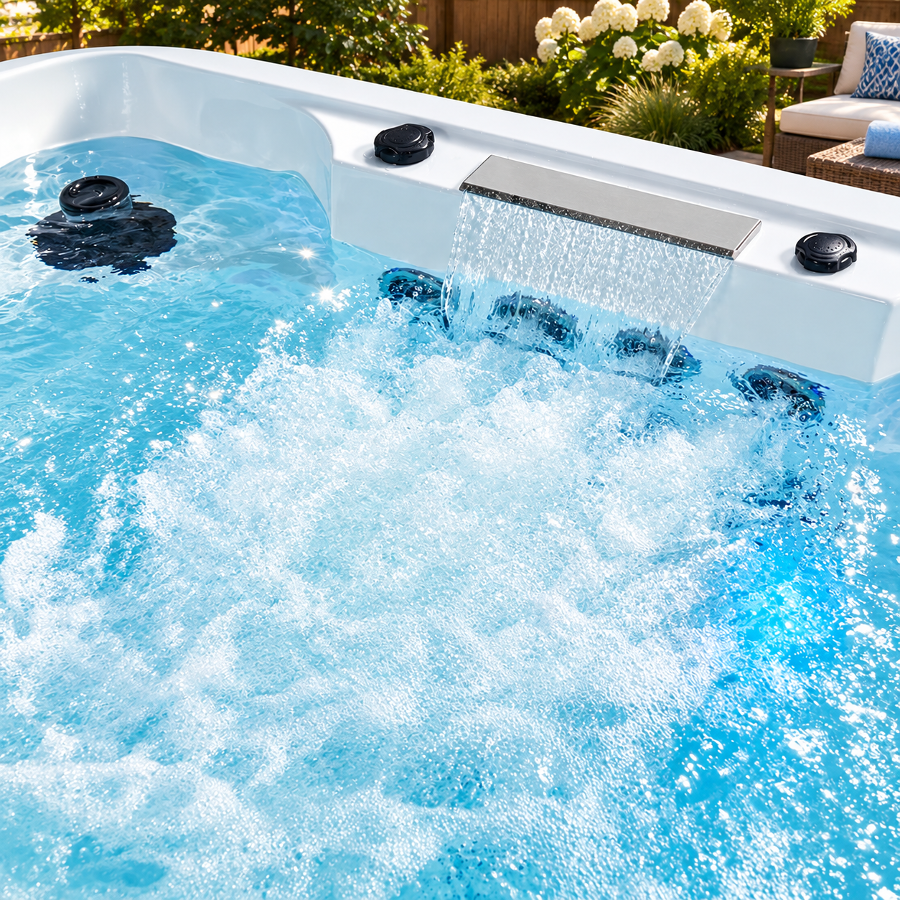
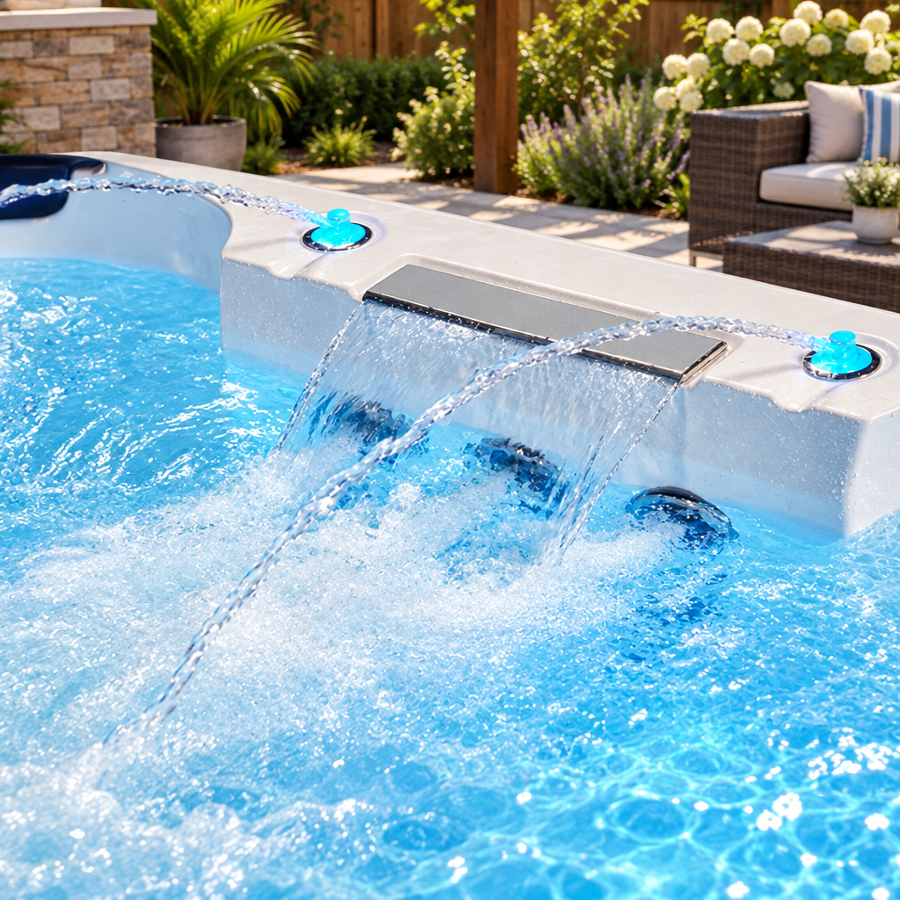
The swim propulsion system relies on three high-efficiency 3 HP water pumps that deliver multi-speed counter-current water flow through wide swim orifices. Swimmers can adjust current speeds to accommodate low-impact cardio workouts or more active training routines based on personal fitness levels. Built-in aesthetic and flow-management features include a flat spillway waterfall and illuminated laminar fountain jets.
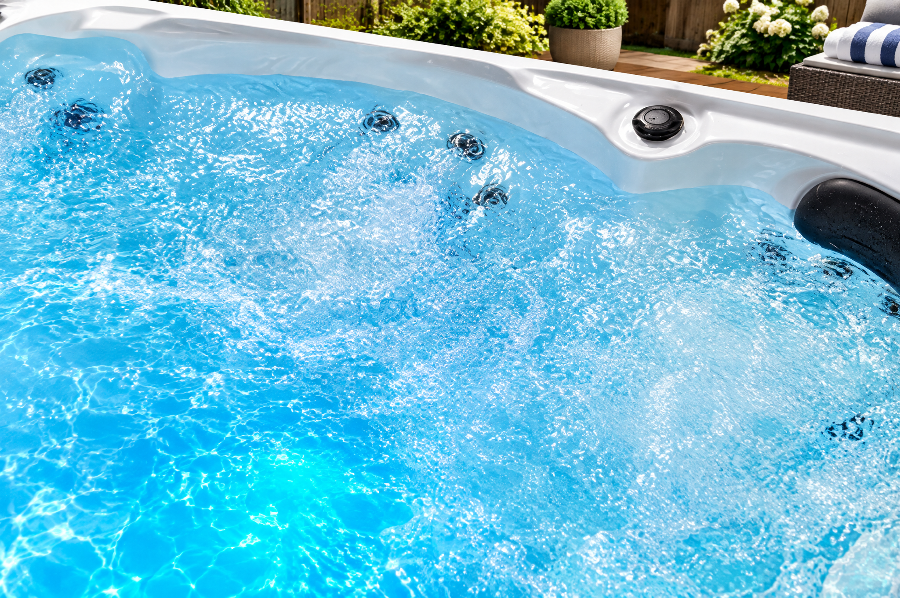
Complementing the swim current, 48 strategically placed hydrotherapy jets provide massage across the back and legs. The technical specifications also list a separate 1 HP circulation pump alongside the three 3 HP water pumps, supporting active water circulation through the filtration assembly.
Thermal Management and Intuitive Interface
For heating, the M-503 specifications list dual 3,000-watt heating elements alongside a manufacturer-rated 13.35 kW total power supply. The rate of heating and overall energy performance depend on ambient outdoor temperatures, site conditions, and proper cover placement, requiring buyers to verify site power availability with a qualified professional.
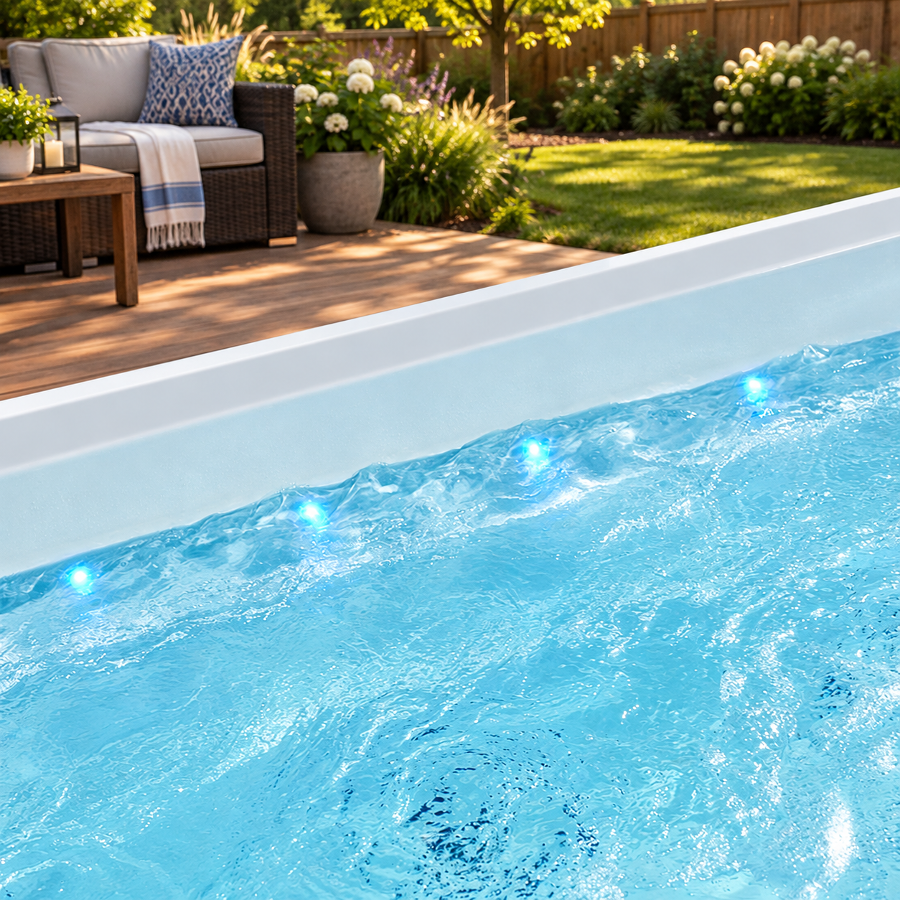
Swimmers interact with the water environment through an intuitive KL2020BT touchscreen control system. This panel delivers direct digital management of target water temperatures, pump speeds, and customizable multi-color LED perimeter and underwater lighting modes. Exterior cabinet finishes in Platinum or Midnight tones integrate naturally into modern decking schemes.
Water Quality Management, Sanitization, and Routine Care
Clean, sparkling water is critical for safe soaking and prolonged equipment life. Neglecting chemistry leads to organic biofilm accumulation inside internal plumbing lines, scaling along heater elements, and potential skin irritation.
Combining Mechanical Filtration with Ozone and Secondary Systems
Mechanical filters physically trap hair, sediment, and suspended particles before water enters the plumbing manifolds. Cartridge filters made of pleated media capture floating debris as water circulates. These filter cartridges require regular rinsing with a garden hose and periodic chemical soaking according to the manufacturer’s maintenance schedule.
The M-503 includes an integrated ozone purification system as supplemental water care. Ozone gas ($O_3$) injected into the circulation stream oxidizes organic matter and bather oils on contact. While ozone assists overall water clarity, it does not replace a residual chemical sanitizer; owners must continuously maintain disinfectant levels in accordance with public health guidance and manufacturer manuals.
Testing Regimens: pH, Free Chlorine, and Chemical Balance
Water chemistry balance is non-negotiable. According to CDC swimming and hot tub safety guidelines, water sanitizer and pH should be tested at least twice daily, and more frequently during periods of heavy bather use. Adhere to authoritative public health parameters to maintain sanitary conditions:
pH Range: Maintain between 7.0 and 7.8 (CDC guidelines recommend 7.2 to 7.8). Operating outside this range compromises sanitizer efficiency, irritates bather eyes, and accelerates equipment corrosion.
Free Available Chlorine: Maintain at a minimum of 3.0 ppm in hot tubs as recommended by the CDC. Active halogen residuals neutralize harmful pathogens introduced by bathers and outdoor environments.
Total Alkalinity and Calcium Hardness: Test and balance total alkalinity and calcium levels strictly according to your spa manufacturer’s manual and chemical manufacturer instructions to preserve acrylic finishes and internal components.
Seasonal Maintenance and Drain-and-Refill Schedules
Over time, accumulated bather waste, treatment products, and environmental dust alter water balance. When routine additions no longer maintain clarity or balance within recommended chemical ranges, a complete drain and refill is required.
Rather than relying on an arbitrary calendar date, water replacement frequency should follow the manufacturer’s instructions and observed usage patterns. For guidance on water service life, public health recommendations from the CDC suggest estimating water replacement intervals with the formula:
$$\text{Days between water replacement} = \frac{\text{Spa volume in gallons} \div 3}{\text{Average users per day}} $$
Applying this formula provides a baseline for tracking how heavy bather traffic accelerates water turnover needs. When draining, consider using an approved plumbing line flush to loosen residual deposits within internal manifolds. Always follow manufacturer guidelines for seasonal maintenance routines.
Step-by-Step Delivery and Commissioning Roadmap
Moving an extensive acrylic structure into a residential backyard requires precise logistical coordination. Following a structured commissioning checklist prevents structural mishaps and expensive installation delays.
Conduct Professional Site and Access Surveys: Measure delivery pathways from street to pad. Verify overhead wire clearances with your local electric utility, and identify clearance constraints around eaves, gas meters, and air conditioner compressors.
Coordinate Crane Rigging Services: Because large swim spas cannot easily navigate narrow side paths, arrange a certified crane operator. The crane company must verify reach, overhead obstacles, and safe lifting radii over the home.
Inspect and Validate the Foundation Base: Ensure the poured concrete slab or engineered support pad has cured completely and meets strength, thickness, and levelness criteria confirmed by your contractor.
Execute Electrical Hookups via Licensed Electrician: Have a licensed professional pull approved conductor cables, wire the external GFCI disconnect switch, and connect power according to local electrical codes and manufacturer schematics.
Fill Following the Manufacturer Manual: Follow the specific filling and pump-priming sequence documented in your owner’s manual to avoid airlocks in the hydraulic plumbing and heater assemblies.
Initiate Cold Balancing and System Commissioning: Power on the touchscreen controller, verify water flow across all pump speeds, and balance pH and alkalinity before engaging heating elements.
Thermal Calibration and Baseline Soak: Allow heating elements to bring water up to the desired setpoint (observing the 104°F / 40°C maximum hot-tub soaking limit referenced by CDC guidance, and consulting the M-503 manual for swim training setpoints), verify sanitizer levels, and secure a compliant cover if supplied or required by local building code.
Frequently Asked Questions About Backyard Spas
What size foundation is required to support a large swim spa?
A swim spa like the M-503 requires a dedicated foundation that fully supports its 5,800 × 2,200 mm footprint without point-loading. The foundation must be level and engineered to handle the full operating weight of the unit filled with 7,890 liters of water plus bathers. Homeowners should consult the manufacturer’s technical specifications and hire a qualified structural engineer to specify appropriate concrete thickness, rebar reinforcement, and subgrade compaction.
How much clearance should be left around the spa cabinet for maintenance?
Clearance guidelines depend on the specific model layout and equipment bay locations. Homeowners should review the manufacturer’s service-access drawings before finalizing deck designs. Providing adequate open space around access panels ensures technicians can inspect pumps, replace heating elements, and access plumbing unions without requiring structural dismantling.
Can an outdoor swim spa be operated during sub-zero winter conditions?
Cold-weather operation depends on the specific unit’s documented insulation performance and available freeze-protection features. Before operating in sub-zero weather, buyers should examine the manufacturer’s specifications for cabinet thermal barriers, insulated covers, and low-temperature circulation cycles. Always consult the product owner’s manual for documented winter operating procedures or seasonal shutdown guidelines.
What is the actual difference between ozone purification and traditional sanitizers?
Ozone is a supplemental oxidizer gas ($O_3$) that neutralizes organic contaminants inside the circulation loop, helping keep water clear. However, ozone provides no long-lasting residual protection throughout the main body of water. Traditional chemical sanitizers, such as free chlorine maintained at 3.0 ppm or above, remain necessary to provide continuous disinfection against bather contaminants.
How often does an 8,000-liter backyard swim spa require complete draining?
Water replacement frequency depends on daily bather frequency, chemical management, and accumulated Total Dissolved Solids rather than a fixed calendar rule. In residential use, water should be replaced whenever balance can no longer be maintained, or in accordance with usage guidelines and formulas recommended by public health authorities and the spa manufacturer.
Selecting Your Ideal Backyard Aquatic Retreat
Transforming an outdoor property into a private health and leisure retreat requires evaluating design dimensions, structural groundwork, and mechanical propulsion systems. Identifying the best spas for backyard environments comes down to matching spatial realities with your personal wellness routines. Whether you prioritize deep hydro-massage or high-resistance fitness training, investing in robust construction, proven pump hydraulics, and multi-stage water filtration ensures your backyard aquatic installation delivers reliable comfort for years to come.
Victoria Star Swim Spa offers the perfect balance between exercise and relaxation, whether you want to swim for fitness or relax in the spacious seating.
Victoria Star Swim Spa offers the perfect balance between exercise and relaxation, whether you want to swim for fitness or relax in the spacious seating.