The Complete 15 Person Hot Tub Guide: Engineering Reality, Spatial Planning, and Large-Capacity Swim Spa Solutions
Home / News / The Complete 15 Person Hot Tub Guide: Engineering Reality, Spatial Planning, and Large-Capacity Swim Spa Solutions
November 05, 2026
When homeowners and resort planners begin searching for a 15 person hot tub, they usually picture a social hub where family members, friends, or guests can gather without feeling crowded. The idea of fifteen adults soaking under the stars is appealing. Yet once you start comparing large-capacity hot tubs and swim spas, a practical question appears quickly. How many of those people get a real seat, and how many are simply standing in the water?
Accommodating a dozen or more bathers at once involves more than a bigger shell. A vessel this size affects your foundation, your electrical service, your water care routine, and the way heat is managed across a long body of water. Fifteen people also displace a lot of water and bring in sweat and oils. Understanding these demands before you buy helps you choose a system that copes with a busy evening and stays manageable afterward.
The Reality of 15-Person Spas: Molded Seats vs. Open-Water Capacity
Why Seat Counts Deserve a Closer Look
Listings for large spas often mix two different numbers. One is the count of molded seats with jets. The other is how many people the water can hold. A shopper looking for a 15 person hot tub can easily read a large footprint as a promise of fifteen comfortable seats, when the specification sheet may list far fewer.
The VS-GT1001 shows why this matters. Its manufacturer lists nine seats inside a 10-meter shell. That is a generous hydrotherapy zone, but it is a nine-seat spa. Any occupancy beyond the listed seats is a separate figure that buyers should confirm with the manufacturer and, for shared or commercial settings, with the local authority that sets bather limits.
The Dual-Zone Alternative: Combining Ergonomic Seating with Swim Corridors
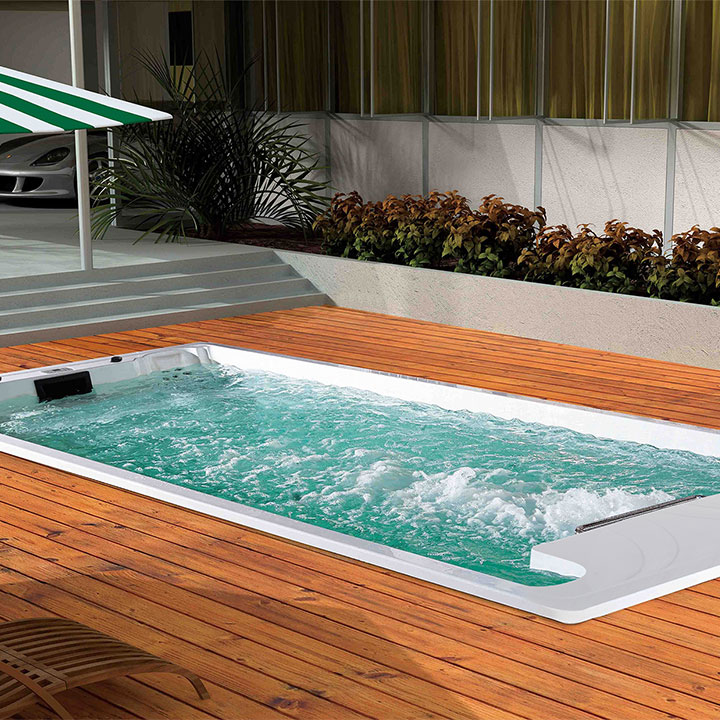
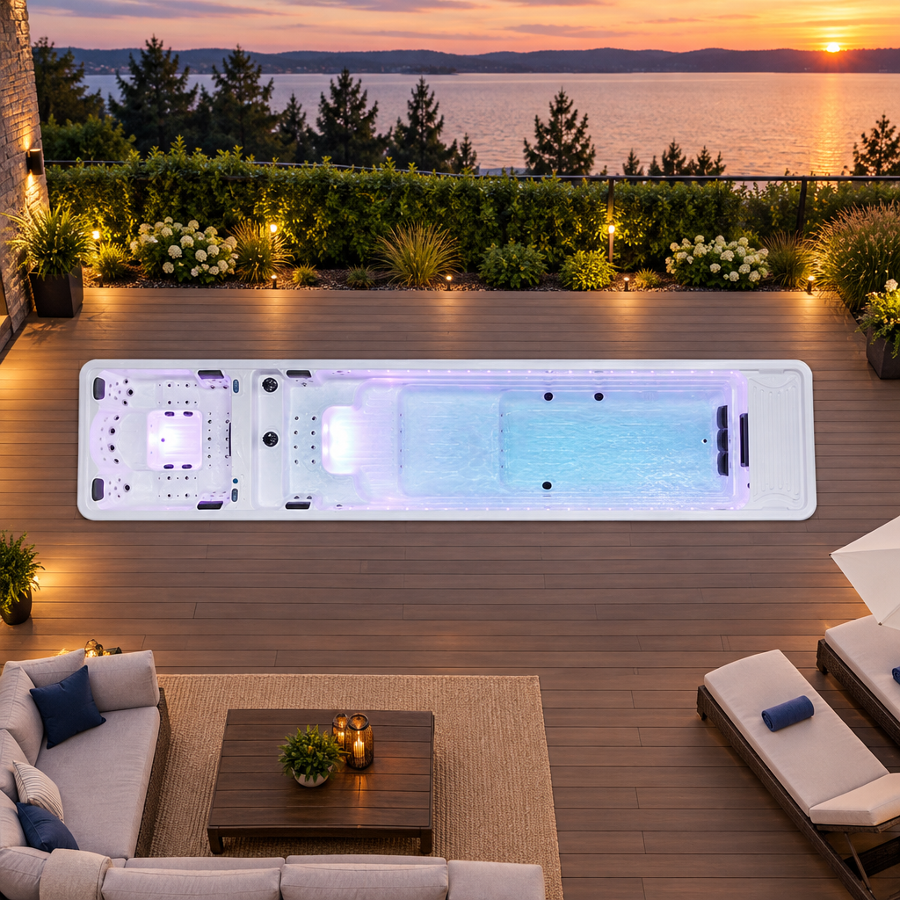
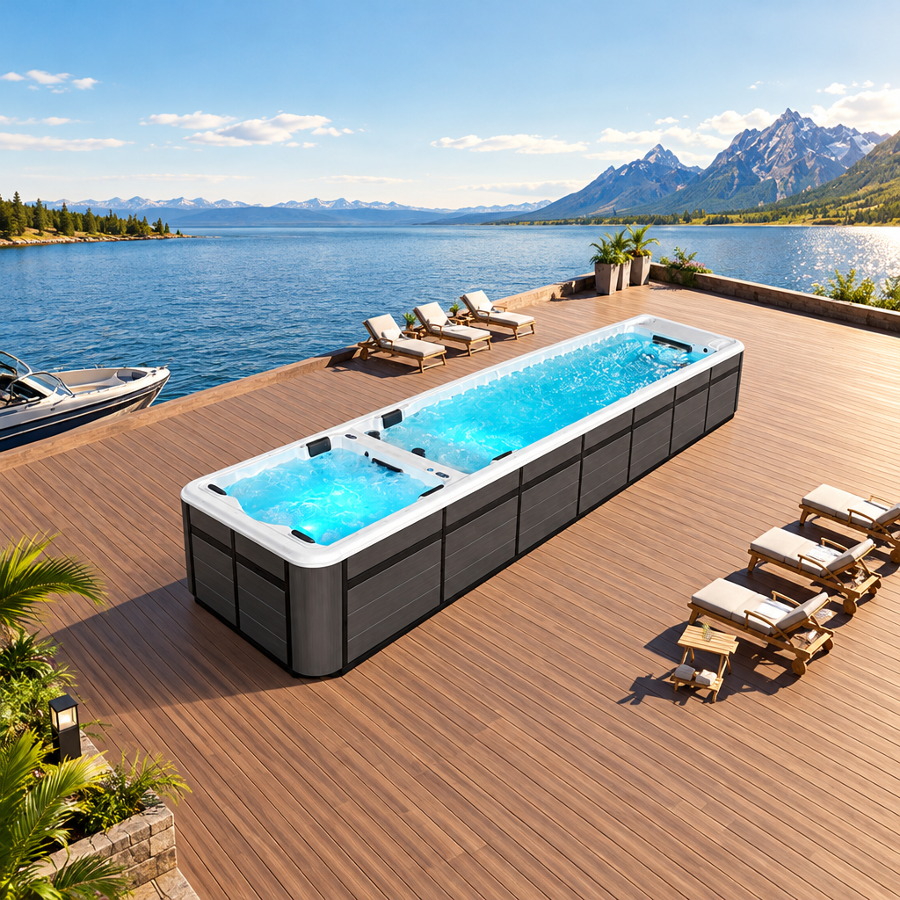
For groups larger than a typical hot tub can seat, many buyers look at extended swim spas instead. A dual-zone swim spa joins a multi-seat hydrotherapy area with an open swim lane in one shell. When nobody is training, the lane offers standing and floating room, a bit like the shallow end of a pool attached to a hot tub. Whether extra bathers can use that room depends on the manufacturer’s stated occupancy limit.
In this layout, people who want a focused jet massage can take the contoured seats, while others relax near the steps or move through the swim channel. Separating the zones spreads people across the vessel. A family gathering then does not require everyone to sit shoulder to shoulder around one footwell. The open swim corridor also provides flexibility for children and guests who prefer to float or move around rather than remain seated. This distinction between dedicated jet seating and general water access is central to understanding how many people a swim spa can actually accommodate comfortably.
Ergonomic Therapy vs. Open Water Bather Load
To make an informed purchase, buyers should separate dedicated therapy seats from total bather capacity. A seat count tells you how many people can receive pump-driven jet massage at the same time. Bather capacity is the maximum number of people the manufacturer, or a local code, allows in the water at once. Check these terms when reading any specification sheet:
Seat Count: The number of molded stations with back, neck, or foot jets. This is the figure most product listings give, and it assumes each person is seated and immersed.
Maximum Bather Load: The total number of occupants allowed in the water. Ask the manufacturer for this figure in writing, because it is not the same as the seat count.
Water Level Margin: The space between the resting water line and the rim or skimmer. Large groups raise the water level, so an overfilled spa can spill water over the edge when everyone climbs in.
Buyers who assume that a long footprint automatically translates to a high occupancy count may be disappointed when they check the actual specifications. Always request written confirmation from the manufacturer regarding both the number of hydrotherapy seats and the total allowable bather load before finalizing a purchase.
Engineering & Structural Foundations: What a 10-Meter Vessel Demands
Calculating Dead Load, Water Weight, and Live Bather Load
Installing an extra-large spa starts with load. A filled swim spa weighs far more than a compact hot tub, because the swim lane alone holds a large volume of water. A structural professional needs to add up the dry shell and frame, the equipment, the water, and the occupants. The manufacturer’s filled weight is the starting point for that calculation, so request it before any site work begins. Water weighs about one kilogram per liter, so water accounts for most of the static load in a vessel this size. Fifteen adults can add roughly another metric ton on top of that. If the ground or slab beneath the spa is not designed for the combined weight, it can settle unevenly over time. Uneven support can stress the shell and cabinet, which is why load figures belong in the planning stage.
Load Element
Description
Planning Note
Dry Shell & Frame
Shell, support frame, cabinet, and equipment
Constant dead load; use the manufacturer’s dry weight
Water Mass
Water volume only
Calculate water volume multiplied by approximately one kilogram per liter, or use filled weight minus dry weight after confirming the manufacturer’s definitions
Live Bather Load
Combined weight of occupants during use
Varies with group size; base it on the confirmed bather limit
Water Movement
Forces from jets and the propulsion system
Ask the manufacturer whether the foundation design should account for it
Negotiating these load calculations with a qualified structural engineer early in the process avoids costly corrections later. Some buyers assume that a gravel bed or an existing patio slab will work, only to discover that neither was designed for the concentrated weight of thousands of liters of heated water. If the manufacturer provides a filled weight, confirm whether that figure already includes dry weight and whether occupants are assumed, so you do not double-count any component when totaling the foundation load.
Concrete Pad and Sub-Base Planning
A vessel this size generally needs a purpose-designed foundation, and a reinforced concrete slab is a common choice. Paving stones, loose gravel, or a standard timber deck are unlikely to suit a filled 10-meter spa unless an engineer has designed them for that load. The surface also needs to be level. Across a ten-meter length, even a slight slope shows up as an uneven water line and uneven support under the frame.
The exact slab thickness, reinforcement, and base depth depend on the filled weight, the soil, and local codes. Treat the steps below as a planning sequence rather than fixed design values:
Request the manufacturer’s installation guide, including filled weight, footprint, and any foundation requirements.
Have a qualified local structural professional assess the soil and design the base and slab for the filled unit and the site.
Build the foundation to that design, including whatever sub-base, reinforcement, and drainage it specifies.
Check that the finished surface is level within the tolerance given by the manufacturer or the designer.
Do not place the spa until the concrete has achieved the strength required by the project design; have the responsible professional determine readiness.
Rushing the foundation stage can lead to cracking, differential settlement, and warranty issues. Waiting for the concrete to reach its design strength is time well spent, especially when the investment runs into tens of thousands of dollars.
Access Route and Crane Delivery Logistics
Delivering a ten-meter swim spa is closer to a rigging job than a normal appliance delivery. Spa dollies cannot roll a unit this long through garden gates or around tight corners of a house. Site logistics usually involve a flatbed trailer and a crane that can lift the shell over fences, trees, or buildings. Plan the route in advance. Check for overhead power lines, low cables, narrow streets, and wall clearances. The crane also needs a stable setup area that can support its outriggers, such as paving or firm compacted ground. Careful preparation reduces the risk of a cancelled delivery and helps the crew place the spa safely on the finished foundation. Some neighborhoods restrict crane operations to specific hours, and homeowner associations may require advance notice. Gathering these permits and permissions in parallel with foundation construction keeps the project on schedule.
Electrical Architecture and Power Distribution
Total Power Supply: Managing 16.55 kW and High-Draw Systems
A large swim spa runs several pumps, an air pump, heaters, lighting, and controls. Many smaller residential hot tubs run on a 120V plug-in circuit or a dedicated 240V circuit, but an extra-large 15 person hot tub alternative needs much more planning. The manufacturer lists the VS-GT1001’s total power supply as 16.55 kW. That figure describes the equipment’s combined rating. It is not a wiring specification on its own. Before buying, ask the manufacturer for the complete electrical requirements: voltage, phase, number of supply circuits, and breaker ratings. A licensed electrician can then check whether the property’s service and panel capacity can support them. Heaters and pumps running together create the highest draw, so the electrician needs the full equipment list as well as the headline total. Some properties have older electrical panels that cannot handle the additional load without an upgrade. Budgeting for a panel upgrade, new sub-panel, or dedicated service drop prevents surprise costs after the spa arrives.
Counter-Current Propulsion and Its Power Needs
Swim spas use a propulsion system to push water down the lane, so a swimmer can keep stroking without reaching the far wall. On the VS-GT1001, the manufacturer lists a 2.8 kW swimming training system rated at 380V, with 12 adjustable speed settings. That 380V rating matters for site planning, because it tells you what kind of electrical supply the training system expects.
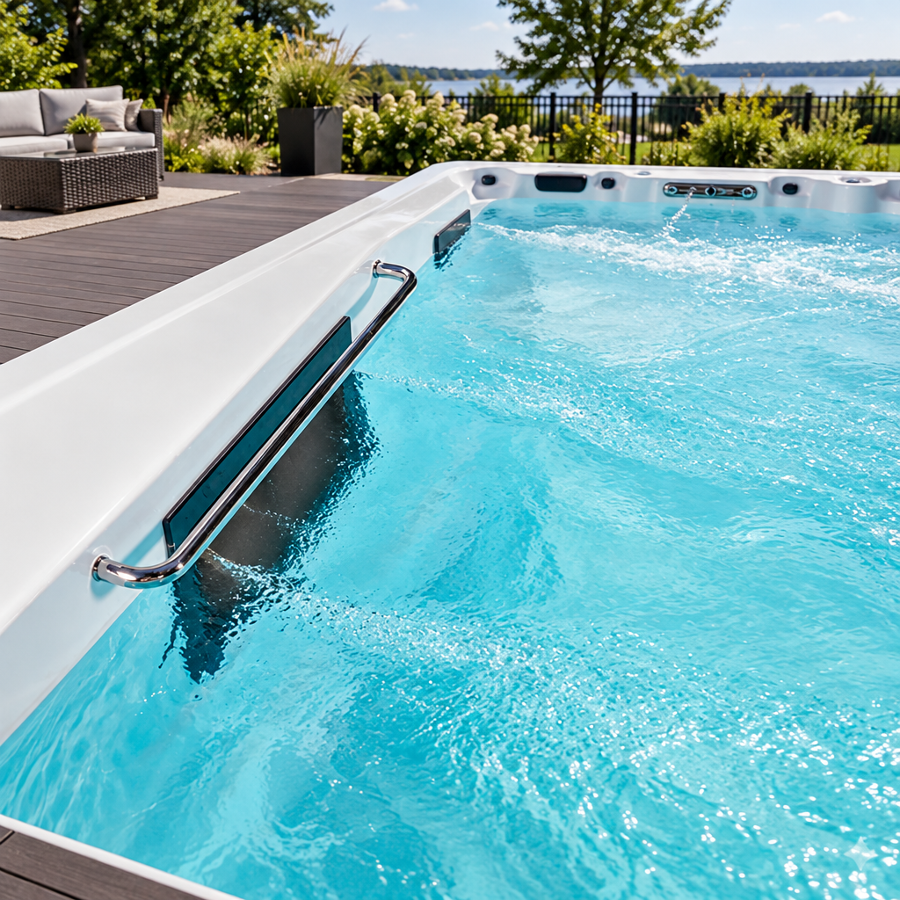
According to the product information, the training system is designed to simulate open-water swimming for continuous training. Adjustable speed lets a beginner work against a gentle current while a stronger swimmer turns it up. Because the layout separates the lane from the seating zone, one person can train while others soak at the same time. The ability to dial the current up or down gives households flexibility. Early morning workouts can run at higher speeds, while evening social use can lower the propulsion to a gentle circulation that keeps the water moving without creating resistance.
Split-Phase vs. Three-Phase Power: Verifying Grid Compatibility
Most U.S. homes receive 120/240V single-phase service. Three-phase supply at 380V or 400V is used in many regions outside North America, including China and much of Europe, and in commercial buildings. It is generally not available at U.S. residences without a utility upgrade, if it can be supplied at all. Because the VS-GT1001’s training system is listed at 380V, confirm compatibility with the manufacturer and your utility before ordering.
U.S. Single-Phase (120/240V): The typical residential service. Equipment rated for 380V may not connect directly, so ask the manufacturer whether a configuration exists for this supply.
Three-Phase (380V–400V): Spreads the load across three conductors, which lowers the current per conductor for the same power. Confirm that the property actually has this service before planning around it.
Ground-Fault Protection (RCD/GFCI): Electrical codes typically require ground-fault protection for spas and hot tubs. A licensed electrician should install it, along with any required disconnect, according to local code.
Buyers outside the United States should verify the local standard voltage and phase configuration with their electrician. Having nominal 380V or 400V three-phase service does not establish direct compatibility. Before ordering, confirm with the manufacturer and electrician the acceptable voltage tolerance, phase, frequency, and the complete unit’s wiring requirements.
Water Chemistry and Bather Load Management
Managing Organic Waste Under Heavy Social Usage
Water care changes when many people share the water. Every bather brings in sweat, skin oils, lotions, and cosmetics. These contaminants consume sanitizer, so a crowded evening uses it up faster than a quiet soak for two. In a large vessel, the effect is easy to underestimate because the water can still look clear at first. Heavy use can deplete disinfectant, so owners should test more frequently and maintain the required residual. When sanitizer runs low, cloudy water, chloramine odors, and biofilm in the plumbing become more likely. Continuous filtration and a regular testing schedule help, especially before and after large gatherings. CDC guidance recommends testing disinfectant and pH at least twice daily for home hot tubs, more often with multiple bathers. Establishing a routine that matches your usage pattern helps catch problems early.
Supplemental Treatment: Ozone, UV, and Filtration
Many swim spas combine several treatment components. The manufacturer states that the VS-GT1001 uses ozone disinfection, UV sterilization, filter cartridges, and sand filtration. Filtration removes suspended particles, while ozone and UV act on the water as it passes through the equipment. These systems are supplemental. UV inactivates microorganisms by damaging their nucleic acid, but only inside the treatment chamber, and it leaves no disinfectant residual in the spa. Ozone also does not provide a lasting residual. Owners still need to monitor and maintain the sanitizer residual and pH required for their installation, using chlorine or bromine as the manufacturer and local rules direct. Supplemental treatment may help manage contaminants or chloramines depending on system design and operation, but does not justify lowering the required sanitizer residual. The residual disinfectant in the water is what protects bathers between filtration cycles.
Adhering to CDC Water Quality and Temperature Guidelines
The CDC publishes separate guidance for home hot tub owners and for operators of public hot tubs. Public facilities follow local health codes, which may draw on the CDC’s Model Aquatic Health Code. A private backyard swim spa is usually governed by the manufacturer’s instructions, with the CDC’s home guidance as a useful reference. The points below reflect that home guidance:
Maximum Water Temperature: Keep hot tub water at or below 104°F (40°C) to reduce the risk of overheating, dizziness, and dehydration.
Chlorine: For home hot tubs, the CDC recommends a free chlorine level of at least 3 parts per million (ppm).
pH: Keep pH between 7.0 and 7.8. High pH reduces chlorine efficacy while low pH increases corrosion risk. Out-of-range pH can also cause discomfort.
Bromine and Other Systems: If you use bromine or another sanitizer, follow the product label, the spa manufacturer’s instructions, and any local requirements for the target range.
CDC guidance recommends testing disinfectant and pH at least twice daily for home hot tubs, more often with multiple bathers. Test strips provide a quick check, while liquid reagent kits offer greater accuracy. Public operators should test at least twice daily and hourly during heavy use, subject to local requirements. Keep a written log of test results and any adjustments made, which helps track patterns and troubleshoot water quality issues.
Practical Case Analysis: The VS-GT1001 Dual-Zone Swim Spa
Dimensional Footprint and 110-Jet Hydrotherapy Configuration
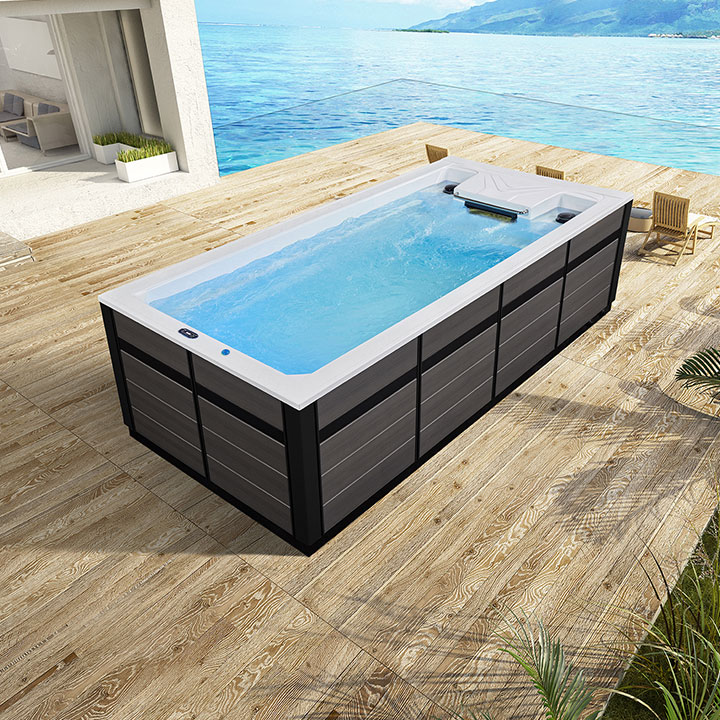
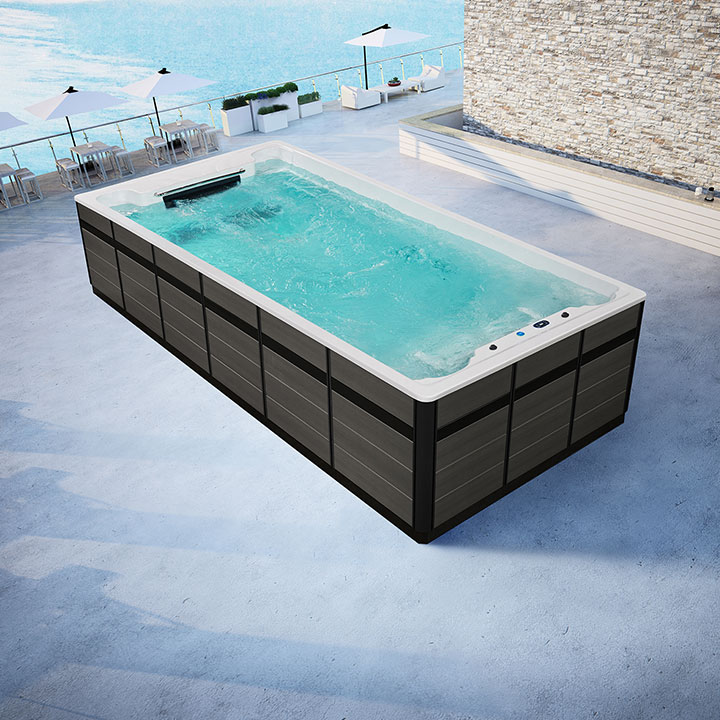
For buyers weighing large-capacity options, the VS-GT1001 shows how a dual-zone swim spa splits training and relaxation. Victoria Star, the hot tub and swim spa brand of Foshan Gaoming Shiyi Sanitary Ware Technology Co., Ltd., runs its own mold forming and assembly workshops. The model’s listed dimensions are 10,000 × 2,200 × 1,450 mm (33′ × 87″ × 57″).
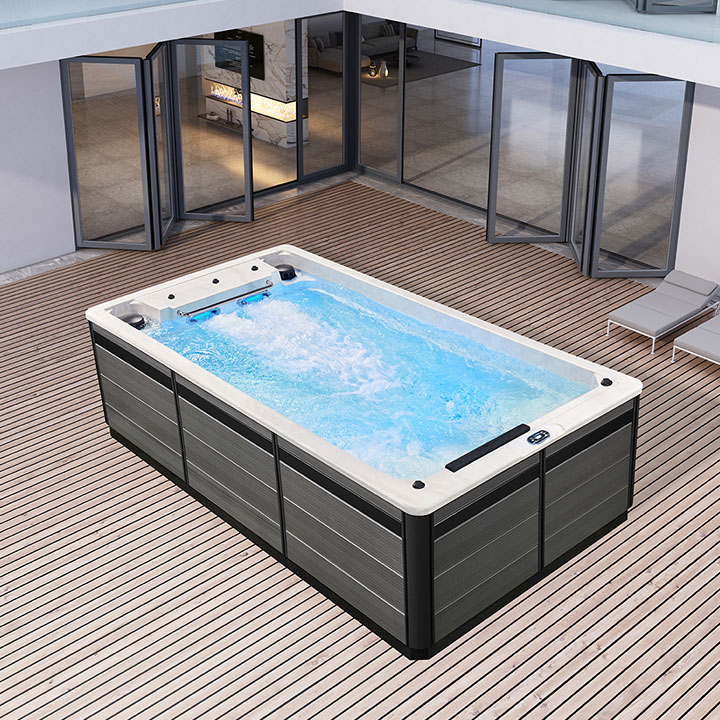
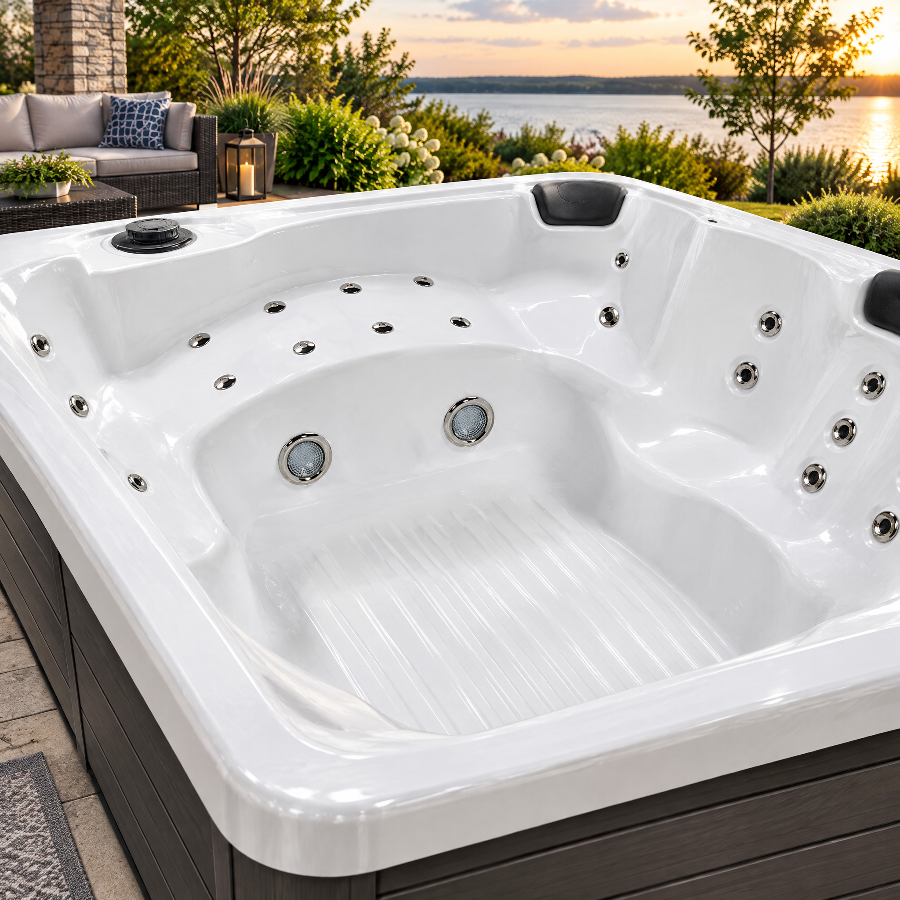
The hydrotherapy zone has nine contoured seats, and the manufacturer lists 110 massage jets in total. Product images show larger directional jets and smaller jets along the backrests, with more jets around the footwell. Next to the seating, the swim lane provides the long stretch of open water described earlier.
Technical Parameter
Manufacturer Specification
What It Means for Buyers
Dimensions
10,000 × 2,200 × 1,450 mm (33′ × 87″ × 57″)
Plan the foundation, access route, and crane lift around this size
Seating
9 seats
Jetted seating for nine; confirm any higher bather limit with the manufacturer
Total Jets
110 jets
Massage jets across the contoured seats
Swimming Training System
1 set, 2.8 KW / 380V, 12 speeds
Requires a supply compatible with 380V; verify before ordering
Water Pumps
1 × 3 HP; 2 × 2 HP
Drive the jets and water flow
Circulation Pumps
2 × 1 HP; 1 × 0.5 HP
Move water through filtration and heating
Air Pump
1 × 0.9 HP
Supplies air for bubble effects
Heaters
2 × 3 KW
Two heating units listed
Total Power Supply
16.55 KW
Combined equipment rating; get full wiring requirements separately
Control System
2 sets KL2022 with smart keypad
Two control sets listed
Water Treatment
Ozone, UV, filter cartridges, sand filtration
Supplements, not replaces, sanitizer and pH management
Lighting and Audio
Bottom and perimeter LED; Bluetooth with 4 AV speakers
Evening ambiance and music
Insulation
PU insulation
Helps reduce heat loss
Colors
Cabinet: Platinum, Midnight; Shell: Porcelain
Finish options
The 110 jets represent a substantial hydrotherapy array. Buyers should ask the manufacturer which jets are adjustable, which are fixed, and how the pump array divides flow among the different jet zones. Understanding the plumbing layout helps set realistic expectations for massage intensity across all nine seats.
Independent Thermal Zones: Workout Lane Meets Therapeutic Hot Tub
One reason buyers choose a dual-zone layout is the potential for different activities at the same time. The VS-GT1001 lists two KL2022 control sets with smart keypads, two 3 kW heaters, and PU insulation. The product information does not state whether each zone can hold its own temperature. If you plan to keep the swim lane cooler than the seating area, ask the manufacturer how the two zones are plumbed and controlled before you order. Some swim spa models use a single body of water that circulates between zones, meaning the entire vessel maintains one temperature. Others use separate plumbing loops and heaters to allow independent temperature control. Clarifying this detail before purchase prevents misunderstandings about how the system operates.
Residential Luxury and Boutique Hospitality Scenarios
The manufacturer positions the VS-GT1001 for home hydrotherapy and fitness, backyard or patio installations, and luxury villas, private estates, and boutique resorts. For a household, it pairs a swim lane for low-impact cardio with a seating zone for recovery and family time. Cabinet colors are listed as Platinum and Midnight, with a Porcelain shell.
For rental villas and boutique resorts, the appeal is one amenity that covers both swimming and soaking. The spa includes a Bluetooth audio system with four AV speakers, plus bottom and perimeter LED lighting, which suits evening use. Hospitality operators should remember that shared-use spas may fall under local public health rules covering bather limits, water testing, and signage. Properties that offer the spa as a guest amenity need to establish clear maintenance protocols. CDC guidance for public hot tubs recommends testing disinfectant and pH at least twice daily and hourly during heavy use, subject to local requirements. Daily sanitizer adjustment and periodic deep cleaning are part of that routine. Posting the maximum bather load and basic safety rules near the spa helps manage guest expectations and reduces the risk of water quality problems.
Frequently Asked Questions (FAQs)
Can 15 people safely fit into a 10-meter swim spa at the same time?
Not necessarily. A 10-meter footprint does not by itself tell you how many people can safely share the water. The VS-GT1001 is listed with nine seats, and it should not be treated as a 15-person-capacity product. Any occupancy beyond the listed seats must be confirmed with the manufacturer and, for shared or commercial use, with the local authority that sets bather limits.
What are the estimated operational running costs for a spa of this scale?
Operating costs depend on climate, local electricity rates, the set temperature, and how often the spa is used. A large swim spa holds a lot of water, so keeping it warm takes steady energy. Insulation and a well-fitted cover reduce heat loss. The VS-GT1001 lists PU insulation; ask the manufacturer for any energy-use estimate for your climate and compare it with your local kilowatt-hour rate.
Can a large swim spa be installed indoors or inside a sunroom?
Indoor installation is possible but needs careful planning. A large heated body of water releases a lot of moisture, so the room needs ventilation and usually mechanical dehumidification to prevent condensation and mold. The floor must carry the full filled weight, which often means a slab on grade designed for that load. Confirm room size, delivery access, and service access with the manufacturer before committing.
Does the CDC Model Aquatic Health Code apply to private residential installations?
No. The CDC Model Aquatic Health Code (MAHC) is voluntary guidance written for public and semi-public aquatic venues, such as municipal pools, fitness centers, and hotels. It is not federal law and becomes mandatory only where a state or local jurisdiction adopts it. Residential owners can still use it, together with the CDC’s home hot tub guidance, as a reference for testing and disinfection practices.
How often should I test the water in a large-capacity swim spa?
CDC guidance recommends testing disinfectant and pH at least twice daily for home hot tubs, more often with multiple bathers. Public operators should test at least twice daily and hourly during heavy use, subject to local requirements. Keep a written log of test results and any adjustments made, which helps track patterns and troubleshoot water quality issues.
Conclusion: Balancing Capacity, Engineering, and Long-Term Value
Shopping for a 15 person hot tub alternative means looking past the footprint to the numbers that decide whether it works: listed seats, maximum bather load, filled weight, and electrical requirements. A 10-meter dual-zone swim spa such as the VS-GT1001 offers nine jetted seats beside an open swim lane, which can suit families and small resorts that want both exercise and soaking. With a professionally designed foundation, a verified electrical supply, and regular water testing, a large-capacity hot tub or swim spa can stay safe and enjoyable for years.
Victoria Star Swim Spa offers the perfect balance between exercise and relaxation, whether you want to swim for fitness or relax in the spacious seating.
Victoria Star Swim Spa offers the perfect balance between exercise and relaxation, whether you want to swim for fitness or relax in the spacious seating.