Starting a Cold Plunge Business: What Buyers Should Know Before Investing
Home / News / Starting a Cold Plunge Business: What Buyers Should Know Before Investing
September 28, 2026
Cold water therapy has moved from niche athlete recovery rooms into backyards, gyms, and boutique spas. Anyone exploring a cold plunge business quickly runs into the same question: which equipment actually holds up under daily commercial use? The answer shapes everything from client retention to long-term maintenance costs.
Demand for structured cold exposure keeps climbing, driven largely by word of mouth among runners, lifters, and wellness enthusiasts who swear by post-session clarity. But building a viable cold plunge business means separating marketing noise from equipment that performs reliably, session after session.
Why Cold Plunge Demand Keeps Growing
Athletes have used ice baths for decades, but the audience has broadened. Office workers now book plunge sessions the same way they’d book a massage. Recovery centers, boutique gyms, and even hotel spas have added plunge tubs as a standalone revenue line rather than a side amenity.
This shift matters for anyone evaluating a cold plunge business model. A single tub can serve multiple clients per day if temperature recovery between sessions is fast enough. That single variable, recovery speed, often determines whether a location can profitably run appointment slots or ends up bottlenecked waiting for water to chill back down.
The Core Problem: Temperature Consistency at Scale
Running a plunge tub once or twice a day at home is forgiving. Running it commercially, with back-to-back bookings, is not. Water that isn’t held at a consistent low temperature undermines the entire value proposition clients are paying for.
This is where the mechanical system behind the tub matters more than the shell or the aesthetics. A tub relying only on ice or passive cooling can’t sustain a full day of bookings. Operators need active temperature control that recovers quickly between uses.
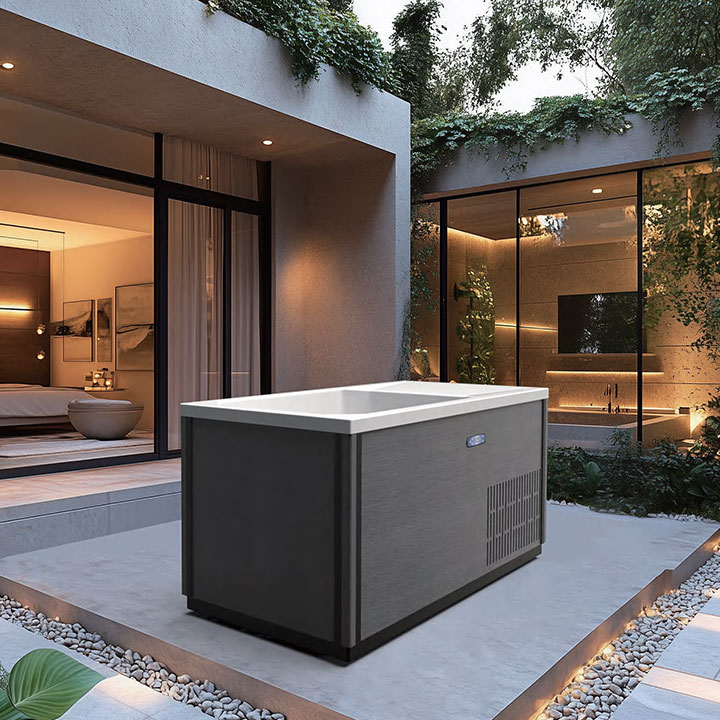
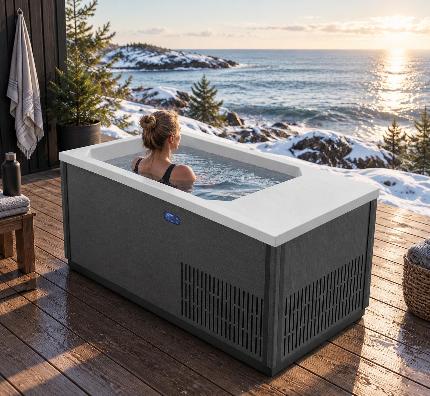
The Outdoor Cold Plunge Tub C02, for instance, uses an integrated 900W heat pump system paired with a 54W brushless pump to regulate water temperature. That combination is built specifically to hold consistent low temperatures rather than relying on manual ice refills, which matters for any operator running multiple sessions daily.
What Cold Immersion Is Actually Doing Physiologically
Understanding the mechanism helps operators explain the service accurately to clients, without overselling it.
Cold water immersion causes blood vessels near the skin to constrict, a response the body uses to preserve core heat. When the body warms back up, those vessels dilate again. This constrict-dilate cycle is commonly associated with several effects:
Reduced post-exercise soreness: Vasoconstriction is thought to limit inflammatory swelling around stressed muscle tissue after intense training.
Circulatory stimulation: The alternating narrowing and widening of blood vessels is associated with increased blood flow and oxygen delivery to tissue.
Mood and stress response: Cold exposure triggers a natural endorphin release, which many users report as improved mental clarity and reduced stress afterward.
None of these effects require exotic technology. They’re a function of water temperature and immersion time. What technology does provide is consistency, keeping that temperature exactly where it needs to be, appointment after appointment.
Equipment Specifications That Actually Matter
When comparing tubs for commercial or high-frequency residential use, a handful of specs separate practical purchases from ones that create maintenance headaches later.
Specification
Outdoor Cold Plunge Tub C02
Why It Matters
Water Capacity
320 L
Enough volume for full-body immersion without excessive water waste
Heater/Control System
900W heat pump
Active temperature regulation instead of passive ice cooling
Pump Output
54W brushless
Circulates water evenly, reduces temperature stratification
Shell Material
Porcelain acrylic
Resists staining and scratching under repeat daily use
Dimensions
1695 x 830 x 850 mm
Compact enough for patios, decks, and indoor recovery rooms
Net Weight
140 KG
Manageable for placement without heavy structural reinforcement
Power Draw
0.954 KW
Relevant for calculating operating cost per session
For a cold plunge business, the pump output and heater wattage are the numbers that translate directly into how many clients a single unit can serve before water quality or temperature starts to drift.
Interior Design Affects Client Experience More Than Expected
Operators often focus entirely on temperature and overlook how the tub’s interior shapes the client’s willingness to stay in for the full session.
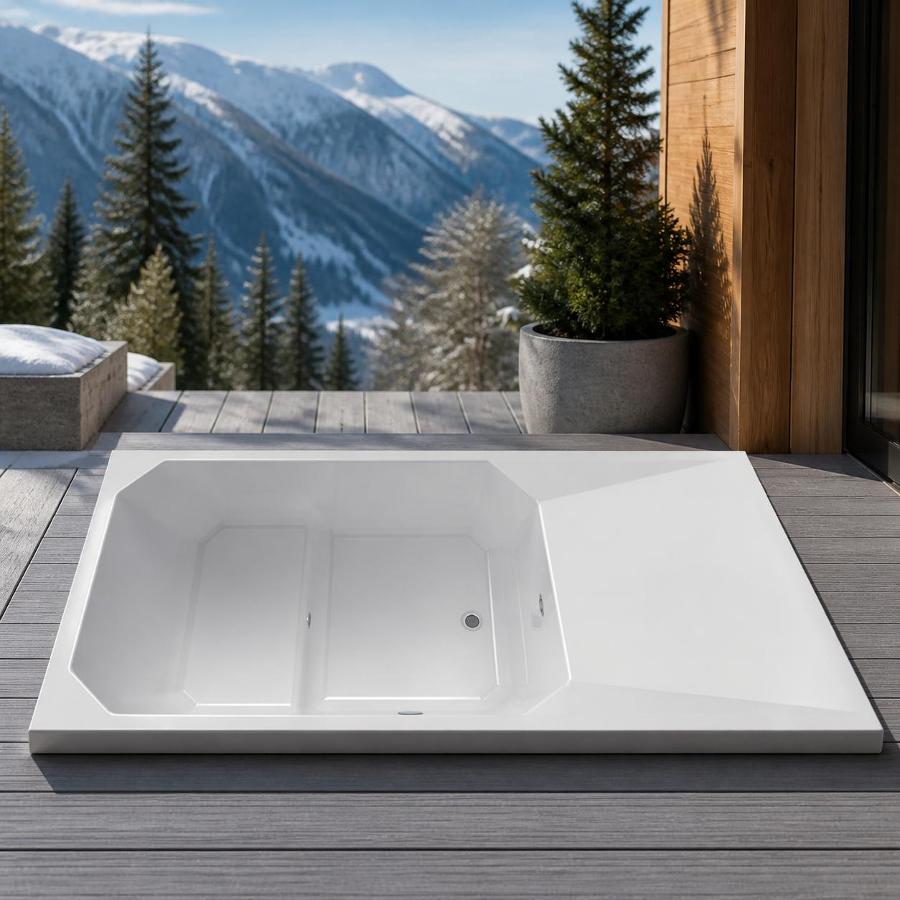
An ergonomic seating step, like the one built into the C02’s basin, gives users a stable position rather than crouching awkwardly on a flat floor. That small design detail affects how long a client comfortably stays submerged, which directly affects whether they get the intended physiological benefit.
A recessed drain fitting and suction vents also matter for hygiene between sessions. Any commercial operation cycling through multiple clients per day needs a tub that drains and refills efficiently without long downtime.
Indoor vs Outdoor Placement Considerations
Where the tub sits changes both the client experience and the maintenance workload.
Outdoor patio or deck: Offers a more resort-like atmosphere but requires a weather-resistant cabinet. Composite panels with ventilation slots, like those on the C02, help manage moisture buildup around the mechanical components.
Indoor recovery room: Easier climate control year-round, but requires attention to floor drainage and ventilation to manage humidity from the plunge and any adjacent heat therapy equipment.
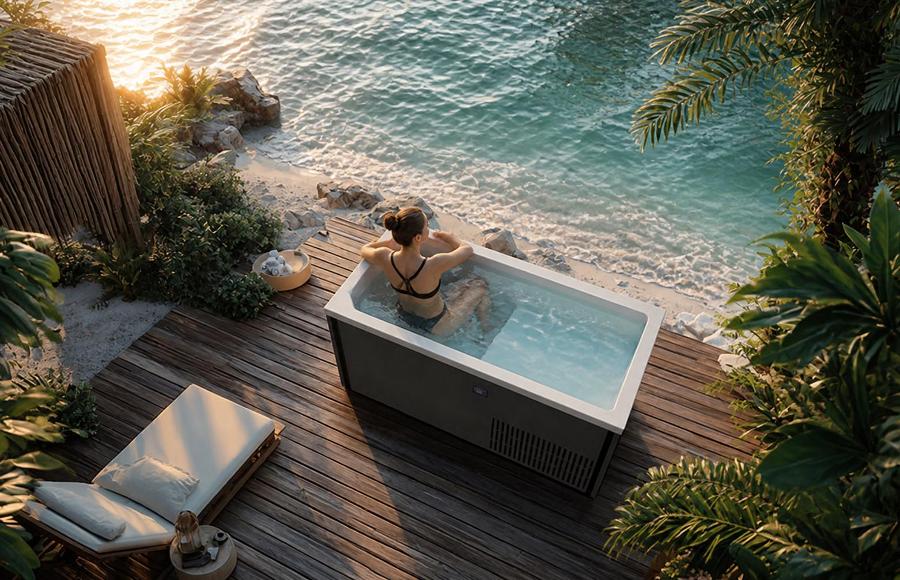
Resort or hospitality setting: Placement near ocean views or garden courtyards adds aesthetic value, though exposure to salt air and direct sun increases the importance of UV-resistant, corrosion-resistant exterior materials.
Each setting changes the calculus slightly, but weather resistance on the exterior cabinet is non-negotiable for any tub placed outdoors year-round.
Choosing Equipment for a Commercial Cold Plunge Business
Selecting a tub for a wellness studio, gym, or recovery center comes down to a short list of practical questions:
How many sessions per day does the location need to support? Higher throughput requires faster temperature recovery, which points toward an active heat pump system over passive cooling.
What’s the available footprint? A unit around 1.7 meters long fits most patios and recovery rooms without major layout changes.
Is the installation indoor or outdoor? Outdoor placements need weatherproof cabinetry; indoor placements can prioritize aesthetics over exterior durability.
What’s the expected power draw against existing electrical capacity? A sub-1 KW system, like the C02’s 0.954 KW draw, is manageable for most residential and light commercial circuits without major electrical upgrades.
Skipping this evaluation is one of the more common mistakes new operators make. They select equipment based on appearance first, then discover mid-season that recovery time between sessions is too slow to keep a booking calendar full.
Frequently Asked Questions
Does a cold plunge tub need constant ice to stay cold? Not if it includes an active cooling system. Tubs with an integrated heat pump, such as the 900W system in the C02, regulate temperature electronically rather than depending on manual ice additions.
How long should a typical cold plunge session last? Session length varies by individual tolerance and goals, and is generally guided by the operator’s protocol or a healthcare provider’s recommendation rather than a universal fixed rule.
Can one tub realistically serve a commercial studio with multiple daily clients? It depends heavily on the pump and heating capacity. Units designed with continuous circulation and active temperature control are better suited to back-to-back bookings than passively cooled tubs.
Is outdoor installation different from indoor in terms of upkeep? Yes. Outdoor units need weather-resistant cabinet materials and more frequent inspection of ventilation components, while indoor units mainly require attention to humidity and drainage.
Matching Equipment to Business Goals
A cold plunge business succeeds or stalls based on operational details most clients never see: recovery time between sessions, cabinet durability, and how easily the unit fits the physical space available. The physiological appeal of cold immersion is well established, but the equipment behind it determines whether that appeal translates into a sustainable service.
For us at Victoria Star, the goal with builds like the Outdoor Cold Plunge Tub C02 has been addressing exactly these operational pressure points, integrated heating, a spacious 320L basin, and weather-resistant construction, so operators spend less time troubleshooting equipment and more time running their cold plunge business.
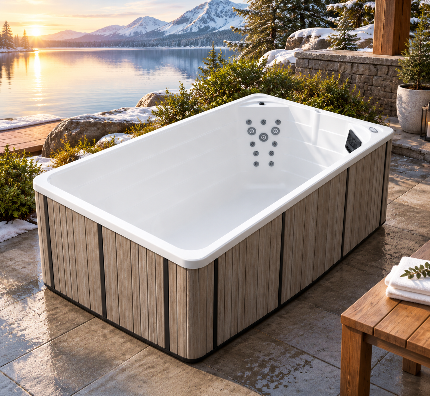
Victoria Star Swim Spa offers the perfect balance between exercise and relaxation, whether you want to swim for fitness or relax in the spacious seating.
Victoria Star Swim Spa offers the perfect balance between exercise and relaxation, whether you want to swim for fitness or relax in the spacious seating.