How Many 7×7 Hot Tub Gallons of Water Are Standard for Backyard Spas?
Home / News / How Many 7×7 Hot Tub Gallons of Water Are Standard for Backyard Spas?
November 02, 2026
Determining the precise 7×7 hot tub gallons of water inside your spa is essential for safe installation, accurate water chemistry, and predictable heating times. As a rough guide, many square spas with an 84 by 84-inch footprint hold somewhere around 300 to 425 US gallons, although individual models can fall outside that band. Exterior cabinet dimensions do not show how much space the seats, steps, and insulation take up. You cannot find the volume by multiplying outer length, width, and height.
Every gallon of fresh water adds about 8.33 pounds to the load on your base, and it changes how much sanitizer and pH adjuster you need. Whether you are planning a concrete pad, ordering chemicals, or estimating first-fill heating time, the manufacturer’s stated capacity for your exact model is the figure to work from. The sections below explain why that number varies and how to confirm it.
Understanding Baseline Capacity for 7-Foot Square Spas
The Standard Range Across Common Models
Most residential hot tubs sold as seven-by-seven feet have an outer cabinet of roughly 84 by 84 inches. Published capacities for these models vary widely from one manufacturer and shell design to the next. A range of about 300 to 425 US gallons (roughly 1,135 to 1,600 liters) is a reasonable starting assumption for planning. Treat it as a rough estimate, not a specification.
The spread comes mainly from the interior shell. Two spas with identical cabinets can hold different amounts of water because their seats, loungers, footwells, and steps are molded differently. Footprint and seat count alone cannot give you a reliable gallon figure. Use any general range, including the ones in this article, only as a sanity check against the number your manufacturer publishes.
Why Exterior Footprint Misleads True Water Volume
Many owners start by multiplying seven feet by seven feet by three feet of cabinet height, which produces a figure above one thousand gallons. That theoretical box ignores the insulation, the perimeter frame, the equipment bay that houses the pumps and control pack, and the molded interior of the shell.
Theoretical Rectangular Box: 84 in × 84 in × 36 in = 254,016 cubic inches (~1,099 gallons)
Rough Water Volume Range: ~300 to 425 gallons, depending on the shell
In This Example: About 61% (at 425 gallons) to 73% (at 300 gallons) of the outer box holds no water
The water level also sits below the top of the shell, at the fill line the manufacturer specifies. The space above that line counts toward cabinet height but never holds water during normal use. Taken together, these factors mean the real volume is only a fraction of the outer box.
Structural Variables That Dictate Fluid Displacement
Open Bucket Seating Versus Dual Ergonomic Loungers
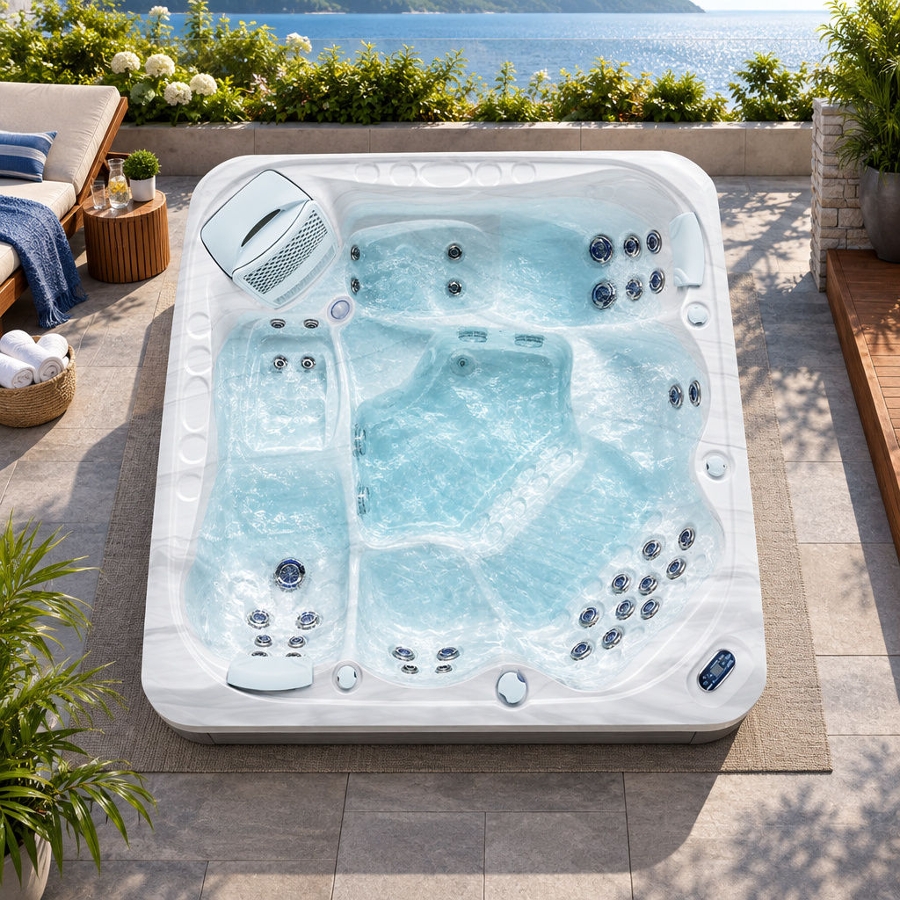
Seating layout is one of the main reasons capacity differs within the same footprint. Upright perimeter seats arranged around an open central footwell leave more room for water. For that reason, these layouts often sit toward the higher end of the range for their size class.
Full-length loungers work the other way. Picture the shell as a mold pressed down into a box of water: every contour that supports a body pushes water out. A lounger rises under the back, knees, and calves to hold a reclined bather, and all of that molded acrylic occupies space that would otherwise hold water. How much capacity a lounger costs depends on its shape and depth, which is why the manufacturer’s stated capacity matters more than any general rule.
Footwell Recesses, Step Geometry, and Filtration Well Volumes
The lower footwell adds another source of variation. A deep, open central footwell adds volume. A shallow footwell, or one interrupted by molded entry steps, leaves less open space. Raised steps and seat platforms are part of the shell itself, so they reduce capacity even though they are not visible from outside the cabinet.
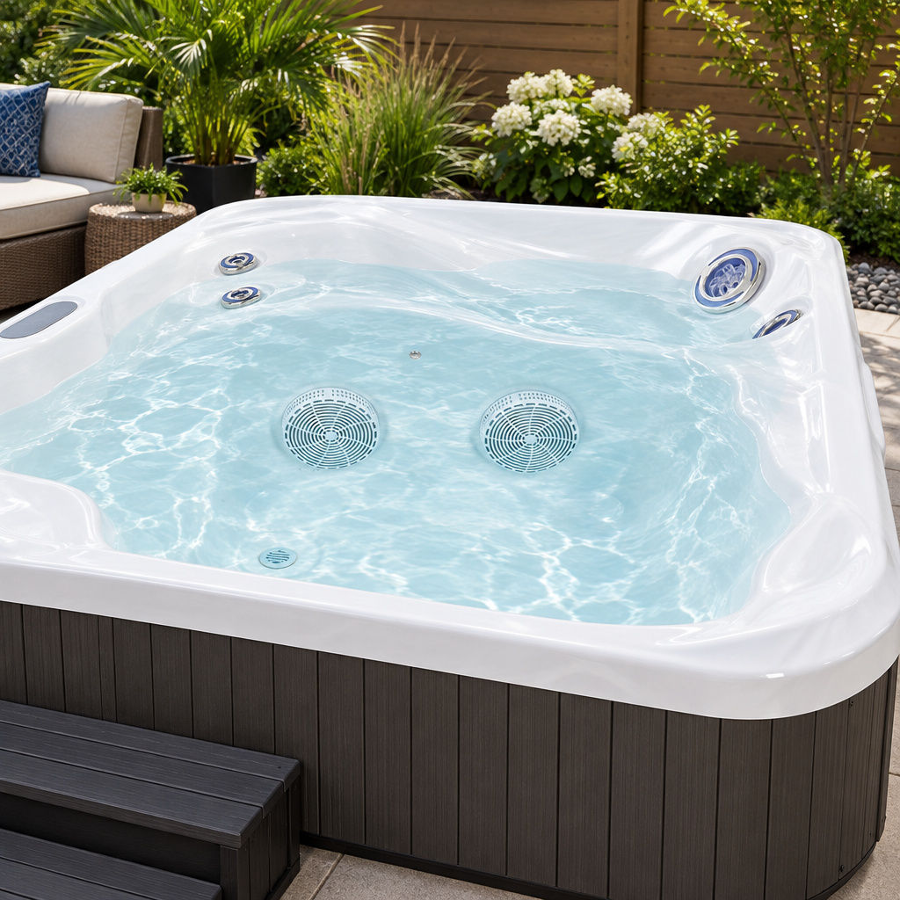
The filter compartment and the plumbing also hold water. Pipes, pump housings, and the heater fill as soon as circulation starts, so the level in the basin can drop slightly after the first start-up. Once the system has run and air has cleared from the lines, top up to the fill line again.
Fill Level Requirements: The Operational Waterline
A hot tub is not filled to the rim. Follow the fill mark and water-level instructions in the owner’s manual, because the correct level varies by model. Some manufacturers mark a line in the skimmer or filter area, while others describe the level relative to the jets or headrests.
Getting the level wrong in either direction has practical costs. Water that is too high spills over when people climb in, which wastes treated water. Water that is too low can let the skimmer or suction fittings draw air, which many manuals warn against. Checking the level after each top-up keeps the volume close to the figure you use for chemical dosing.
Practical Methods to Measure or Calculate Actual Spa Volume
Step-by-Step Approaches to Identify True Capacity
When paperwork is missing, finding the true capacity takes deliberate checking rather than guesswork. Relying on forum estimates for a different model can leave you chasing water chemistry that never balances. Work through these methods in order, starting with the most authoritative source.
Check the owner’s manual or the manufacturer’s specification sheet for your exact model code, since that is where rated water capacity usually appears.
Look at the data label near the equipment access panel or power entry; some labels list capacity, although many show only electrical ratings.
Contact the manufacturer or dealer with the model and serial number if neither document gives a figure.
Record your water meter reading before the first fill and again when the water reaches the recommended fill line.
Time how long your hose takes to fill a five-gallon bucket, calculate the flow rate in gallons per minute, and multiply it by the total fill time.
Use an interior geometric calculation only as a rough cross-check when the methods above are not available.
Mathematical Estimation and Irregular Shell Formulas
If you must estimate water volume mathematically, never treat the cabinet as the basin. Measure interior length and interior width at mid-depth, from inside wall to inside wall. Then measure the water depth from the footwell floor to the recommended fill line.
Multiply interior length, width, and depth in inches, then divide by 231 to convert cubic inches to US gallons. The result treats the basin as an empty box, so it will overstate the real volume. Seats, loungers, and steps take up a large share of that box, and no single correction factor fits every shell. Use the figure only to judge whether a quoted capacity is plausible, then confirm it with the manual or a metered fill.
Flow Rate Timing and Utility Meter Verification
The most reliable way to measure your volume during initial setup is the household water meter. Make sure faucets, ice makers, and washing machines stay idle while the spa fills. Record the starting meter reading down to the smallest unit the meter shows.
If your meter reads in cubic feet, multiply the units used by 7.48 to convert to US gallons. Alternatively, time how long the hose takes to fill a marked five-gallon bucket to get a usable flow rate. Multiplying that rate by the total filling minutes gives a working estimate of your operating capacity.
Why Capacity Accuracy Dictates Safe Operation and Structural Integrity
Chemical Dosing and Sanitizer Equilibrium
Chemical doses are calculated from water volume, so a wrong gallon figure carries into every treatment. CDC guidance for hot tubs calls for a pH between 7.0 and 7.8, with free chlorine of at least 3 parts per million or bromine of at least 4 ppm. Product labels give doses for a set volume, often per 100 or 500 gallons, and the label’s directions govern the amount you actually add.
If you underestimate your capacity, you will under-dose, and sanitizer can fall below the minimum quickly in hot, heavily used water. If you overestimate it, you will over-dose. High sanitizer levels can irritate skin and eyes and are harder on covers, cushions, and equipment.
Under-dosing risks: Sanitizer readings drop below the minimum, water can turn cloudy, and bacteria and biofilm have a better chance to establish in the plumbing.
Over-dosing risks: Bathers may notice skin and eye irritation, pH can swing and become harder to balance, and the cover, headrests, and metal parts face extra wear.
Target values: Follow the product label and CDC guidance, which set minimums of 3 ppm free chlorine or 4 ppm bromine, with pH between 7.0 and 7.8. Test regularly with a reliable kit or test strips.
Structural Engineering: Deck Load, Foundation, and Water Weight
Water weighs about 8.33 pounds per US gallon. A spa holding 375 gallons therefore carries roughly 3,124 pounds of water alone, before you add the empty spa and the people in it. The table below shows water weight only, using simple arithmetic.
Water Volume (US Gal)
Water Weight (lbs)
Water Weight (kg)
300
~2,499
~1,136
350
~2,916
~1,325
375
~3,124
~1,419
400
~3,332
~1,514
425
~3,540
~1,609
These figures are not a total load. The dry weight of the spa varies by model, and the number and size of occupants vary from one soak to the next. For planning, use the manufacturer’s published dry weight and filled weight for your model rather than an estimate.
Placement then depends on the surface. On the ground, manufacturers usually ask for a level, solid base such as a concrete pad and list their requirements in the installation guide. On an elevated deck, rooftop, or terrace, the load path, joist and post spacing, and local building rules all matter. Have a qualified structural engineer or building professional evaluate the structure before the spa arrives.
Heating Duration, Thermal Retention, and Power Demands
Water volume also sets heating time. A 3 kW electric heater delivers about 10,236 British Thermal Units (BTUs) per hour. Raising one pound of water by 1°F takes about one BTU, so the heavier the water, the slower it warms.
The figures below assume the full 3 kW goes into the water with no heat loss. For 350 gallons, or about 2,916 pounds of water, the rise works out to about 3.5°F per hour, so a 40°F rise would take about 11.4 hours. At 425 gallons, the rate drops to about 2.9°F per hour, and the same rise takes about 13.8 hours. Real-world times run longer because the cover fit, air temperature, and wind all draw heat away.
Comparative Capacity Matrix for Square Hot Tubs
Design Factors That Change Capacity Between Models
Instead of assigning a gallon figure to each size class, it is more useful to know which design features push the number up or down. The table below shows what to compare when two spas share a similar footprint, and where to find the detail.
Design Factor
Effect on Water Volume
What to Check
Cabinet footprint
Larger cabinets can hold more, but not in direct proportion
Exact outer dimensions on the spec sheet
Shell depth
Deeper shells usually hold more water
Interior depth and seat heights
Loungers
Molded lounger shapes take up interior space
Number and length of loungers
Upright seats and steps
Raised seats and molded steps reduce open water space
Seat layout drawing or overhead photo
Footwell size
A larger open footwell adds volume
Overhead shell photo or drawing
Fill line position
A higher fill mark means more water
Fill instructions in the owner’s manual
Once you have narrowed your choice, ask for the published fill capacity and filled weight of each finalist. Those two numbers answer the chemistry, heating, and placement questions far better than footprint alone.
Footprint Adjustments: Evaluating Models Beyond Standard 84 Inches
When shopping for mid-sized spas, buyers often find models slightly larger than the 84-inch class. For instance, the VS-605C 6 Person Square Hot Tub from Victoria Star measures 2350 × 2350 × 900 mm, or approximately 93 × 93 × 35 inches. That places it between the usual seven-foot and eight-foot categories.
According to the product data, the VS-605C has four upright seats and two full-length loungers, 37 jets, an aluminum-plastic skirt, a 3 kW heater, and two 2 HP water pumps. Its two loungers take up interior space, so its volume cannot be read from a footprint chart. Check the factory-rated capacity and filled weight for this model before ordering chemicals or preparing a pad or deck.
The product data also lists a 0.35 HP circulation pump and an ozone disinfection system for water care. These features support routine maintenance, but sanitizer doses still depend on the verified water volume and the chemical label.
Frequently Asked Questions
How many 7×7 hot tub gallons of water should I plan for when budgeting chemical treatments?
Use the capacity stated in your product manual. If you do not have it yet, about 300 to 425 gallons is a rough planning range for many 84-inch spas, but confirm the real figure before you dose. Then calculate each dose from the chemical label for that verified volume. Labels state the amount per a set number of gallons, and using the wrong volume shifts every dose by the same proportion.
What is the filled weight of an average seven-foot square spa?
There is no reliable average, because dry weight differs from model to model. The water alone in a 350-gallon spa weighs about 2,916 pounds, and the empty spa and occupants add more on top of that. Use the filled weight published by the manufacturer, and get a qualified structural evaluation before placing any spa on an elevated deck.
How long does a garden hose take to fill a seven-foot spa?
Many residential outdoor spigots deliver roughly 4 to 9 gallons per minute, depending on water pressure and hose diameter. At those rates, a 350-gallon spa takes roughly 40 to 90 minutes to fill. A second hose can shorten the fill, although the total flow still depends on your household supply.
Do reclined loungers reduce total hot tub water capacity?
Yes. Sculpted loungers occupy interior space that would otherwise hold water, because the molded acrylic rises under the back, knees, and legs. The exact reduction depends on the lounger’s shape and depth, so compare the published capacities of the models you are considering.
Where on the cabinet can I find the official water volume rating?
Start with the owner’s manual or the manufacturer’s specification sheet, since capacity is most often listed there. Some spas also carry a data label near the equipment access panel or power entry, although many labels show only electrical ratings. If neither source gives a figure, contact the manufacturer or dealer with the model and serial number.
Practical Next Steps for Spa Owners
Knowing your exact 7×7 hot tub gallons of water removes guesswork from every stage of ownership. The figure drives chemical doses, first-fill heating time, and the load your base must carry. Rather than relying on generic estimates, check the manufacturer’s stated capacity and filled weight, confirm the volume with a metered fill, and have any elevated deck evaluated by a qualified professional before installation.
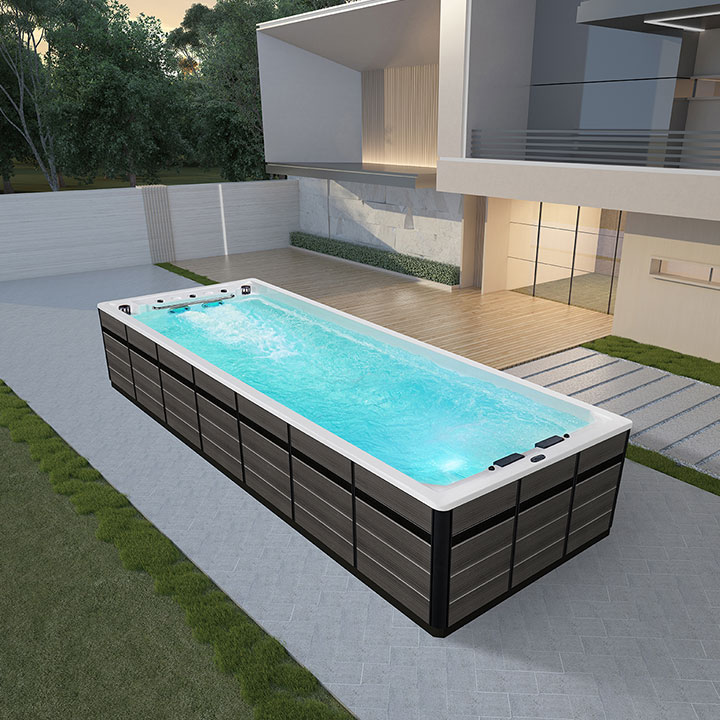
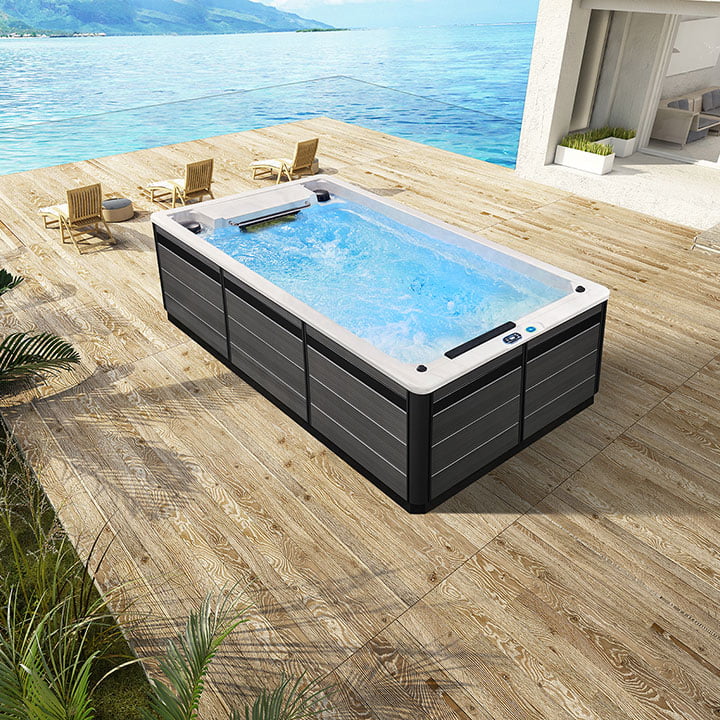
Victoria Star Swim Spa offers the perfect balance between exercise and relaxation, whether you want to swim for fitness or relax in the spacious seating.
Victoria Star Swim Spa offers the perfect balance between exercise and relaxation, whether you want to swim for fitness or relax in the spacious seating.