Custom Swim Spa Options: What to Know Before You Buy
Home / News / Custom Swim Spa Options: What to Know Before You Buy
September 30, 2026
Why Homeowners Are Turning to Swim Spas Instead of Pools
A custom swim spa solves a problem that traditional pools create: most backyards simply don’t have room for a full lap pool. Swim spas compress swimming, resistance training, and hydrotherapy into a footprint closer to a large hot tub than an in-ground pool excavation.
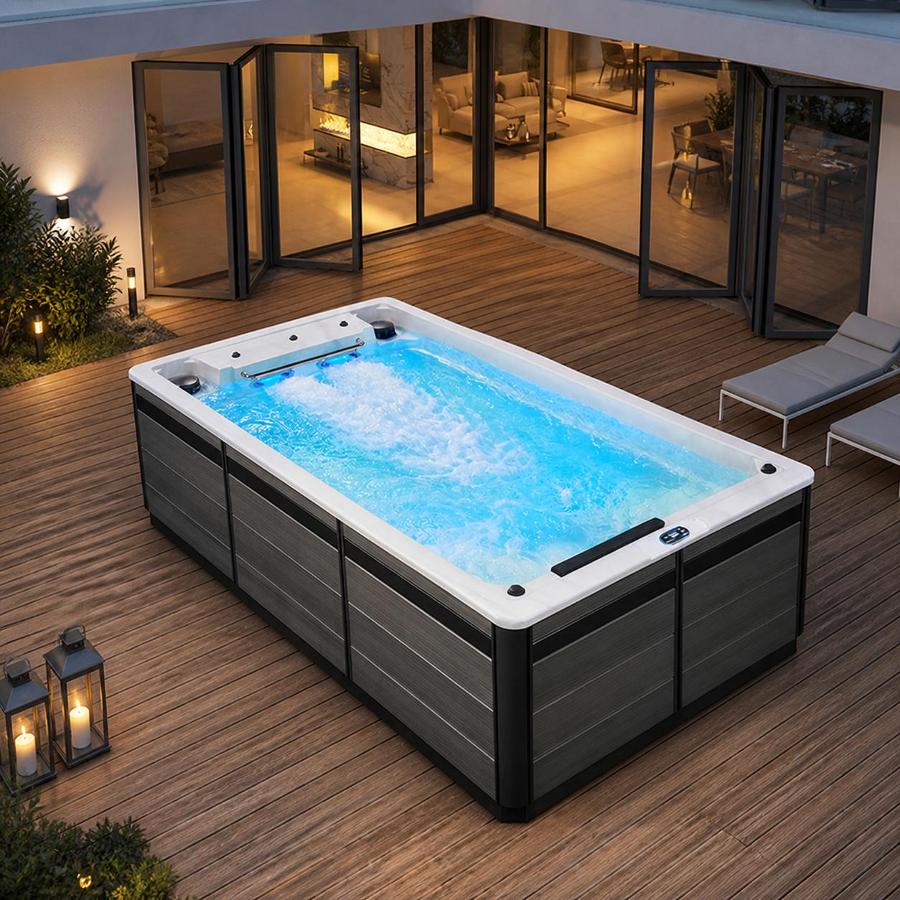
That space efficiency matters more than it sounds. A typical residential lap pool needs at least 40 feet of clear yard, plus setback allowances and drainage planning. A swim spa like the M-301, at roughly 13 feet long, fits on a deck, patio, or even an enclosed porch with adequate structural support. The tradeoff isn’t performance, it’s footprint, and for most homeowners that’s the whole point.
What Makes a Swim Spa "Custom"
Customization in this category usually means matching the unit to how someone actually intends to use it. A swimmer training for triathlons needs a different current profile than someone recovering from a knee replacement. Custom swim spa manufacturers address this through configurable variables:
Jet layout and count — how many hydrotherapy jets, and where they sit relative to shoulders, lower back, and legs.
Pump horsepower — determines current strength and whether the unit favors gentle recovery swims or resistance training.
Cabinet and shell finishes — aesthetic choices that need to match a deck, a landscape, or an interior wellness room.
Control interface — touchscreen versus button panel, and how granular the temperature and jet adjustments are.
None of this is cosmetic dressing. Jet placement, in particular, is the difference between a unit that feels like a bathtub with bubbles and one that meaningfully reduces muscle soreness after a workout.
The Two Jobs a Swim Spa Has to Do
Swim spas are asked to do two mechanically different things, and it’s worth separating them before comparing products.
Job one is generating a swimmable current. This requires high-output water pumps pushing water through swim jets fast enough to create resistance a person can swim against continuously, without the current dying off after a few strokes. The M-301, for example, runs three 3 HP pumps plus a 2 HP pump dedicated to this countercurrent function, alongside a separate 1 HP circulation pump that handles filtration independently. Keeping circulation on its own pump is a sensible design choice, since it means the filtration cycle doesn’t compete with swim current output.
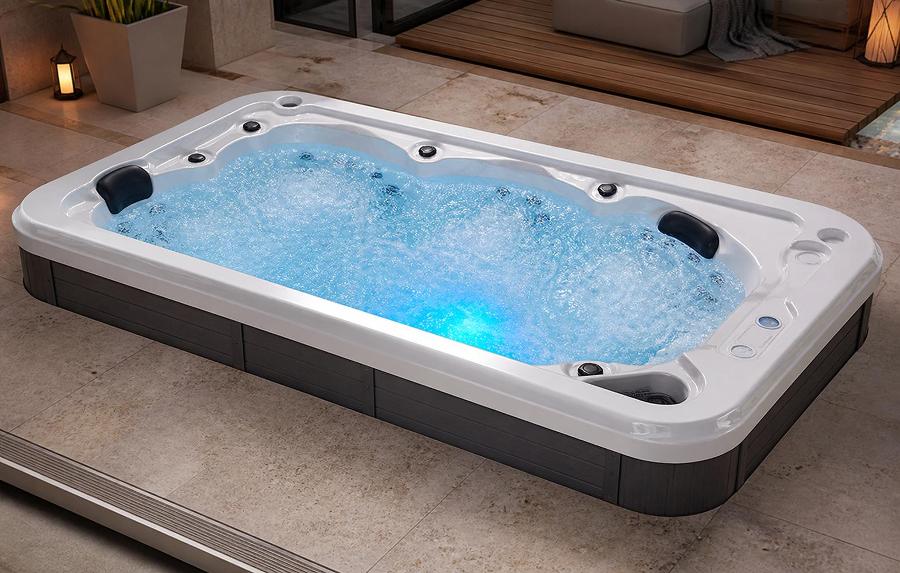
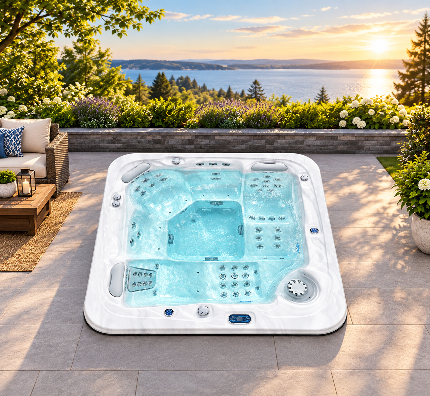
Job two is hydrotherapy massage, which is a completely different water dynamic. Massage jets are lower flow, higher pressure, and positioned around seating rather than at one end of the shell. The M-301 uses 27 jets arranged across its two ergonomic seats, aimed at delivering deep muscle relief rather than propulsion. A spa that’s good at one job isn’t automatically good at the other, which is why serious buyers should ask manufacturers how the two jet systems are separated, not just how many jets exist in total.
Sizing and Capacity: What the Numbers Actually Mean
Swim spa dimensions get thrown around as marketing copy, but they carry real functional weight. Water volume affects heating cost and current stability. Length affects stroke count before you hit the wall. Width affects how many people can use the seating side simultaneously.
Specification
M-301 Detail
Seating Capacity
2 seats
Overall Length
3880 mm (approx. 13 ft)
Overall Width
2200 mm (approx. 87 in)
Overall Height
1250 mm (approx. 49 in)
Water Capacity
4,650 liters
Total Jet Count
27
Heater Output
1 x 3,000 W
Power Supply
11.85 kW
A two-seat configuration like this suits couples or individual swimmers who want a private lane rather than a social gathering spot. Larger swim spas with more seating exist, but they trade some current efficiency for social capacity, since more open water volume can dilute the countercurrent strength unless pump output scales up proportionally.
Water Quality: The Part Buyers Underestimate
Ask anyone who has owned a hot tub for a few years and they’ll tell you water maintenance is the chore that determines whether they actually use the thing. Swim spas hold far more water than a standard spa, so the maintenance burden scales accordingly if the filtration system is undersized.
This is where purification technology earns its keep. Multi-stage filtration paired with ozone and UV sterilization, as used in the M-301’s water system, reduces how often a swimmer needs to shock the water with chlorine or bromine. Ozone breaks down organic contaminants before they build up, and UV sterilization neutralizes microorganisms that survive filtration. Neither technology eliminates the need for a sanitizer entirely, but according to the manufacturer’s specifications, the combination meaningfully cuts down chemical dosing and the sharp smell that comes with over-chlorinated water.
Buyers comparing custom swim spa options should ask a blunt question: does the filtration run continuously, or only when the jets are on? A system tied to jet operation leaves water static for hours at a time, which is exactly when algae and bacteria get a foothold.
Controls, Lighting, and the Parts People Forget to Ask About
Hydrotherapy and swim current get most of the attention in sales conversations, but daily usability often comes down to smaller details.
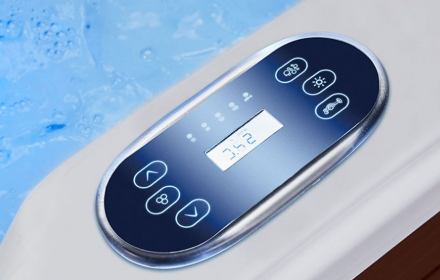
A touchscreen control panel, like the KL2020BT interface fitted to the M-301, sits flush in the spa rim and lets a user adjust temperature, jet intensity, and lighting without leaving the water. That matters more in winter, when nobody wants to step out dripping wet to fiddle with a wall-mounted panel.
Lighting is easy to dismiss as decorative, but multi-color LED systems built into the shell edge and underwater zones extend how the spa gets used across a full day. Morning swim sessions don’t need ambiance. Evening hydrotherapy soaks, on the other hand, benefit from dimmed, colored light the same way a bathroom benefits from warmer bulbs at night.
Where a Swim Spa Actually Fits in a Property
Placement decisions come down to structural load, utility access, and how the unit will actually get used day to day. Common installation scenarios include:
Backyard patio or deck — the most common setup, provided the deck is rated for several thousand kilograms of water weight plus the unit itself.
Indoor wellness rooms — increasingly common in homes with enclosed sunrooms, though ventilation and humidity control become non-negotiable.
Post-workout recovery spaces — positioned near a home gym for athletes using the countercurrent for cool-down swims and jets for muscle recovery.
A three-pump-plus-circulation setup like the M-301’s draws over 11 kW at full output, so any installation plan needs an electrician to confirm the property’s panel can handle a dedicated circuit before the unit ever ships.
Frequently Asked Questions
Can a swim spa replace a full lap pool for training purposes? For most recreational and fitness swimmers, yes. The continuous current means a swimmer never has to turn or push off a wall, which some coaches argue produces a more consistent stroke rhythm than lap swimming. Competitive swimmers training for wall-turn technique still need pool time.
How much electricity does a swim spa use compared to a standard hot tub? Swim spas draw more power because they run additional high-horsepower pumps for the current, on top of heating. A unit like the M-301, rated at 11.85 kW, uses meaningfully more than a two-pump hot tub, so budgeting for the electrical upgrade is part of the decision.
Do custom swim spas require a permanent foundation? Most require a level, reinforced pad capable of bearing the full water weight plus the unit and occupants. A 4,650-liter model like the M-301 carries roughly 4.65 metric tons of water alone, so a standard wooden deck may need reinforcement first.
Is ozone and UV purification a replacement for chlorine? No. It’s a supplemental system that reduces chemical demand and improves water clarity, but manufacturers still recommend a baseline sanitizer for microbial control.
Making the Decision
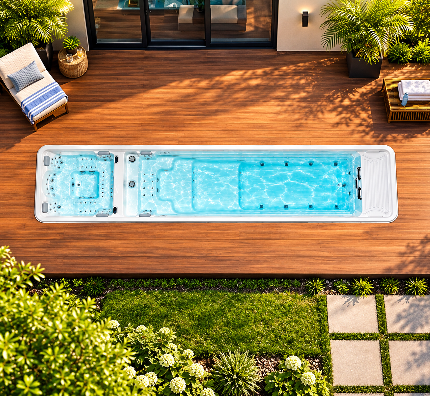
Choosing among custom swim spa manufacturers comes down to matching pump configuration, jet layout, and water volume to how the household actually intends to use the unit, whether that’s daily training laps, evening hydrotherapy, or both. At Victoria Star, the M-301 was engineered around that dual purpose, pairing a dedicated countercurrent system with 27 targeted hydrotherapy jets and multi-stage water purification in a two-seat footprint suited to home installation. For anyone comparing options, the right custom swim spa isn’t the one with the most jets on paper, it’s the one whose pump output, filtration, and layout actually match the daily routine it’s meant to support.
Victoria Star Swim Spa offers the perfect balance between exercise and relaxation, whether you want to swim for fitness or relax in the spacious seating.
Victoria Star Swim Spa offers the perfect balance between exercise and relaxation, whether you want to swim for fitness or relax in the spacious seating.