Complete Buying and Specification Guide for a 6 Person Hot Tub
Home / News / Complete Buying and Specification Guide for a 6 Person Hot Tub
November 02, 2026
Investing in a 6 person hot tub transforms an ordinary outdoor living area into a functional hydrotherapy retreat, balancing family leisure with serious muscle recovery. Navigating this category requires looking beyond shell colors and marketing slogans to evaluate internal water capacity, plumbing configurations, continuous electrical supply demands, and true structural engineering. A well-designed 6 person hot tub provides generous personal space without forcing occupants into an awkward tangle of knees and elbows.
Evaluating high-end residential spas means scrutinizing how manufacturers engineer pump displacement, water filtration, and ergonomic shell contours. High-capacity hydrotherapy models, such as the Victoria Star VS-605L luxury spa, integrate sophisticated engineering with dedicated wellness spaces. For us, true manufacturing precision means balancing hydraulic flow, structural insulation, and water sanitation so that daily operation remains consistent, quiet, and predictable for homeowners.
Demystifying the 6 Person Hot Tub: Capacity vs. Practical Comfort
When shopping for a 6 person hot tub, understanding the distinction between listed seating capacity and real-world spatial comfort is paramount. Many consumers discover that six nominal bucket positions can feel cramped if the vessel lacks sufficient footwell volume and shoulder clearance. Evaluating personal space requirements beforehand prevents buyer remorse and ensures everyone enjoys their hydrotherapy session.
Rated Seating Capacity vs. True Elbow Room
Spa seating ratings indicate how many people the manufacturer expects the shell to hold. In practice, accommodating six large adults simultaneously requires thoughtful contour design, wide shoulder rests, and a deeply recessed footwell. If the center well is restricted, bathers inevitably collide knees, turning a relaxing session into an uncomfortable game of spatial negotiation.
For most households, choosing a six-person shell provides a comfortable envelope for four regular users, leaving breathing room and easy movement. When guests arrive for a weekend gathering, the extra capacity absorbs the crowd. Assessing physical interior volume rather than simply counting molded positions gives a far more accurate measure of real-world comfort.
Ergonomic Layouts: Dedicated Lounger vs. Open Perimeter Seating
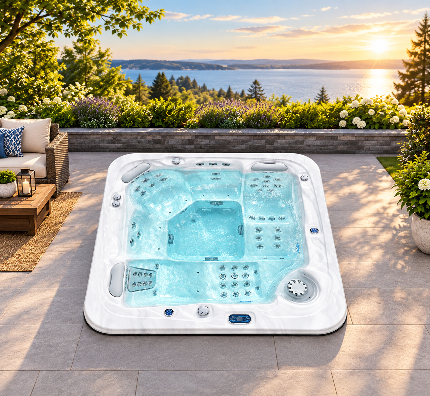
Molded layout design presents a core functional choice between an open-bench perimeter and an integrated full-body lounger. An open perimeter layout maximizes the count of upright seats, fostering direct eye contact and easy conversation. However, open benches sacrifice the full-body reclining posture that many bathers prefer for leg and lower-back massage.
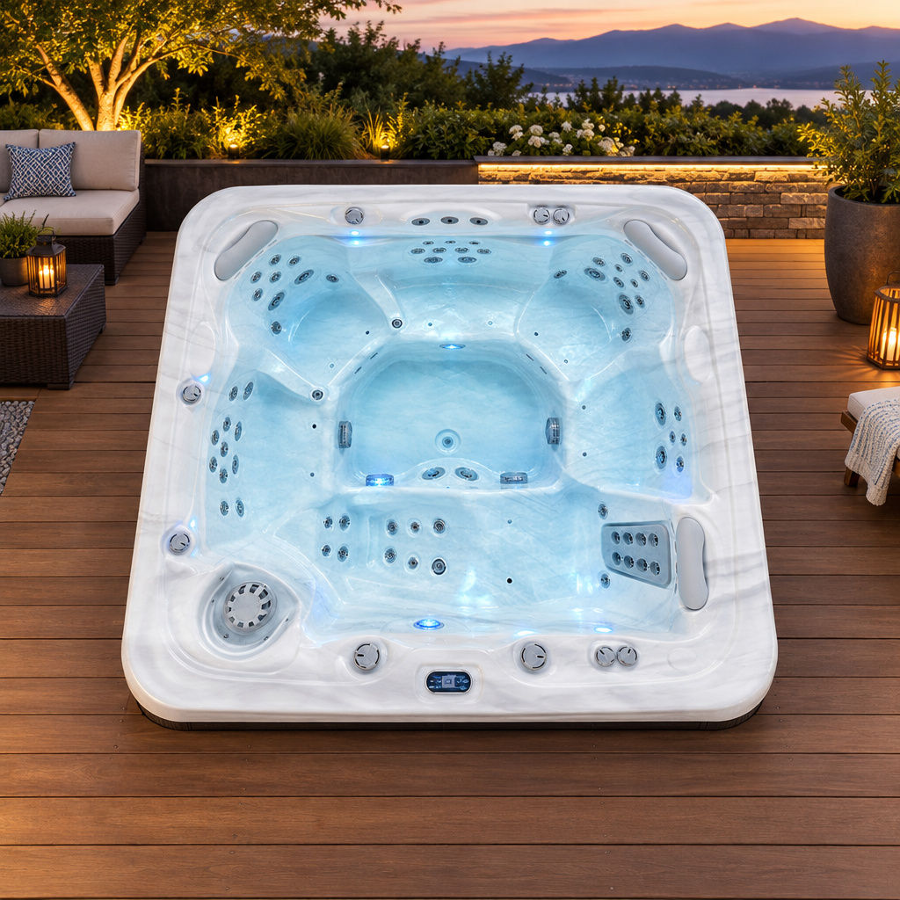
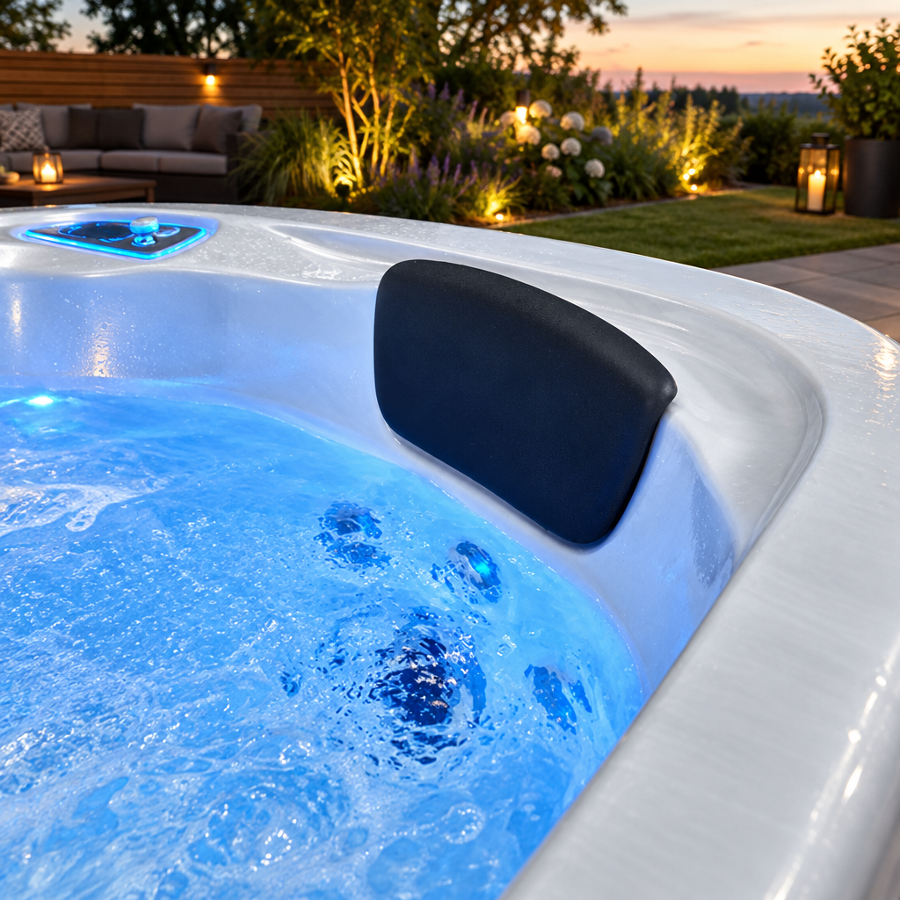
A dedicated lounger supports the spine and lifts the legs, which helps keep the bather in position while the jets run. The VS-605L addresses this design choice with four contoured upright seats and one full-length ergonomic lounger. The manufacturer rates the model for six persons, so ask how the seating positions are counted and sit in the shell before buying to judge the fit for your group.
Interior Water Volume, Depth, and Bather Displacement
Seat depth decides how much of the body stays under warm water. If a seat sits too high, the shoulders stay exposed to cold air on winter evenings, and many bathers end up slouching to stay warm. The VS-605L specifications list an exterior height of 39 inches, which is not the same as seat immersion depth, so ask the dealer for seat-depth figures or sit in a display model before buying.
Water level also changes with bather load. When several adults get in, the displaced water pushes the level up toward the skimmer opening. How much room the shell leaves depends on the model’s actual fill volume, so confirm the recommended fill level and water capacity in the installation or owner documentation.
Dimensional and Spatial Planning: Will a 6 Person Model Fit Your Property?
A spa of this category commands substantial square footage and requires careful logistical planning long before the delivery truck arrives. Taking exact measurements of the site, calculating perimeter maintenance allowances, and verifying pathway clearances protect both your property and the spa during transit and final positioning.
Outer Shell Dimensions and Clearance Margins
The physical footprint of a six-person unit often runs close to eight feet on a side. The VS-605L measures 8 feet by 91 inches with a height of 39 inches, translating to 2540 mm by 2310 mm by 980 mm. This large profile provides generous interior capacity, but it also calls for careful planning around existing patios, garden borders, and walls.
Beyond the outer shell rim, plan for service access around the cabinet. The equipment panel must stay reachable so technicians can inspect pumps, the heater, and plumbing connections. Follow the manufacturer’s stated access and cover-lifter clearances for the specific model, because the panel location and lifter type determine how much space each side needs.
Delivery Pathway and Ingress Logistics
Delivering a spa of these dimensions is a serious material-handling job. Spas are often moved on a dolly, so the route from the driveway to the foundation must be cleared in advance. Gate latches, low-hanging tree branches, gas meters, and air conditioner compressors can easily snag an eight-foot cabinet.
Use the checklist below as a preliminary survey, then confirm the actual requirements with your delivery provider for this unit and route:
Gate openings: Measure the narrowest point along the route, and compare it with the transport dimensions the delivery provider gives for the VS-605L.
Overhead clearance: Measure the lowest eaves, gutters, and branches, and ask the provider how the spa will be oriented during the move.
Turning radius: Confirm there is pivot space around tight 90-degree corners along the route.
Ground surface: Ask whether plywood boards are needed over turf or soft gravel to keep the dolly from sinking.
Alternative lifting: Arrange a crane if side access is blocked by structures.
When structural obstacles or narrow zero-lot-line paths eliminate ground transit, a crane lift becomes the safest alternative. A mobile crane with certified rigging can lift the spa over rooflines and fences directly onto the prepared foundation pad, avoiding strain on the exterior cabinet corners.
Structural Foundation and Dead/Live Load Requirements
Never underestimate the total operating weight of a filled spa. The structural load includes the dry weight of the shell and cabinet, the weight of the water, and the combined body weight of all bathers. Tap water weighs approximately 8.34 pounds per gallon, so every 100 gallons of fill adds roughly 834 pounds before anyone gets in. The supplied VS-605L specifications do not list dry weight or water capacity, so request both from the manufacturer before planning the base.
The spa needs a firm, level base that meets the manufacturer’s installation instructions and local building requirements. An uneven base puts uneven stress on the frame and shell, which can lead to cracks or leaks over time. If you plan a concrete slab, have a qualified contractor or engineer set the thickness, reinforcement, and leveling tolerance.
Common foundation options compare as follows:
Concrete slab: The most common choice for ground-level installs; design it to the manufacturer’s instructions and local requirements.
Engineered modular spa pads: Interlocking plastic pads laid over a prepared base; confirm the manufacturer approves them for a spa of this size.
Elevated timber deck: Requires a structural engineering review of the actual loads before installation.
Direct turf or loose soil: Not suitable, because uneven settling can twist the frame and stress plumbing.
Engineering and Mechanical Specifications That Determine Performance
The massage you feel depends on mechanical components housed out of sight behind the cabinet panels. The relationship between jet openings, pipe sizes, pump horsepower, and the heater affects how strong the jets feel, how quietly the spa runs, and how well it holds temperature.
Jet Count vs. Hydraulic Balance and Hydrotherapy Zones
A frequent misconception among first-time buyers is that more jets automatically create a better massage. In reality, spreading a pump’s flow across too many openings can leave each jet weaker. Jet count and pump horsepower do not establish actual massage intensity, so judge it from verified flow data or an in-person wet test.
The VS-605L has 98 hydrotherapy jets placed throughout its seats and lounger. According to the product information, they target the back, waist, shoulders, legs, and feet, with adjustable pressure. Because jet count alone says little about how the massage feels, try the seats with the pumps running before committing.
Pump Horsepower and Dedicated Circulation Systems
The VS-605L uses two 3 HP water pumps and a 0.5 HP air pump, according to its specifications. Splitting the jets between two pumps is the manufacturer’s configuration intended to support the 98-jet system. Horsepower ratings alone do not tell you the flow or pressure at each jet, so judge massage strength during a wet test. The air pump adds air bubbles to the water.
The model also includes a separate 0.35 HP circulation pump. In spas built this way, the circulation pump is smaller than the massage pumps and moves water through the filter and heater between soaks. The owner’s manual describes how the VS-605L schedules circulation and filtration cycles.
Heating Output and Thermal Recovery
The VS-605L lists a single 3 kW heater. How quickly any spa reheats depends on heater output, water volume, outdoor temperature, cover condition, and how long the cover stays off. Expect slower recovery in cold weather or during long soaks with the cover removed.
The model’s power supply specification is 8.05 kW. This figure tells your electrician how much capacity to plan for, but it does not by itself show which loads can run together. Some spa control systems limit the heater while massage pumps run, depending on how they are wired, so check the model’s wiring diagram and rating plate for the actual electrical requirements.
Water Care Architecture: Filtration, Ozone, and UV Technologies
Keeping water clear requires filtration, supplemental treatment such as ozone and UV, and steady chemical sanitation working together. Because warm water can support the growth of germs and organic matter, a multi-stage treatment approach matters for both bather health and equipment life.
Mechanical Cartridge Filtration and Flow Dynamics
Mechanical filtration acts as the first barrier against windblown dust, skin cells, and body oils. Pleated filter cartridges capture suspended particles as water flows through the surface skimmer. Regular cleaning keeps the pleats free of oily build-up, maintaining flow to the heater and pumps.
Rinse and deep-clean the cartridge at the intervals and with the products specified by the spa and filter manufacturers. Avoid pressure washers, which can damage the filter media. A clogged cartridge restricts flow, and many control systems respond with flow or pressure error codes.
The Complementary Roles of Ozone Sanitization and UV Light
Many water care systems pair mechanical filtration with ozone and UV treatment. The VS-605L product information describes a multi-stage setup that combines filter cartridges, ozone sanitization, and UV light technology. In typical spa designs, ozone and UV units treat water inside the equipment rather than in the open tub. The owner’s manual explains how the VS-605L system is configured.
For that reason, ozone and UV treatment systems supplement the residual sanitizer instead of replacing it. The CDC emphasizes maintaining a continuous residual sanitizer in hot-tub water. Homeowners should keep a free chlorine residual between 3 and 10 ppm or a bromine residual between 4 and 8 ppm, because ozone and UV leave no lasting sanitizer in the water where people sit.
Maintaining Water Balance and Temperature Safeguards
Chemical balance affects water safety, skin comfort, and the lifespan of the heater and other metal parts. Water that is out of balance can corrode metal surfaces or leave calcium scale on internal components. CDC guidance for home hot tubs recommends testing sanitizer and pH at least twice a day, and more often when several people are using the tub. Follow the spa and sanitizer manufacturers’ instructions as well.
Target water chemistry values:
pH: 7.2 to 7.8, the range the CDC recommends for hot tubs. Staying in range helps limit eye irritation and equipment corrosion.
Free chlorine: 3 to 10 ppm, or bromine at 4 to 8 ppm, per CDC guidance.
Total alkalinity and calcium hardness: Use the ranges in the spa manufacturer’s or sanitizer system’s instructions, since targets vary by spa and sanitizer.
Bather safety also requires observing strict thermal upper limits. The CDC advises keeping hot-tub water at or below 104°F (40°C). Prolonged soaking at temperatures above this threshold risks hyperthermia, heat exhaustion, and dizziness. Furthermore, children under five years old should never enter hot tubs due to their elevated risk of overheating, dehydration, and rapid core temperature spikes.
Specification Spotlight: Examining the VS-605L
Analyzing the technical build profile of a specific model shows how these individual components fit together in a home hydrotherapy spa. The VS-605L combines a large shell with lighting, audio, and multi-stage water care.
Engineering Specification
Technical Data (VS-605L)
What It Means for the Buyer
Shell Dimensions
8′ × 91″ × 39″ (2540 × 2310 × 980 mm)
Large footprint; plan delivery and site space early
Seating Capacity and Layout
Rated for 6 persons; 4 Seats + 1 Lounger
Upright seating for groups plus one reclining position
Total Jet Count
98 Hydrotherapy Jets
Coverage across back, waist, shoulders, legs, and feet
Massage Pump Hardware
2 × 3 HP Water Pumps
Jets split between two pumps; judge strength in a wet test
Circulation Pump
1 × 0.35 HP
Separate smaller pump for filtration and heating circulation
Air Pump
1 × 0.5 HP
Adds air bubbles to the water
Heater Capacity
1 × 3 kW
Listed heater rating; recovery time depends on conditions
Power Supply
8.05 kW
Planning figure for the electrician; confirm on the rating plate
Cabinet & Shell
Aluminum-Plastic Skirt / Porcelain Acrylic
Platinum or Midnight cabinet; porcelain shell with grey marble veining
Control Systems and User Experience: The KL2022 Interface
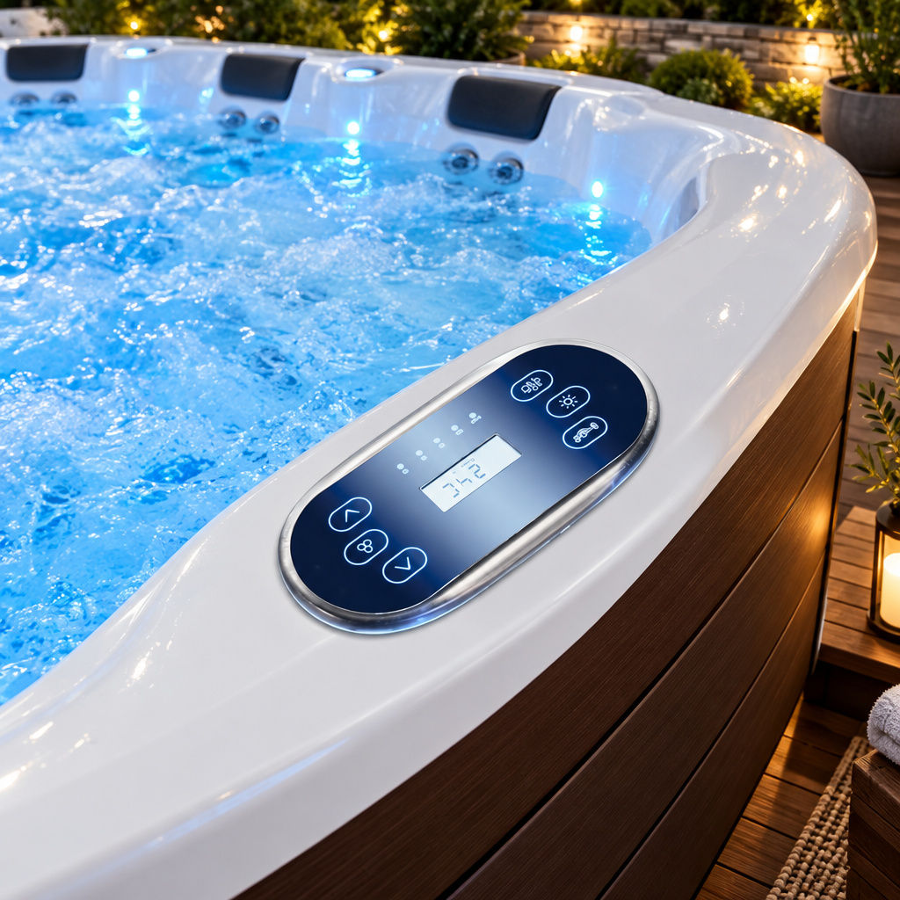
Operating a hydrotherapy spa should be straightforward. The VS-605L uses the KL2022 smart keypad control system, an oval digital panel set into the acrylic rim. Its backlit blue LCD screen displays water temperature and mode readings.
The keypad lets bathers adjust water temperature, jet activation, lighting modes, and filtration cycles. If your utility offers off-peak rates, check the owner’s manual to see how filtration and heating schedules can be set around them.
Integrated Multi-Sensory Features: Illumination and Acoustics
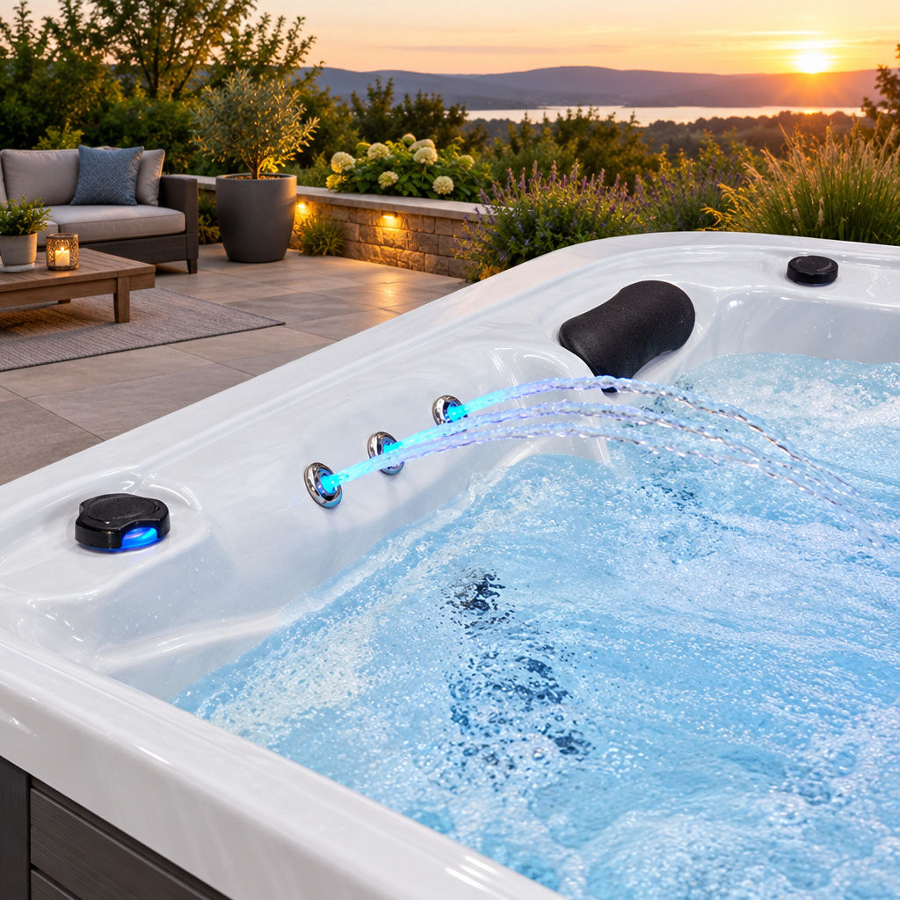
Light and sound shape the mood of an evening soak as much as the water does. The VS-605L features multi-color LED mood lighting beneath the water surface, around the perimeter, and in illuminated water jets. Customizable color transitions set the evening mood and make the interior easier to see when getting in and out after dark.
Complementing the lighting is an integrated Bluetooth audio system with four AV speakers. Bathers can stream music, podcasts, or ambient soundscapes directly from a smartphone or tablet, without the need for separate waterproof speakers.
Site Preparation, Electrical Installation, and Safe Operation
Careful site preparation supports safety, code compliance, and a long service life. Cutting corners on electrical wiring or base drainage can create hazards and lead to costly repairs.
Dedicated Electrical Infrastructure and GFCI Protection
With an 8.05 kW power supply rating, the VS-605L calls for electrical planning by a licensed electrician before delivery. The connection method, circuit, GFCI protection, and disconnect must follow the rating plate, the manufacturer’s wiring diagram, and the electrical code adopted in your area. Codes based on the National Electrical Code (NEC) commonly require GFCI protection for spa and hot tub circuits. A GFCI cuts power when it detects current leakage, protecting bathers from electric shock.
Electrical preparation steps:
Hire a licensed electrician to assess your home’s main distribution panel.
Verify that spare service capacity can accommodate the spa’s 8.05 kW rated requirement and the figures on its rating plate.
Confirm which edition of the electrical code your local authority has adopted and whether a permit and inspection are required.
Install GFCI protection and a disconnecting means where the adopted code and the manufacturer’s wiring instructions require.
Run the conductor size and wiring method specified by the electrician and the manufacturer into the spa control box.
Always consult manufacturer documentation and municipal building inspectors before finalizing conduit runs. Requirements vary by region and code cycle, and an experienced electrician will ensure wire gauge sizes account for voltage drop over long distances.
Elevation Planning: Backyards, Patios, Terraces, and Rooftops
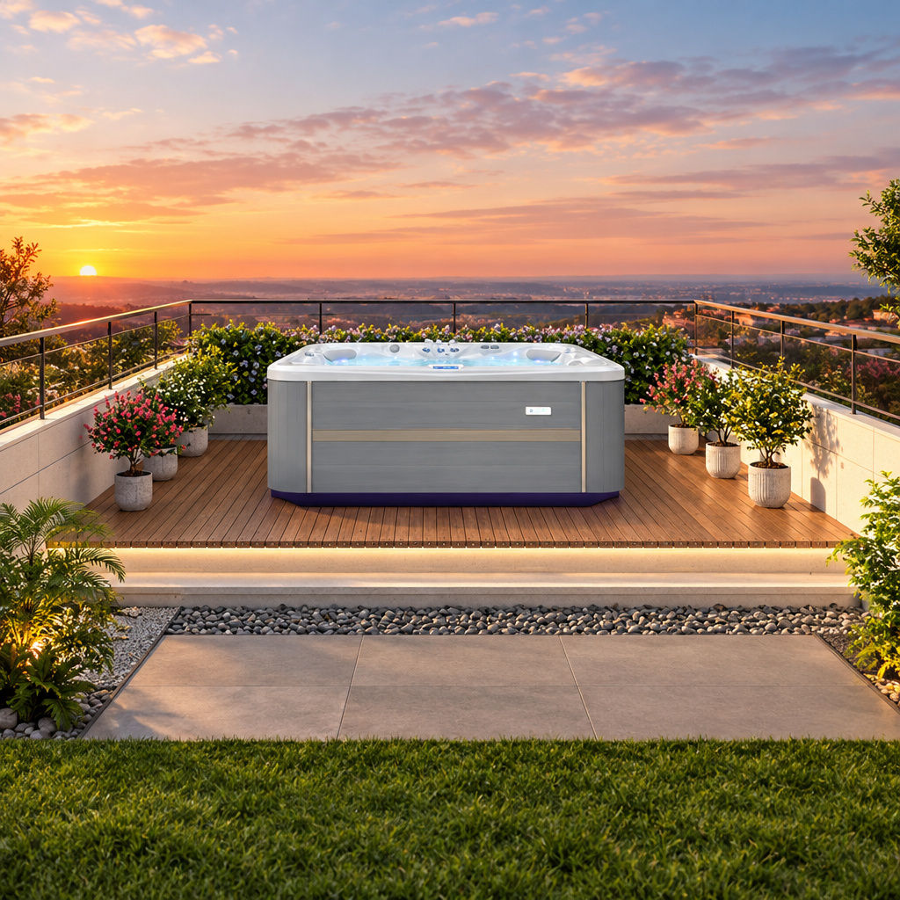
Selecting the installation environment depends on structural bearing capacity, personal privacy, and site accessibility. While ground-level backyard patios remain the most common setting, elevated timber decks and urban rooftop terraces offer open views for an outdoor soak.
When positioning a 6 person hot tub on an elevated wooden deck or rooftop terrace, commission a structural engineer to calculate the total and distributed loads. That calculation needs the model’s dry weight, water volume, occupant load, and the details of the support structure, so obtain the weight and capacity figures from the manufacturer first. Many residential decks are not built for a concentrated load of this kind, and joists, beams, or posts may need reinforcement.
Preventative Maintenance Schedule for Year-Round Durability
Preventative maintenance protects internal plumbing, limits scale on the heater, and keeps the spa clean and inviting. A simple routine takes only a few minutes at a time and helps avoid cloudy water and service calls.
Recommended spa maintenance routine:
Water testing: Test sanitizer and pH (7.2–7.8) at least twice a day, as CDC guidance for home hot tubs recommends, and more often when several people use the tub. Also follow the spa and sanitizer manufacturers’ instructions.
Water level: Check the level as needed and top up to the manufacturer’s recommended fill line.
Filter care: Rinse and deep-clean cartridges at the intervals the filter and spa manufacturers specify.
Monthly: Inspect the cover seal, check jet action, clean the acrylic waterline with a non-abrasive sponge, and test the GFCI as the manufacturer directs.
Drain and refill: Follow the water-replacement interval in the manufacturer’s guidance or one calculated from spa volume and daily bather load. Drain sooner if water quality is hard to maintain.
Periodic inspections: Follow the owner’s manual for cabinet, skirt panel, plumbing, and equipment checks, and leave work behind the service panel to a qualified technician.
Frequently Asked Questions
Can a 6 person hot tub comfortably fit six adults simultaneously?
A 6 person hot tub is rated by its manufacturer to hold six people, but six full-grown adults at once can crowd the footwell and shoulder space. Many households find these spas most comfortable for three to five regular users, with the full rating reserved for occasional gatherings. The VS-605L is marketed for six persons and has four upright seats plus one lounger. Ask the manufacturer how the seating positions are counted, and wet-test the layout to judge comfort for your group.
What are the exact exterior dimensions of the VS-605L, and how much clearance is required around it?
The VS-605L measures 8 feet by 91 inches by 39 inches (2540 mm by 2310 mm by 980 mm). Keep the equipment access panel reachable for maintenance and inspections, and leave room for the cover lifter. The manufacturer’s installation instructions give the clearances required for each side.
Does a hot tub with an ozone and UV system eliminate the need for chlorine or bromine?
No. In typical spa designs, ozone and UV units treat water inside the equipment, and they leave no lasting sanitizer in the tub itself. The CDC advises maintaining a continuous chemical sanitizer residual, specifically 3 to 10 ppm for free chlorine or 4 to 8 ppm for bromine, to protect bathers from germs spread through the water.
What is the maximum safe water temperature for a residential hot tub?
The CDC recommends that hot-tub water temperatures should never exceed 104°F (40°C). Soaking at higher temperatures can cause rapid core overheating, dizziness, and fainting. Below that limit, follow your spa’s operating instructions, keep soaks short, and check with a doctor if you are pregnant or have a health condition.
What kind of electrical supply and breaker size does an 8.05 kW hot tub require?
An 8.05 kW rated hot tub needs a dedicated circuit planned by a licensed electrician. The exact connection method, amperage, and breaker size depend on supply voltage, wire distance, the manufacturer’s wiring instructions, and the electrical code adopted in your area. The electrician should read the spa’s rating plate and size the circuit, conductors, GFCI protection, and disconnect accordingly.
Can the VS-605L 6 person hot tub be installed on an elevated wood deck or rooftop terrace?
It may be possible, but only after a licensed structural engineer confirms the structure can carry the load. The engineer needs the model’s dry weight and water volume from the manufacturer, plus the expected number of occupants, to calculate total and distributed loads. Many residential decks need reinforcement before a filled spa can be placed on them.
How often should the water in a six-person hot tub be fully drained and refilled?
The interval depends on water volume and how many people use the spa. CDC guidance calculates days between water replacement as one-third of the spa volume in gallons, divided by the average number of bathers per day. For example, a hypothetical 400-gallon spa with two bathers a day works out to about 67 days. Follow the manufacturer’s guidance, and drain sooner if the water turns cloudy or becomes hard to balance.
Are children under five years old permitted in a hot tub?
According to CDC child safety guidelines, children under five years of age should not be permitted in hot tubs. Young children have a higher body surface-area-to-mass ratio and less developed thermoregulatory systems, leaving them susceptible to rapid overheating, dehydration, and heat stroke. Older children should soak for short durations at reduced water temperatures under close adult supervision.
Selecting the Ideal 6 Person Hot Tub for Your Home
Selecting the right 6 person hot tub involves matching physical site conditions with the right mechanical setup, dependable water care, and ergonomic seating design. Checking the pump configuration, the circulation pump, controls like the KL2022 panel, and supplemental ozone and UV treatment helps you judge how a spa will perform day to day. With a solid foundation, code-compliant GFCI wiring, and balanced water chemistry, a 6 person hot tub can serve as a backyard or rooftop retreat through every season.
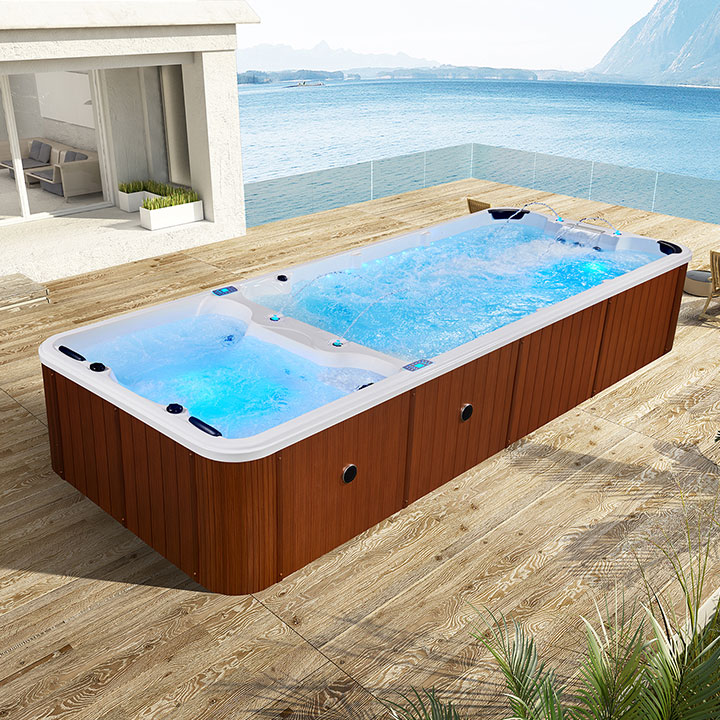
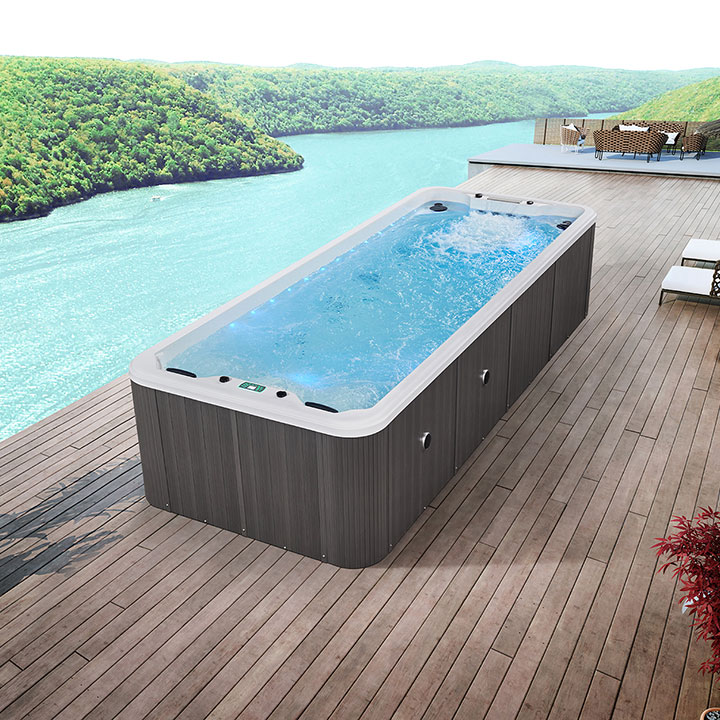
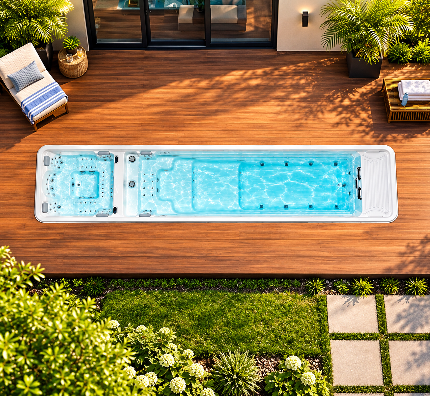
Victoria Star Swim Spa offers the perfect balance between exercise and relaxation, whether you want to swim for fitness or relax in the spacious seating.
Victoria Star Swim Spa offers the perfect balance between exercise and relaxation, whether you want to swim for fitness or relax in the spacious seating.