Building Your Own DIY Swim Spa: What Actually Goes Into the Decision
Home / News / Building Your Own DIY Swim Spa: What Actually Goes Into the Decision
September 29, 2026
Searching for a diy swim spa usually starts with a simple question: can you actually build one yourself, or is buying a manufactured unit the smarter move? The honest answer sits somewhere in between, and it depends heavily on what you’re trying to get out of the water in the first place.
Why "DIY" Means Different Things to Different Buyers
The term diy swim spa gets used loosely online. For some people, it means pouring concrete and plumbing their own pump system from scratch. For others, it means buying a self-contained unit and handling the site prep, electrical hookup, and installation themselves. These are very different projects with very different risk profiles.
A fully scratch-built swim spa demands structural engineering knowledge, watertight construction skills, and an understanding of hydraulic pump sizing. Get any of those wrong and you end up with cracked shells, leaking seams, or a pump that can’t push enough water to create a usable current. That’s not a weekend project for most homeowners.
The more realistic version of DIY, and the one most people actually pursue, involves purchasing a pre-engineered swim spa shell and self-installing it on a prepared pad. You still handle the labor and logistics, but you’re not reinventing the plumbing or guessing at structural loads.
What a Pre-Engineered Shell Solves for You
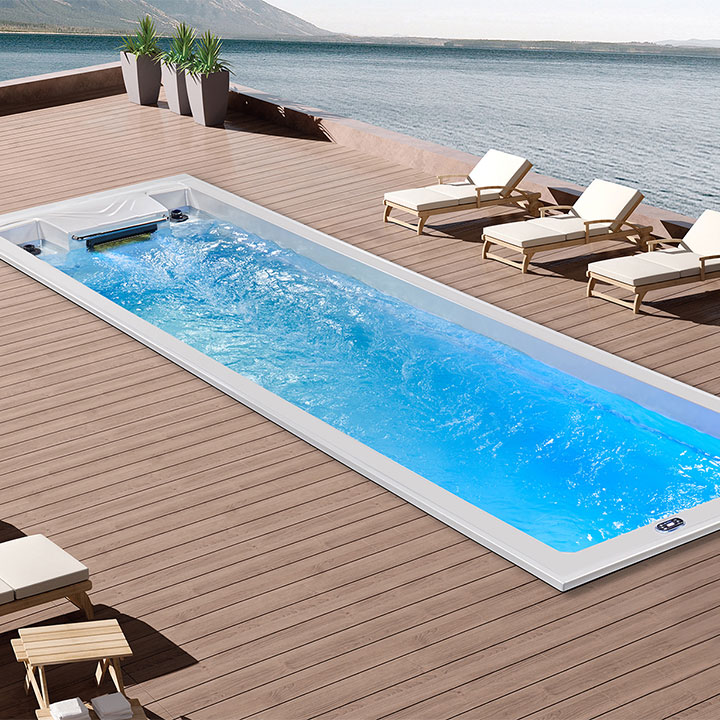
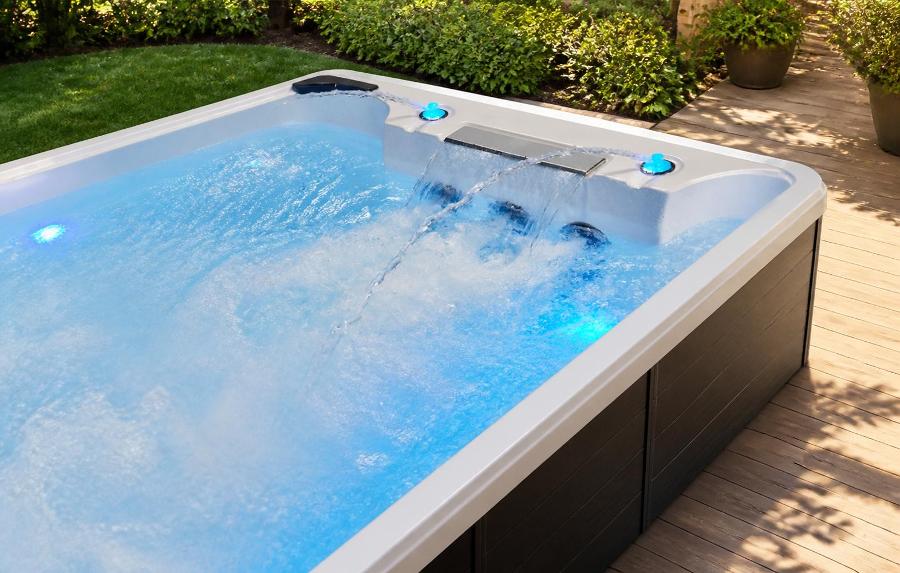
Counter-current swimming only works if the water flow is strong enough and even enough to simulate a real swim lane. This is where most true DIY builds fall apart, because achieving consistent flow across a five or six meter span takes real pump engineering, not just a powerful motor bolted to the side.
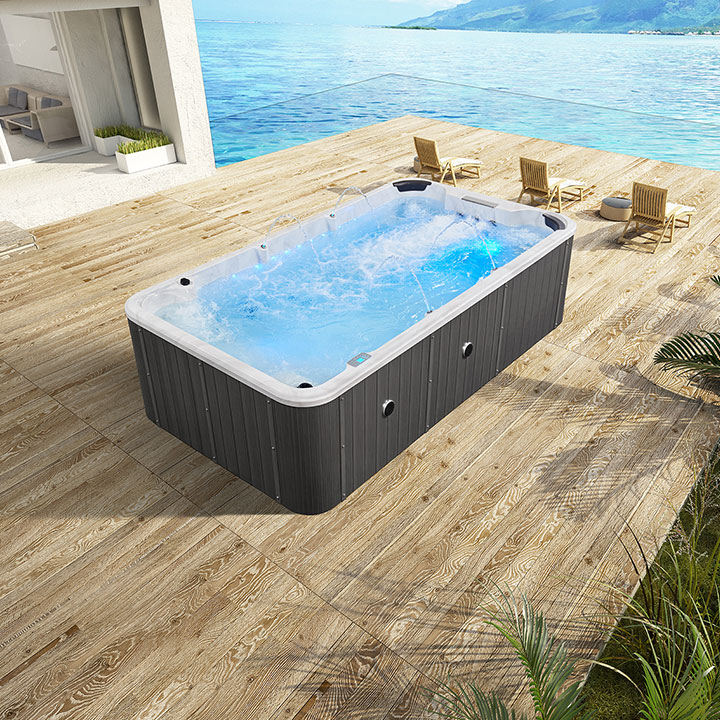
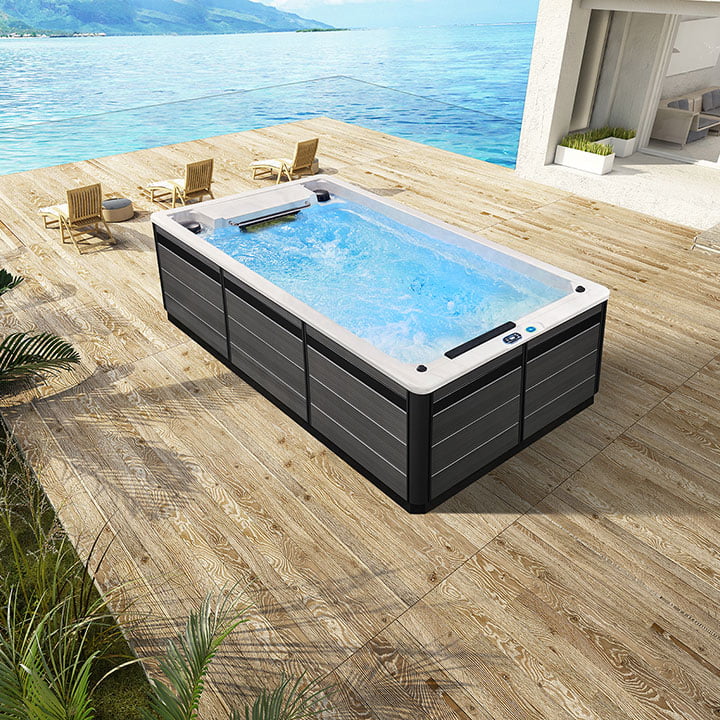
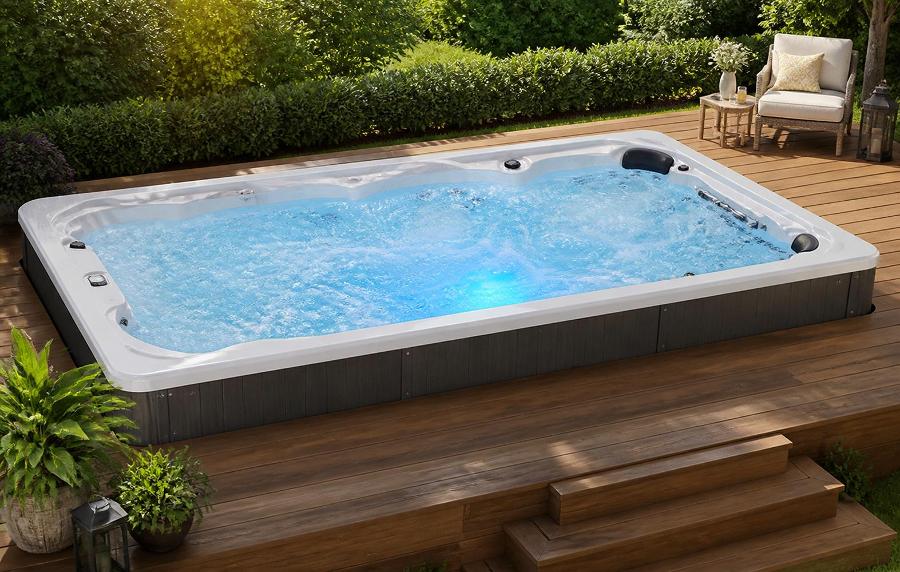
Take the M-503 Above Ground Backyard Swim Spa as a reference point. According to its product specifications, it runs three 3 HP water pumps to generate multi-speed counter-current flow across a 5,800 mm length, paired with 48 jets positioned for muscle recovery rather than just general bubbling. Replicating that kind of balanced output with mismatched aftermarket parts is a genuine engineering problem, not a minor inconvenience.
That’s the practical tradeoff. You can DIY the siting, the deck, the electrical run to a disconnect box, and the surrounding landscaping. The hydraulic core, the part that actually makes swim training feel like swim training, is better left to equipment that’s already been engineered as a system.
Site Prep: The Part You Can Genuinely DIY
Where self-installation makes the most sense is everything outside the shell itself. This is the labor-intensive stage where doing it yourself saves real money without introducing structural risk.
Confirm ground load capacity, since a filled swim spa of this size holds around 7,890 liters of water plus the shell weight.
Pour or level a reinforced pad, whether concrete, compacted gravel, or a reinforced deck rated for the combined weight.
Run dedicated electrical service to the unit’s disconnect, sized for the total power draw.
Plan drainage around the pad so runoff and winter drain-downs don’t pool near the foundation.
Coordinate final placement and hookup with a licensed electrician for the permanent connection.
Skipping the engineering guesswork on the shell while still owning the site work is, in practice, the version of diy swim spa most homeowners land on. It’s a fair split of labor and liability.
Power and Heating Requirements You Shouldn’t Underestimate
One mistake self-installers make is assuming a swim spa draws power like a standard hot tub. It doesn’t. The M-503, for example, is specified with a 13.35 KW power supply to handle dual 3,000 watt heaters, three 3 HP pumps, and a 1 HP circulation pump.
That’s a meaningfully larger electrical load than a typical hot tub, and it changes what your panel and disconnect need to support. Underestimating this is a common reason DIY installs stall out mid-project, waiting on an electrician to correct undersized wiring.
Component
Spec (M-503)
Why It Matters for DIY Planning
Power Supply
13.35 KW
Determines panel capacity and wire gauge needed
Heaters
2 x 3,000 W
Runs continuously to maintain set temperature
Water Pumps
3 x 3 HP
Drives counter-current swim flow
Circulation Pump
1 x 1 HP
Keeps filtration and ozone system active
Water Capacity
7,890 Liters
Impacts pad load rating and fill/drain logistics
Water Quality Isn’t Something to Improvise
Filtration is another area where cutting corners backfires quickly. A swim spa holds thousands of liters of standing water that needs constant, reliable sanitation, not an occasional shock treatment. The M-503 addresses this with multi-stage filtration paired with ozone sterilization, which the product specifications describe as reducing how often you’re manually dosing chemicals to keep water clear.
If you’re building or specifying your own filtration loop, ozone systems and multi-stage filters aren’t optional extras, they’re what keeps a large water volume from turning cloudy or odorous within days. Skimping here doesn’t save money long term, it just shifts the cost into more frequent chemical purchases and water changes.
Jet Placement Matters More Than Jet Count
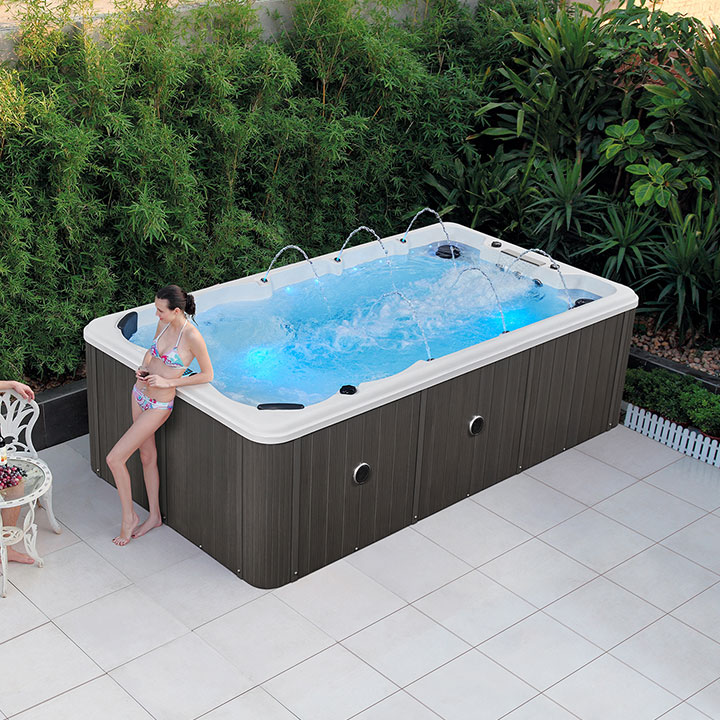
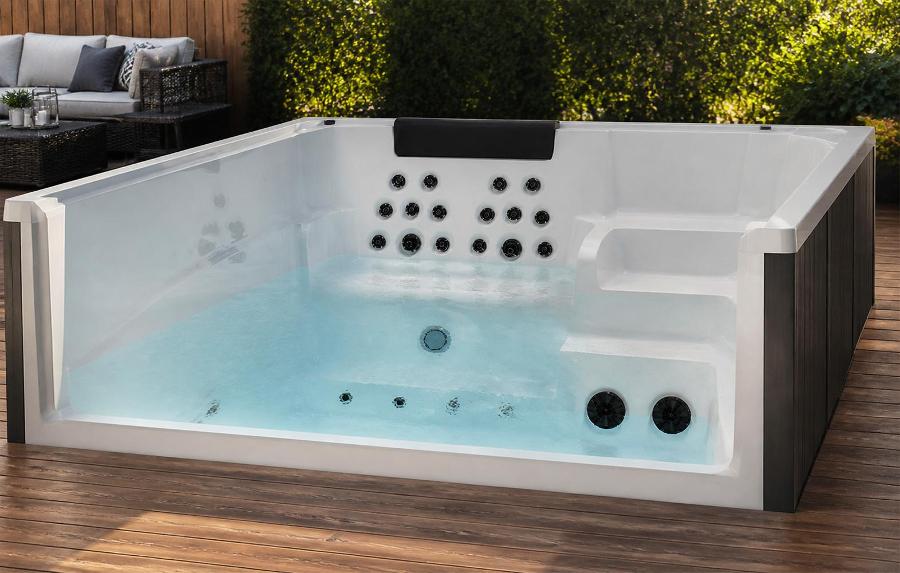
It’s tempting to judge a swim spa by raw jet count, but placement determines whether hydrotherapy actually relieves anything. The M-503’s 48 jets are positioned to target the back and legs specifically, addressing the muscle groups most strained by counter-current swimming itself.
This is a useful principle for anyone comparing swim spa options: a higher jet count scattered without regard to seating position delivers less real benefit than a smaller number of jets aimed at pressure points people actually use during recovery. Two dedicated ergonomic seats with targeted jet clusters will usually outperform a crowded layout with no clear zones.
Controls, Lighting, and the Realistic Cost of Convenience
Touchscreen controls like the KL2020BT system found on the M-503 handle water temperature, jet speed, and lighting mode from a single interface. For a self-installed unit, this matters because it removes a layer of custom wiring and programming that would otherwise fall on the installer.
Multi-color LED lighting, both underwater and along the perimeter, is often dismissed as a cosmetic feature, but it has a practical function too. Soft, controllable brightness makes evening use safer by improving visibility around the rim and steps, which is worth factoring in if your swim spa sits on a deck away from exterior lighting.
Sizing the Unit to Your Actual Use Case
Before finalizing any diy swim spa plan, be honest about how the space will get used day to day. A unit built for serious lap training needs a longer, uninterrupted swim lane, while a household focused mainly on relaxation might prioritize seating and jet zones over swim length.
If continuous cardio training is the priority, look for a longer swim lane with strong, multi-speed current output.
If muscle recovery after workouts matters more, prioritize jet placement and seating ergonomics over raw pool length.
If evening or family use is common, factor in lighting control and safe visibility around the water’s edge.
If you’re limited on space, measure your pad footprint against full external dimensions, not just quoted interior length.
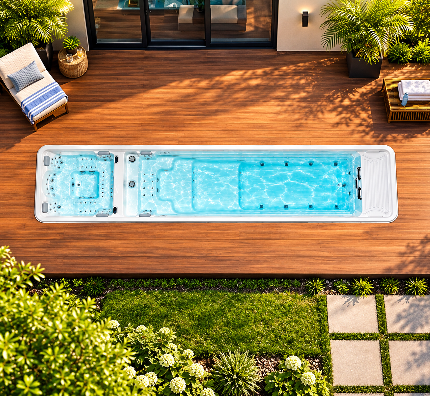
The M-503, at 5,800 mm by 2,200 mm with a two-seat hydrotherapy zone, is built around exactly this dual-purpose use case: a genuine swim lane on one end, dedicated recovery seating on the other.
Frequently Asked Questions
Can I build a fully functional swim spa from scratch without engineering experience? It’s technically possible but risky. Structural failures, leaks, and underpowered pump systems are common outcomes when the hydraulic and structural engineering isn’t handled by people with direct experience in it.
What’s the most realistic form of DIY for most homeowners? Buying a pre-engineered shell and self-installing the site prep, electrical run, and surrounding structure. You keep the labor savings without taking on the engineering risk.
Do swim spas need different electrical service than hot tubs? Often, yes. Multiple high-output pumps and dual heaters can draw considerably more power than a standard hot tub, so panel capacity and wiring need to be sized according to the specific unit’s requirements, not assumed to match a typical hot tub circuit.
Does a higher jet count always mean better hydrotherapy? Not necessarily. Jet placement relative to seating position matters more than the total number, since poorly positioned jets deliver less targeted relief.
Getting the Balance Right
The most sustainable version of a diy swim spa project isn’t about avoiding professional engineering altogether, it’s about knowing which parts of the build genuinely benefit from your own labor and which parts need to be handled as a pre-engineered system. Site prep, electrical coordination, and deck construction are fair game for hands-on homeowners. The pump hydraulics, filtration, and structural shell are where pre-built units like the M-503 earn their keep, delivering the counter-current strength and water clarity that a scratch build would struggle to match. For us at Victoria Star, that’s the balance we design toward: giving people a real diy swim spa experience on the installation side, without asking them to gamble on the engineering underneath it.
Victoria Star Swim Spa offers the perfect balance between exercise and relaxation, whether you want to swim for fitness or relax in the spacious seating.
Victoria Star Swim Spa offers the perfect balance between exercise and relaxation, whether you want to swim for fitness or relax in the spacious seating.