Best Swim Spa Covers: How to Choose the Right Fit, Insulation, and Operating System
Home / News / Best Swim Spa Covers: How to Choose the Right Fit, Insulation, and Operating System
November 06, 2026
Finding the best swim spa covers requires balancing thermodynamic efficiency, structural integrity, and daily physical usability. Unlike compact hot tubs, swim spas present vast open water surfaces where evaporative cooling and thermal radiant loss accelerate rapidly. A poorly fitted cover turns your fitness investment into an expensive outdoor heater that drains power continuously. Selecting the best swim spa covers ensures long-term heat retention, prevents debris accumulation, and keeps running costs manageable across changing seasons.
Investing in proper protection also safeguards water sanitation chemistry from intense sun exposure. Atmospheric moisture loss accounts for the vast majority of heat dissipation in residential aquatic vessels. Without an airtight thermal barrier, constant evaporation forces heaters and chemical dosing systems to run in overdrive. Examining core densities, vapor barrier seals, and lifter mechanisms allows owners to make decisions grounded in measurable performance rather than vague marketing promises.
Core Engineering Factors: What Defines the Best Swim Spa Covers?
Evaporative Heat Loss and Vapor Barrier Seals
Water absorbs significant amounts of thermal energy to change phase from liquid to gas. When a swim spa remains unsealed, ambient air currents continuously strip heat away through surface evaporation. A well-engineered cover stops this latent heat transfer by creating an airtight envelope across the entire acrylic shell.
Moisture ingress into the cover core itself presents a major technical challenge. When warm vapor penetrates the internal foam, the insulation quickly degrades and the assembly gains excessive weight. High-grade covers combat this issue with multi-layer chemical vapor wraps, using vacuum-sealed polyethylene sheeting around each foam panel to prevent waterlogging.
Foam Core Rigidity and Snow Load Deflection
Structural support depends directly on the core material composition. High-density expanded polystyrene (EPS) foam panels provide the baseline rigidity required to span large acrylic openings without sagging under dynamic weight. Buyers should inspect the manufacturer’s written density ratings and load limits rather than assuming all foam blanks provide identical structural strength.
Flat covers inevitably collect standing water, which accelerates vinyl stretching and internal foam bowing over time. To ensure efficient runoff, covers require a cross-sectional slope that directs water toward the shell edge. Buyers should verify specific taper dimensions with the fabricator to confirm the pitch matches their local rainfall and winter snow conditions.
Operational Usability and Physical Weight Limits
Even high-insulation covers offer little value if their physical weight discourages daily use. Large-format covers can weigh over one hundred pounds when assembled, turning routine swim training into an exhausting two-person chore. Physical fatigue frequently tempts owners to leave covers unlatched or misaligned, which destroys thermal efficiency.
Selecting a system that matches physical capability is just as important as evaluating insulation values. Whether incorporating pneumatic lifter arms, rolling track assemblies, or integrated automated lifts, the operational system directly determines how often the spa is opened and enjoyed.
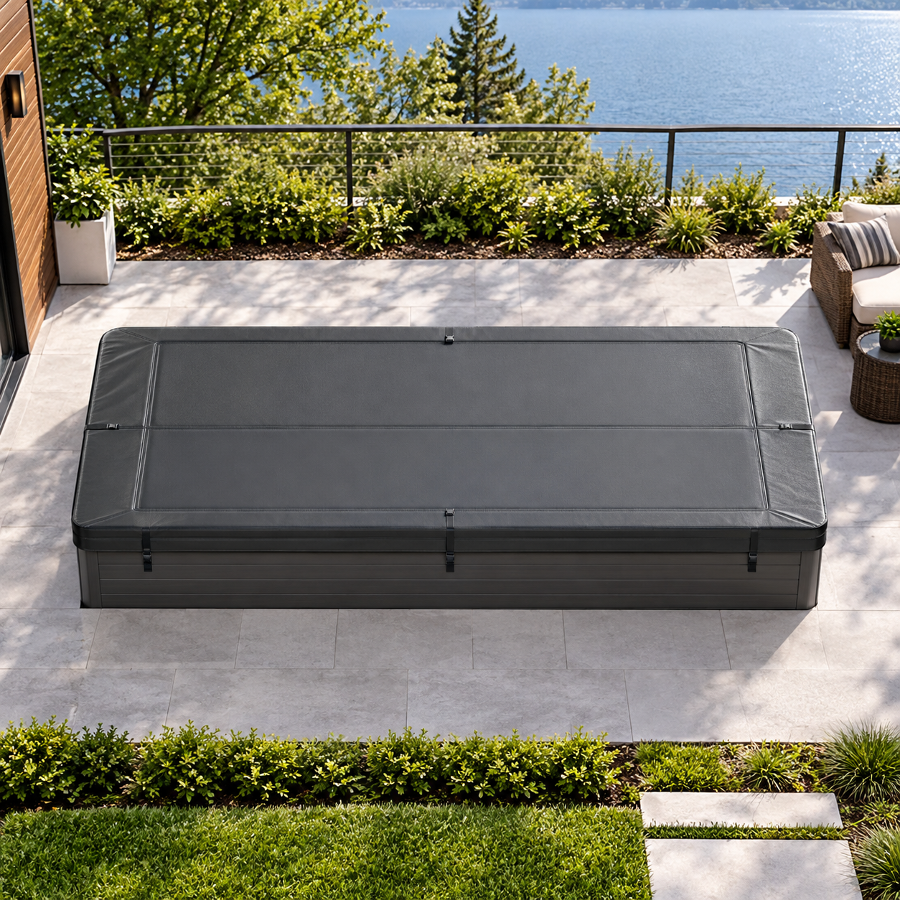
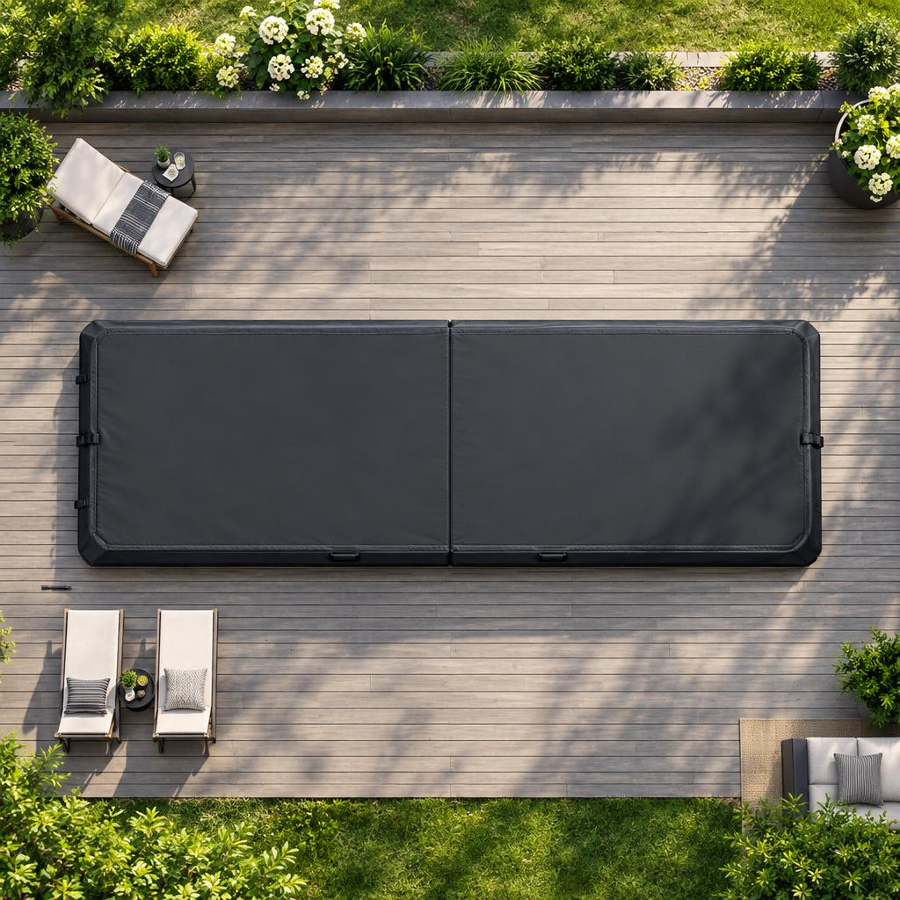
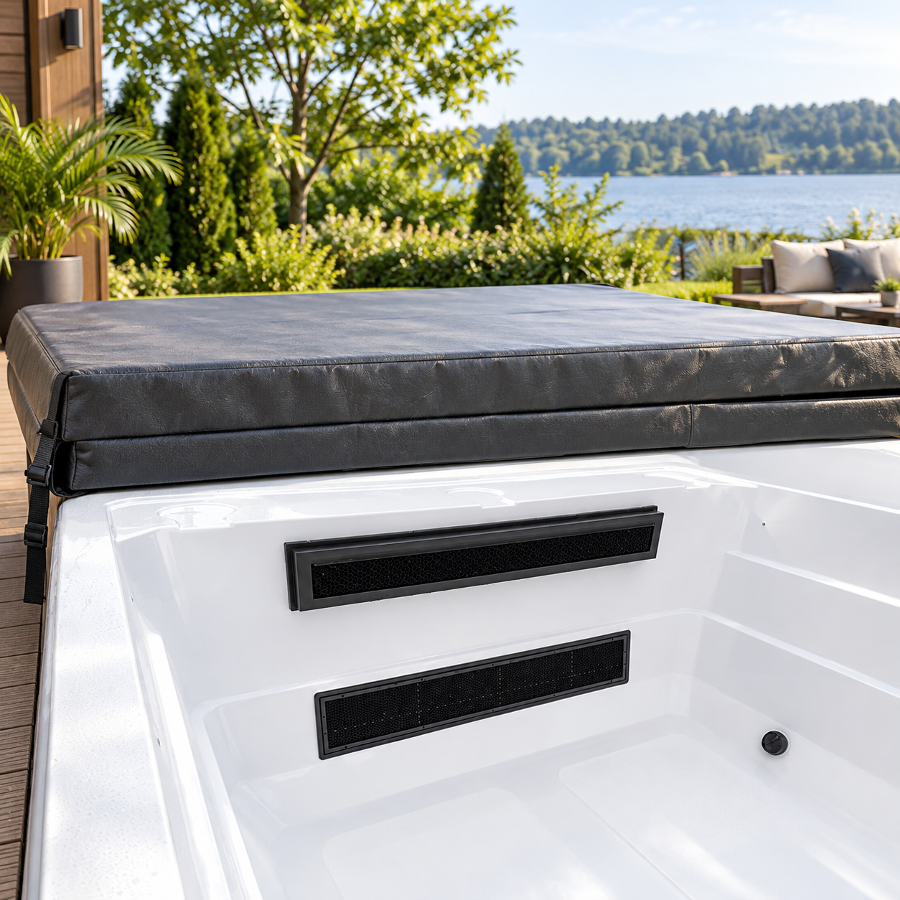
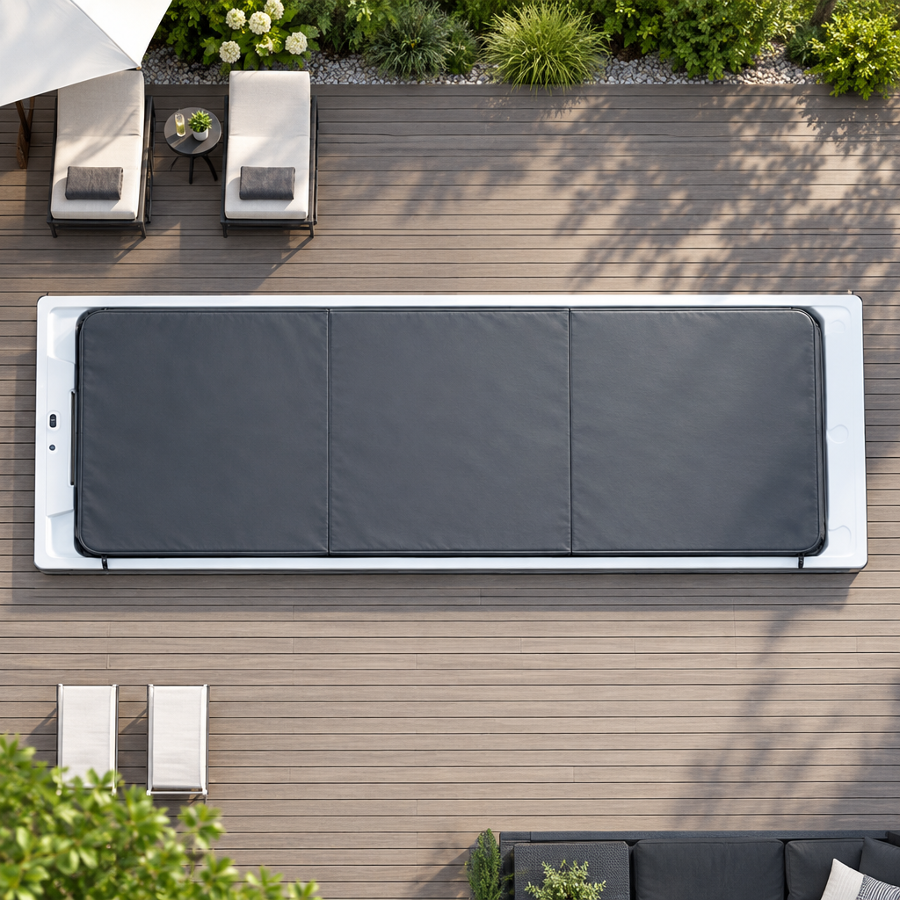
Traditional folding covers divide the swim spa length into three, four, or five hinged segments. Each section features tapered EPS foam encased inside heat-sealed vapor barriers and an exterior marine vinyl skin. This segmented layout allows owners to uncover only the hydrotherapy end during short soaking sessions while keeping the main swim tank insulated.
Handling multiple thick panels manually across a twelve-to-twenty-foot shell requires steady physical effort. Hinge joints and center seams create potential thermal escape gaps if the sealing gaskets fail to compress tightly against the acrylic rim. Installing dual mechanical side lifters assists in folding these large panels, though users still need adequate side clearance along the surrounding deck.
Automated and Mechanical Lifting Systems
Mechanical lifting systems replace manual handling by incorporating motorized drives, hydraulic assemblies, or track mechanisms into the cover structure. Depending on the engineering design, the system elevates vertically or slides clear of the swim lane when activated. The actual perimeter seal, drive mechanics, and control interfaces vary significantly across brands and require close review of written specifications.
Mechanical covers involve higher initial investment and require dedicated installation planning around cabinet access panels. Power supplies and structural mounting points must be planned alongside the swim spa foundation. For expansive, commercial-grade swim vessels, automated covers represent a practical design solution that prevents daily operational friction.
Roll-Up Rigid Slatted Covers
Roll-up covers utilize continuous fabrics reinforced with transverse structural ribs made from aluminum or composite channels. Rather than folding bulky blocks upward, a single user can roll the assembly along the rim like a flexible mat. This design creates a low, streamlined profile that preserves open backyard sightlines.
Because rolling covers rely on specific foam layers to roll compactly, their overall insulating R-value varies by design. The continuous outer fabric demands strict maintenance to prevent debris from catching inside the seams during roll-up operation. Buyers should verify the specific heat retention performance of a slatted cover against their climate needs.
Cover System Type
Primary Insulation Mechanism
Ease of Daily Operation
Typical Footprint & Clearance Needs
Maintenance Focus
Multi-Panel Folding
Tapered EPS Foam (specifications vary)
Manual effort required (often 2 people)
Requires 18–24 inches side/end pivot clearance
Vinyl seam conditioning & vapor bag inspection
Automated Lifting
Integrated rigid shell (specs vary)
Automated operation (drive design varies)
Requires fixed vertical or end-roller space
Mechanical guides, wiring, and actuator hardware
Roll-Up Slatted
Composite/Ribbed design (specs vary)
Easy single-person rolling motion
Compact roll stored at one narrow spa end
Track cleanliness, hinge cleaning, UV protection
Floating Thermal Blanket
Polyethylene bubble sheet
Manual placement under main cover
Sits directly on water; zero deck footprint
Rinsing chemical residue & drying storage
Floating Thermal Blankets as Secondary Protection
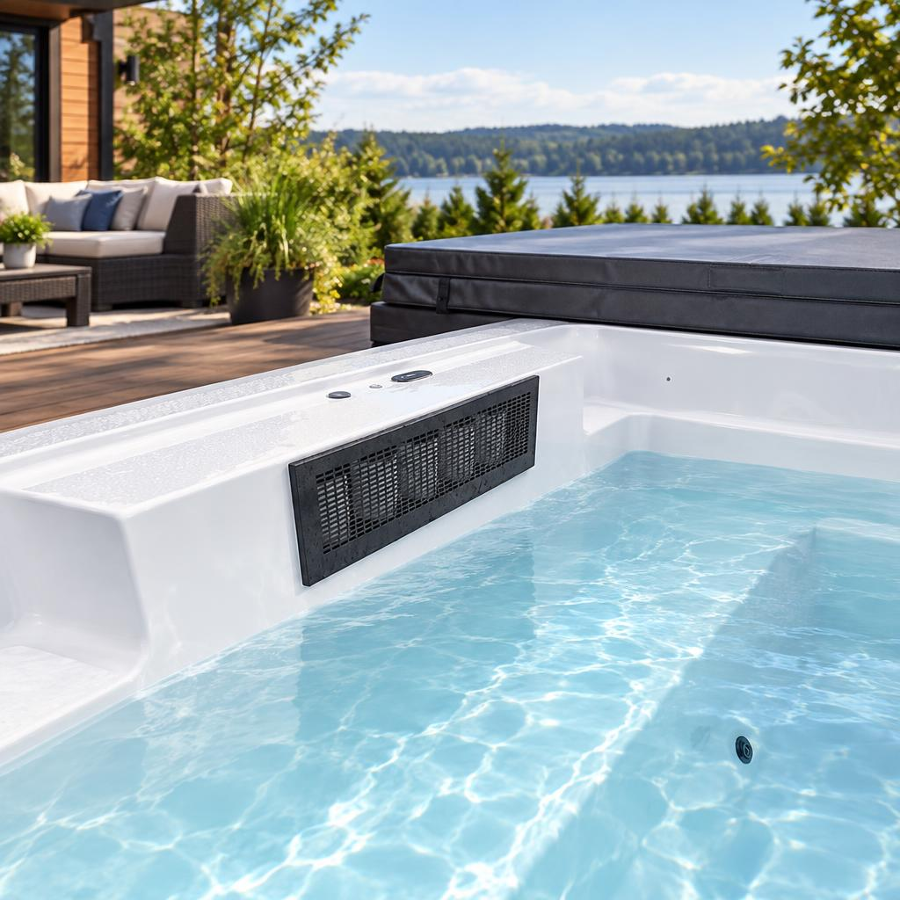
Floating blankets rest directly upon the water surface beneath the structural hard cover. Constructed from closed-cell polyethylene foam or chemical-resistant bubble material, they establish an immediate barrier against water vapor. Placing this sheet across the water line can reduce moisture evaporation before vapor contacts the underside of the main exterior cover.
Adding an internal vapor barrier can help limit the volume of chemical vapor and condensation reaching the primary cover’s undersurface. While overall performance depends heavily on water chemistry, perimeter fit, and ambient temperature, keeping moisture off the main lid helps reduce moisture accumulation inside internal panels over time.
Material Selection and Internal Reinforcement
Marine-Grade Vinyl versus Solution-Dyed Woven Polyester
Outer fabrics endure relentless sun exposure, driving rain, and sub-zero temperatures. Marine-grade vinyl coated with mildew inhibitors and UV stabilizers has served as the conventional standard for decades. It resists surface staining and wipes down easily, though intense solar radiation can leach its plasticizers over time, causing hardening and cracking.
Solution-dyed woven polyester has emerged as a resilient alternative to vinyl skins. Because the pigments are introduced into the polymer solution prior to fiber extrusion, the colored fibers resist fading under prolonged sun exposure. Tear strength and weather resistance still vary based on base fiber denier, backing films, and protective surface treatments.
Foam Encapsulation and Moisture Barrier Layers
Water saturation destroys insulation values. When moisture displaces air cells inside expanded polystyrene foam, the material’s thermal resistance drops significantly. The weight of saturated panels can also warp structural framework and overstrain cabinet lifter joints.
To prevent water absorption, quality covers vacuum-seal the core inside an impermeable film envelope. Leading fabricators use thick polyethylene barriers bonded with commercial heat-welded seams, avoiding taped edges that separate in chlorinated steam. Bottom grommets vent residual condensation, preventing internal condensation buildup.
Internal Reinforcement and Structural Bracing
Broad structural spans require reinforcement to help prevent sagging under snow loads and heavy precipitation. Many manufacturers insert metal channels, such as aluminum or galvanized steel sections, along the hinge lines or panel edges to increase longitudinal rigidity. Buyers must verify the specific bracing materials and rated load capacities directly with the cover fabricator.
Unreinforced foam blocks eventually deflect downward under continuous weathering and rain accumulation. Once a center seam dips below horizontal, water gathers in the depression, creating a structural sinkhole that strains seams and breaks the perimeter thermal seal.
The central hinge connecting folding sections represents an area prone to conductive and convective heat leakage. As warm air rises toward the top of the vessel, unsealed gaps along the fold line allow thermal energy to escape into the surrounding atmosphere. Many manufacturers address this issue by incorporating continuous insulated draft pads or sealing gaskets along the hinge.
When closed, a continuous hinge seal helps bridge the seam gap and limit air exchange. Around the exterior, perimeter skirts drape over the acrylic rim to shield the acrylic edge from direct sun exposure and reduce drafts along the lip. Buyers should confirm whether a selected cover includes full-length hinge pillows or only end-stop pads.
Barrier Safety Protocols and Operational Code Compliance
ASTM Safety Performance Standards
Owners should not assume a cover meets safety requirements based solely on its appearance, decorative style, or marketing claims. ASTM F1346 establishes standard performance specifications and labeling requirements for pool and spa safety covers, distinguishing certified equipment from basic thermal or dust blankets.
ASTM F1346 establishes standard performance specifications, including:
Static Load Resistance: Under ASTM F1346-23, covers for vessels with a width or diameter greater than 8 feet must be subjected to a 485-pound static test load; smaller vessels are evaluated using a 275-pound static load. This load requirement is associated with the weight of two adults and a child to verify structural integrity.
Perimeter Deflection Resistance: Cover perimeter edges must resist deflection tests to prevent openings that would allow a test object to pass into the water.
Fastening Hardware Security: Fastening mechanisms must secure the cover firmly to the structure and remain anchored under specified testing protocols to deter unauthorized opening.
Buyers should always consult current standard publications and request the manufacturer’s testing documentation to confirm compliance for their specific model.
Comprehensive Backyard Safety and Perimeter Control
A certified safety cover functions as one protective layer within a broader backyard safety plan. Public health agencies and pool safety organizations emphasize that physical barriers work best as part of a redundant protection system. Relying solely on a fabric cover without surrounding isolation gates introduces unnecessary risk.
Self-closing and self-latching perimeter gates, perimeter boundary fences, and functional water surface alarms must work alongside secure cover hardware. Whenever the swim vessel sits uncovered for cooling or chemical venting, active adult supervision remains the only acceptable defense against accidental immersion.
Tie-Down Anchors and High-Wind Securing Systems
Expansive cover panels act like sails when exposed to strong open-ground winds. Sudden storm gusts can lift unsecured panels, shattering internal foam cores, bending metal lifter hinges, or damaging adjacent patio structures. Installing dependable tie-down hardware protects both the cover and the spa itself.
Keyed locking latches should be screwed directly into the structural wooden or aluminum cabinet studs rather than thin decorative cladding panels. In coastal or plains areas prone to high winds, secondary tie-down storm straps routed completely across the cover’s structural spine provide essential reinforcement against sudden wind uplift.
Precision Sizing and Ordering Measurements
Obtaining Accurate Cover Templates
Ordering a custom swim spa cover requires precise measurements tailored to the specific vessel. A common error involves assuming a universal measurement method or measuring the external wooden cabinet rather than the acrylic tub shell. Covers must sit firmly on the flat horizontal acrylic lip to compress the bottom perimeter vapor gasket.
Buyers should first request the measurement guide or template directly from the swim spa manufacturer or the cover fabricator. These documents define the exact baseline for the shell, corner radii, and perimeter offsets required for a proper fit.
Most modern swim spas feature rounded corners to balance structural pressure and improve hydrodynamic manufacturing. Matching this corner curvature is critical for ensuring a snug thermal seal around the entire perimeter.
Position a carpenter’s framing square flush against the corner of the swim spa shell rim.
Note the point on the ruler where the curving acrylic edge starts to break away from the straight leg of the square.
Read the measurement from the corner of the framing square to this initial contact point; this distance represents the precise corner radius.
If uncertain between two dimensions, confirm the corner radius with the manufacturer’s technical team before finalizing an order.
Planning Setback Clearances for Lifting Systems
Physical clearance constraints dictate which lifter design will work on a given installation. Mechanical pivot-arm lifters swing outward and hold folded panels vertically along the end or sides of the spa, demanding significant unobstructed deck clearance.
Before ordering, measure clearance around all sides of your foundation pad. In-deck or flush pit installations introduce unique clearance challenges, as standard side-mounted swing arms cannot clear perimeter floor joists without specialized recessed mounting brackets.
Large-Format Case Example: The Victoria Star VS-GT1202
Dimensional Demands of an 11.7-Meter Integrated Acrylic Vessel
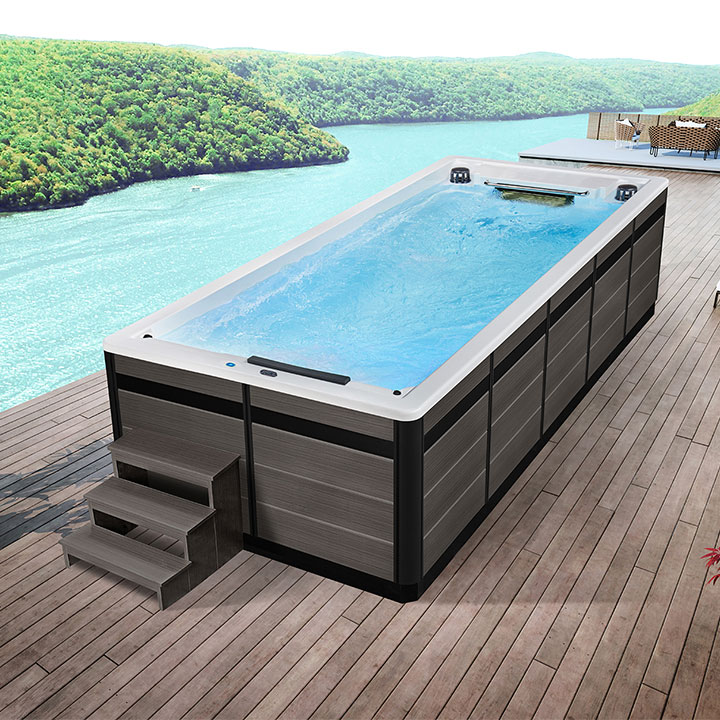
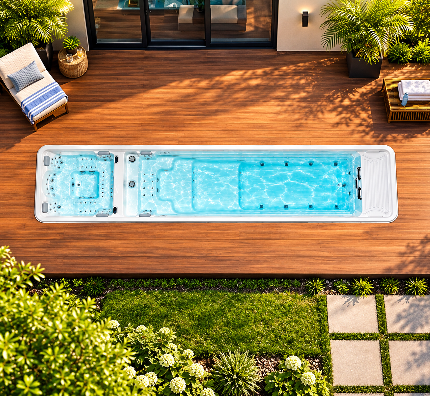
Handling covers on standard four-meter swim spas is relatively straightforward, but large luxury fitness vessels present unique structural challenges. The Victoria Star VS-GT1202 illustrates the scale involved: measuring 11,700 × 3,800 × 1,550 mm (approximately 38′ × 149" × 61"), this vessel demands substantial structural coverage.
Spanning nearly twelve meters in length and almost four meters across, this expansive porcelain-finish acrylic layout accommodates both serious athletic workouts and social relaxation. A vessel of this scale requires dedicated engineering to retain heat efficiently. The shell is insulated with polyurethane (PU) foam backing to minimize conductive heat loss through the cabinet walls, which places the burden of stopping surface evaporation directly on the cover system.
For an aquatic system of this size, relying on traditional manual bi-fold panels is practically impossible. Handling multiple separate vinyl sections across an 11.7-meter span creates substantial operational friction that can discourage regular fitness workouts.
Victoria Star VS-GT1202 Specifications:
  Length:       11,700 mm (approx. 38 ft)
  Width:        3,800 mm (approx. 149 in)
  Depth:        1,550 mm (approx. 61 in)
  Shell:        Porcelain Acrylic with PU Insulation
  Cover System: Optional Automated Lifting Pool Cover
Optional Automated Lifting Cover Implementation
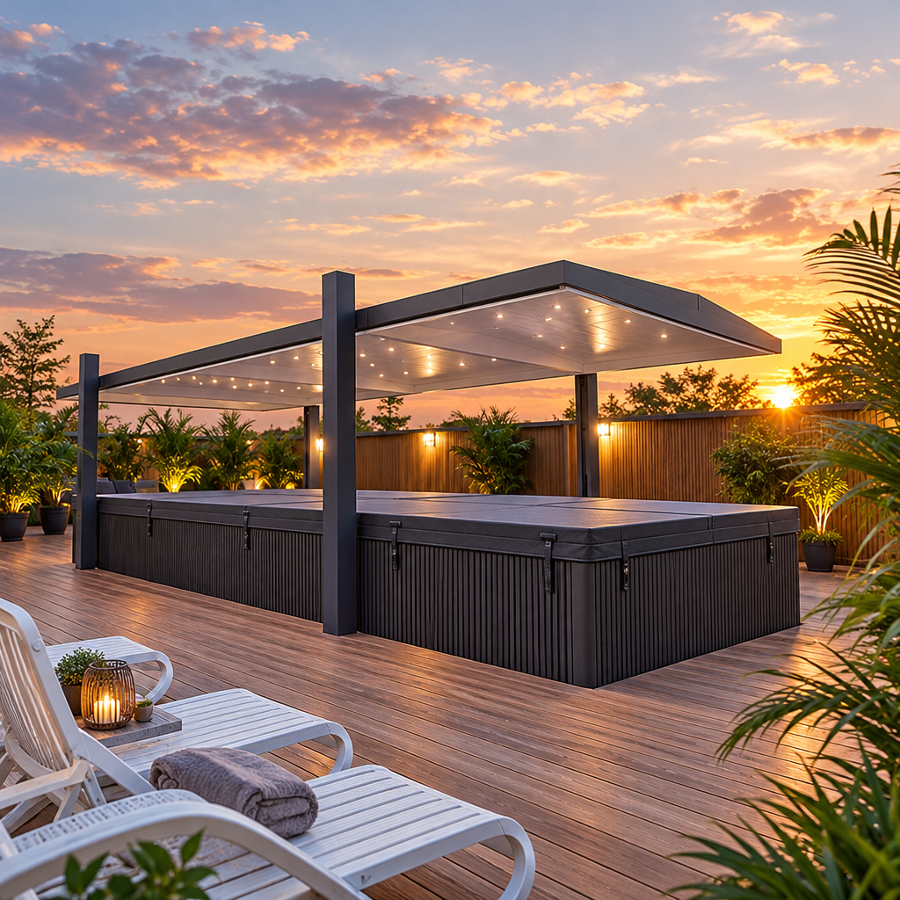
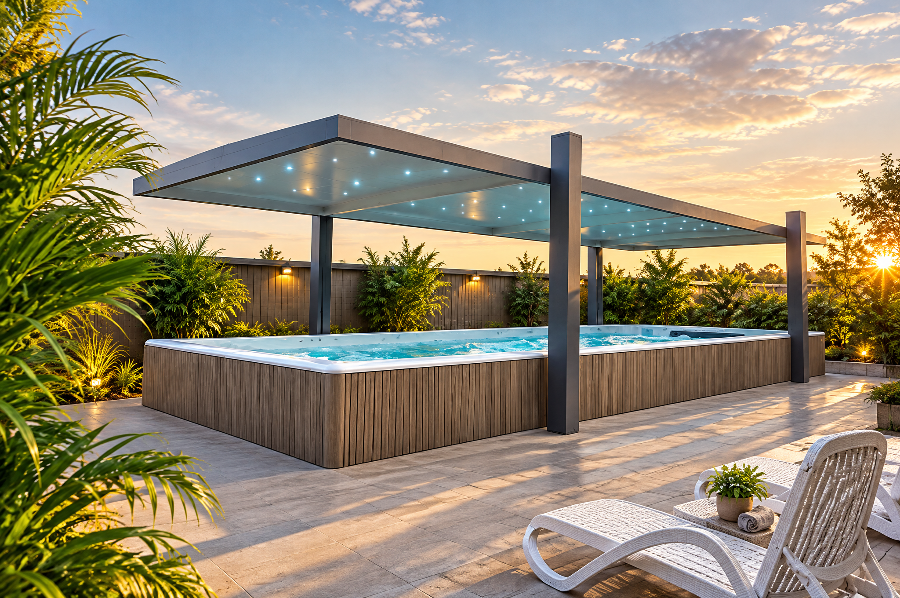
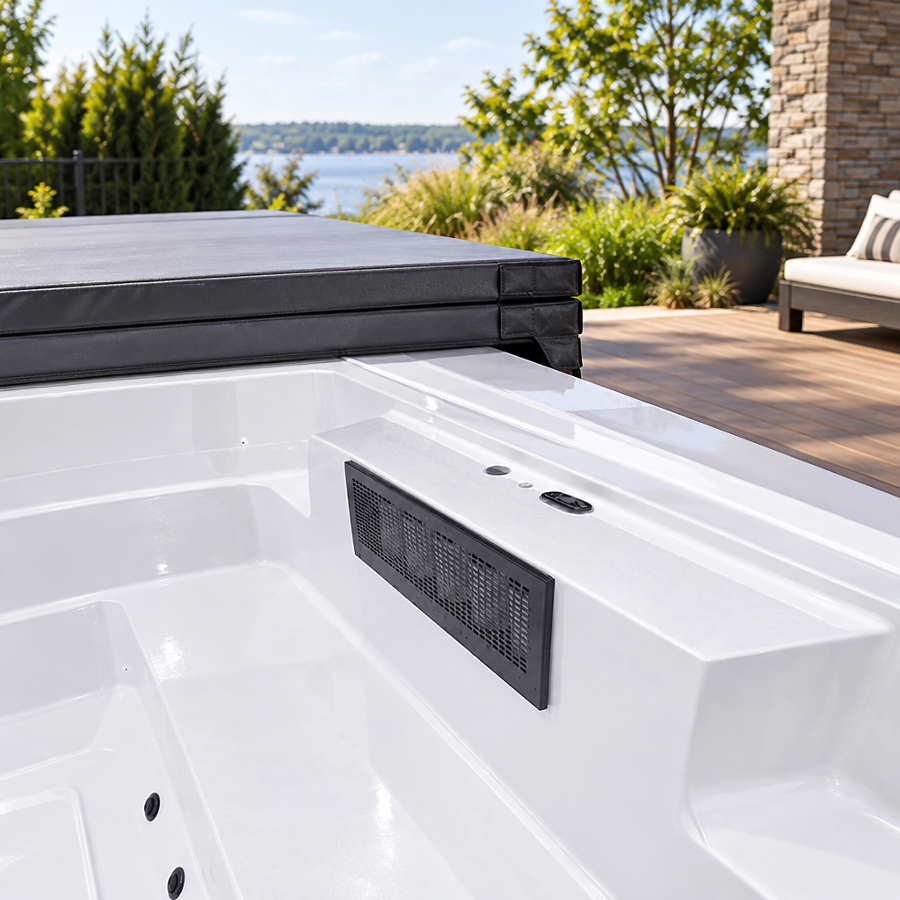
To manage the physical footprint of an 11.7-meter vessel, the VS-GT1202 can be specified with an automated lifting pool cover as a factory option. According to the manufacturer’s technical specifications, this automated cover system is engineered to reduce water evaporation, minimize thermal loss, and shield the open vessel from environmental debris and solar UV radiation.
Incorporating an automated lifting mechanism eliminates the strain of handling massive multi-panel covers manually. By establishing a physical barrier over the expansive water surface when closed, the system simplifies operation for users who opt for this configuration.
Factory Specifications and System Coordination
Large swim spas rely on coordinated mechanical systems to maintain consistent water temperature and sanitation. The optional automated cover works in tandem with the Always Clean Water multi-stage sanitation assembly, which combines ozone disinfection, UV treatment, filter cartridges, and sand filtration.
Covering the pool tightly when idle shields the water from windborne dirt, fallen leaves, and solar UV exposure. While shielding the surface helps keep organic debris out of the basin, it remains an accompaniment to, rather than a replacement for, scheduled water testing and chemical sanitization. At Victoria Star, a brand developed by Foshan Gaoming Shiyi Sanitary Ware Technology Co., Ltd., manufacturing processes combine hydrotherapy technology with precision forming to deliver reliable high-end wellness systems.
Maintenance, Care, and Replacement Indicators
Chemical Off-Gassing and Venting Procedures
Corrosive chemical off-gassing causes premature cover failure far more often than direct sunlight. When chlorine, bromine, or non-chlorine shock oxidizers are added to warm water, high concentrations of caustic chemical vapors collect directly beneath the cover lid.
Trapped acidic condensation attacks the protective scrim fabrics, degrades plastic vapor barriers, and corrodes metal reinforcing channels. To extend the life of your cover, owners should follow the instructions provided by their spa manufacturer, cover fabricator, and chemical supplier regarding proper ventilation and cleaning frequencies.
Identifying Foam Waterlogging and Structural Failure
Even well-maintained swim spa covers experience wear over years of environmental exposure. Recognizing warning signs of degradation allows you to replace a failing cover before excessive heat loss inflates utility bills.
The cover becomes excessively heavy: When the internal polyethylene vapor wrapper tears, open-cell foam pockets absorb water vapor like a sponge. A panel that suddenly feels twice its original weight is saturated and has lost its thermal resistance.
Standing water puddles along the center seam: If rainwater pools rather than draining off the tapered edge, the internal structural support has bent or the EPS foam core has suffered structural compression.
Cracking or brittle vinyl surfaces: Outer fabrics that feel stiff, brittle, or split along stress seams expose internal insulation to rain and environmental degradation.
Strong chemical or mold odors emanating from the foam: A sour or musty smell indicates mildew is colonizing damp internal foam, which compromises both hygiene and structural integrity.
Symptom: Panel Feels Extremely Heavy
  └── Diagnosis: Vapor barrier failure → EPS foam waterlogging
        └── Consequence: Lost insulation value & excessive lifter strain

Symptom: Water Puddles Along Center Ridge
  └── Diagnosis: Structural spine deflection or foam core sagging
        └── Consequence: Ongoing water retention & accelerated seam failure

Symptom: Brittle, Splitting Vinyl Surfaces
  └── Diagnosis: Long-term UV plasticizer loss
        └── Consequence: Outer membrane tearing & water ingress
Frequently Asked Questions
Are swim spa covers manufactured in universal, standard sizes?
No, swim spa covers are rarely cross-compatible between different manufacturers. Because swim spa outer dimensions, corner radii, and perimeter skimmer heights vary across brands, a generic off-the-shelf cover will rarely provide an airtight fit. Choosing custom-fabricated covers built to exact shell dimensions ensures the perimeter gaskets seal tight against the acrylic rim to prevent heat leakage.
How much thermal energy escapes through an uninsulated swim spa?
Energy agency evaluations of open heated pools estimate that surface evaporation accounts for roughly 70% of total heat loss, with radiant and convective losses accounting for the remainder. While exact thermal loss rates in swim spas depend heavily on water temperature, ambient wind, surface area, and local climate, exposed warm water steadily loses heat to surrounding air. Installing an insulated barrier restricts this evaporative exchange, helping keep operating demands on the heating equipment lower than leaving the water open to the elements.
Can a single adult realistically handle a multi-panel swim spa cover?
Opening an unassisted traditional multi-panel cover requires significant effort from an individual. Because the folding panels span seven to ten feet across, reaching the middle hinge from outside the deck creates poor lifting leverage. Installing specialized mechanical lifter bars or transitioning to roll-up or automated systems allows a single user to uncover the spa safely without back strain.
What distinguishes a basic dust cover from an ASTM F1346 certified safety cover?
Basic dust covers merely keep leaves, rain, and light debris out of the spa water; they cannot support weight and will collapse under the load of a child, adult, or pet. An ASTM F1346-compliant safety cover undergoes specific physical load and deflection tests, verifying static load capability to support rescue operations and requiring secure locking fasteners to inhibit child access. Buyers should verify the compliance status of their specific model via manufacturer documentation.
Why do swim spa covers gradually absorb water and become heavy?
Moisture absorption occurs when the protective plastic vapor film surrounding the EPS foam core punctures or degrades from exposure to chemical off-gassing. Once moist air breaches this inner membrane, the temperature difference between warm spa water and cold ambient air causes condensation inside the foam cells. Over time, liquid water displaces the dead-air insulation pockets, degrading thermal performance and adding dead weight.
Can automated lifting covers function reliably during freezing winter months?
Automated covers designed for cold climates can operate in winter, but they require active seasonal management. Freezing sleet or melting snow can bind mechanical track assemblies, hinge joints, and motor cables. Brushing heavy snow accumulations off the cover and clearing ice from moving parts before activating the lifting mechanism protects drive hardware from overload.
What type of lifter is best for a swim spa installed flush inside an outdoor deck?
Flush in-deck installations cannot accommodate standard side-mounted swing arm lifters because the deck floor blocks the pivoting arm path. For flush or semi-recessed swim spas, rolling slat designs, shelf-style pull lifters mounted on adjacent walls, or fully integrated automated lifting covers provide the best operational clearance.
Selecting the best swim spa covers ultimately comes down to matching dependable materials with your specific lifestyle needs. Balancing high-density EPS foam cores, heavy-duty vapor wraps, and durable marine-grade outer fabrics creates a strong defense against heat loss and high electric bills. For expansive, high-performance setups like the Victoria Star VS-GT1202, pairing high-output swim training with an optional automated lifting cover eliminates manual lifting completely. Careful measurements, certified safety locking hardware, and steady preventative maintenance ensure your swim spa remains an inviting, energy-efficient, and secure home wellness retreat for years to come.
Victoria Star Swim Spa offers the perfect balance between exercise and relaxation, whether you want to swim for fitness or relax in the spacious seating.
Victoria Star Swim Spa offers the perfect balance between exercise and relaxation, whether you want to swim for fitness or relax in the spacious seating.