Backyard Tub Pool Guide: Choosing a Hot Tub, Swim Spa, or Backyard Pool
Home / News / Backyard Tub Pool Guide: Choosing a Hot Tub, Swim Spa, or Backyard Pool
November 06, 2026
Homeowners planning a personal aquatic retreat often encounter the phrase backyard tub pool while weighing different options. This search term bridges two separate outdoor concepts: the compact, heated hydrotherapy of a traditional hot tub and the spacious exercise utility of a swimming pool. Deciding between these choices requires evaluating your available yard space, your fitness goals, your budget, and how you intend to relax at home.
A dual-purpose installation can provide the continuous resistance swimming of a standard pool alongside ergonomic massage seating. Whether you have an open patio or a modest suburban lot, selecting the right backyard tub pool setup transforms your routine. This comprehensive guide outlines the distinctions between categories, structural preparations, mechanical requirements, and long-term water management protocols.
What Does "Backyard Tub Pool" Mean?
Why the Term Refers to Multiple Water Features
The phrase backyard tub pool is rarely listed on standard engineering schematics. Instead, homeowners use it when looking for an installation that blurs the boundary between warm soaking and active lap swimming. It expresses a desire for deep water, year-round heating, and structured seating without committing the entire yard to a fifty-foot excavated concrete basin.
Depending on the supplier, this term might refer to a large portable hot tub, a plunge pool, or a dedicated above-ground swim spa. Each variation approaches water volume and temperature control differently. Understanding what lies behind these industry designations prevents costly purchasing errors and misaligned lifestyle expectations.
Hot Tubs, Traditional Pools, and Swim Spas: Key Differences
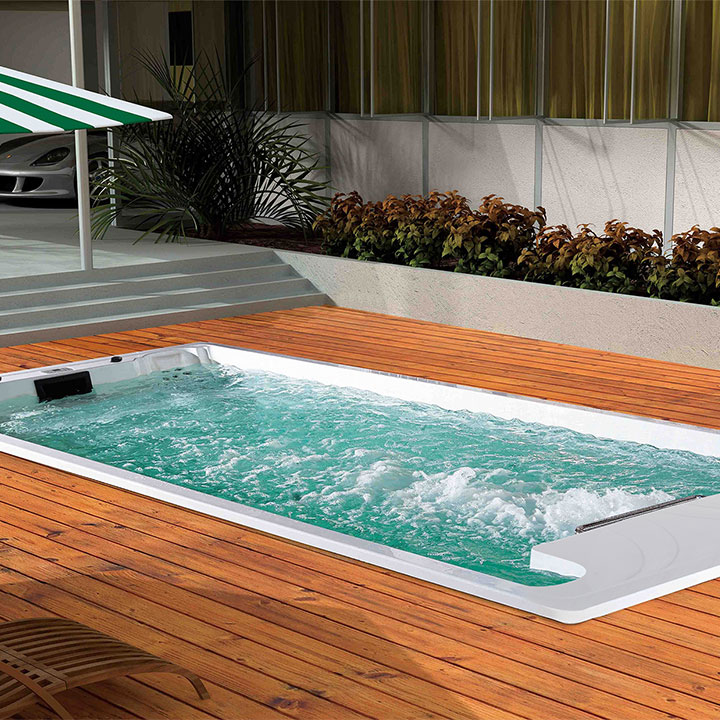
Traditional in-ground swimming pools require extensive excavation, dedicated plumbing lines, and substantial water volumes. In contrast, portable hot tubs prioritize targeted hydrotherapy and elevated water temperatures in a compact, pre-plumbed footprint. Swim spas function as a bridge between the two, providing a self-contained vessel engineered with directional resistance currents.
The functional differences determine how homeowners use their yards throughout the four seasons. While standard pools often sit closed under winter tarps, insulated swim spas maintain steady water temperatures year-round. This comparison clarifies how specifications vary across typical residential installations:
Specification / Feature
Traditional In-Ground Pool
Portable Hot Tub
Above-Ground Swim Spa
Typical Water Volume
40,000 – 80,000 Liters
1,000 – 2,000 Liters
6,000 – 9,000 Liters
Primary Function
Recreation & Free Swimming
Passive Soaking & Hydrotherapy
Resistance Swimming & Therapy
Year-Round Operation
Often winterized in cold climates
Full four-season capability
Full four-season capability
Footprint Requirement
Large (typically 8m+ length)
Compact (2m to 2.5m square)
Moderate (4m to 6m length)
Installation Scope
Excavation, masonry, long permits
Delivered complete on flat pad
Delivered complete on engineered pad
Who Benefits Most from a Hybrid Swim Spa
A hybrid unit suits individuals who want structured aquatic exercise without sacrificing the restorative benefits of localized water massage. Dedicated swimmers who lack the acreage for a 25-meter lap lane find steady resistance streams sufficient for unbroken cardiovascular training. The water current holds the body in place, eliminating the need to perform flip turns every few strokes.
Simultaneously, active households gain an adaptable leisure center where family members can cool down or soak. For individuals managing joint discomfort, the buoyant environment reduces gravitational stress on the hips and knees. It fulfills several fitness and wellness functions in a single self-contained footprint.
How to Choose the Right Water Feature for Your Space
Defining Your Primary Purpose: Recovery, Exercise, or Socializing
Before measuring property boundaries, identify the primary activity you expect this backyard vessel to support every week. If your priority is evening recovery after strenuous labor, focused jet counts and ergonomic contouring matter far more than swim length. If cardiovascular conditioning is your central aim, pump capacity and laminar water flow take precedence.
Social gatherings demand open floor space, multi-level benching, and perimeter illumination for evening safety. Clarifying this balance prevents spending money on high-powered swim current machinery when simple hydrotherapy loungers would satisfy your family. Every design decision flows directly from this operational priority.
Measuring Backyard Dimensions and Setback Requirements
Placing any substantial water vessel into a residential yard requires precise spatial calculation. Measure the raw perimeter of the intended site, then review municipal zoning bylaws regarding property setbacks. Many jurisdictions enforce mandatory distances between permanent water structures, side property lines, and existing residential foundations.
Remember that equipment maintenance panels require regular human access. Technicians must be able to remove side skirting to inspect plumbing connections, pumps, and pack controllers. Leaving at least three feet of clear perimeter space around all four sides ensures your installation remains fully serviceable over its lifespan.
Evaluating Structural Access for Delivery and Equipment Placement
Delivery day presents unique logistical demands that standard home delivery services cannot accommodate. A fully plumbed swim spa is a rigid, multi-ton fiberglass and acrylic monocoque structure that cannot bend around tight roof gutters. Crane delivery over rooflines or fence lines is often mandatory when side access pathways are under four feet wide.
Survey overhead power lines, low tree branches, and underground septic tanks along the transit path. Identifying pathway obstructions early lets you plan crane placement, organize local parking permits, and prevent costly delivery aborted fees. Proper delivery planning protects both the structural shell and your surrounding landscape.
Above-Ground Versus In-Ground Installation
Structural Benefits of Self-Contained Above-Ground Units
Self-contained above-ground units consolidate internal plumbing, filtration cartridges, electric heaters, and circulation pumps inside an engineered structural cabinet. This consolidated architecture removes the need for separate subterranean pump pits or remote equipment vaults that can collect moisture and debris. Everything required to operate the spa remains accessible behind insulated cabinet panels.
Above-ground placement also mitigates ground excavation risks, such as striking hidden utility mains or encountering high water tables. Homeowners who move residences can drain, disconnect, and transport an above-ground unit to a new property. This transportability protects your capital investment in a way built-in concrete pools cannot match.
Foundation Requirements: Site Preparation and Support Design
A stable, level foundation is non-negotiable for any large aquatic structure. When filled with water and occupied by bathers, a 5.8-meter swim spa exerts substantial downward force on the ground below. Installing such a vessel on uneven turf or loose paver sand inevitably leads to structural torsion, shell cracking, and voided warranties.
Excavate organic topsoil until reaching firm, undisturbed sub-base earth.
Lay a compacted aggregate sub-base to promote proper drainage beneath the site.
Pour a level, reinforced concrete foundation designed specifically for heavy aquatic loads.
Consult a structural engineer or qualified contractor to verify that the pad thickness and sub-surface reinforcement meet the manufacturer’s load-bearing specifications and local soil conditions.
Allow the slab to cure fully before maneuvering the heavy vessel into position.
Maintaining Perimeter Clearances for Maintenance and Service Access
Placing a swim spa flush against a retaining wall or wooden boundary fence introduces serious long-term maintenance liabilities. While a seamless aesthetic looks tidy initially, internal pipe unions, heater elements, and pump seals require periodic inspection. If an internal component requires replacement, service crews must be able to access the cabinet access panels without tearing down perimeter decks.
Design surrounding decks, privacy screens, and modular stairs with quick-release fasteners or removable floor panels. This thoughtful engineering touch ensures easy access to the equipment bay while preserving your yard design. It protects your landscape investment whenever routine equipment maintenance is due.
Navigating Local Permits, Zoning, and Setback Regulations
Installing a large water vessel triggers municipal building codes designed to prevent accidents and protect neighborhood infrastructure. Some local codes apply swimming pool safety regulations to any outdoor basin exceeding specific water depths, such as 18 or 24 inches, while others use different criteria. These guidelines frequently mandate lockable safety covers, self-latching perimeter barriers, and verified distances from electrical drops.
Engage your local building authority during the planning stage to review property site plans and clarify local pool definitions. Securing the necessary permits before delivery avoids municipal fines and costly mandated structural relocations. Compliance ensures your installation satisfies both municipal codes and homeowner insurance guidelines.
Technical Overview: The M-503 Above Ground Swim Spa
Physical Dimensions, Dry Weight, and Water Capacity
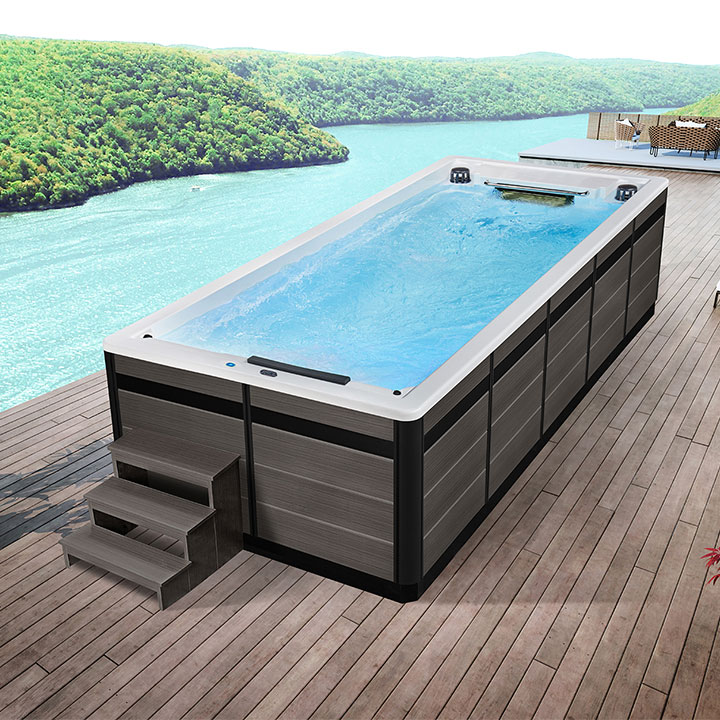
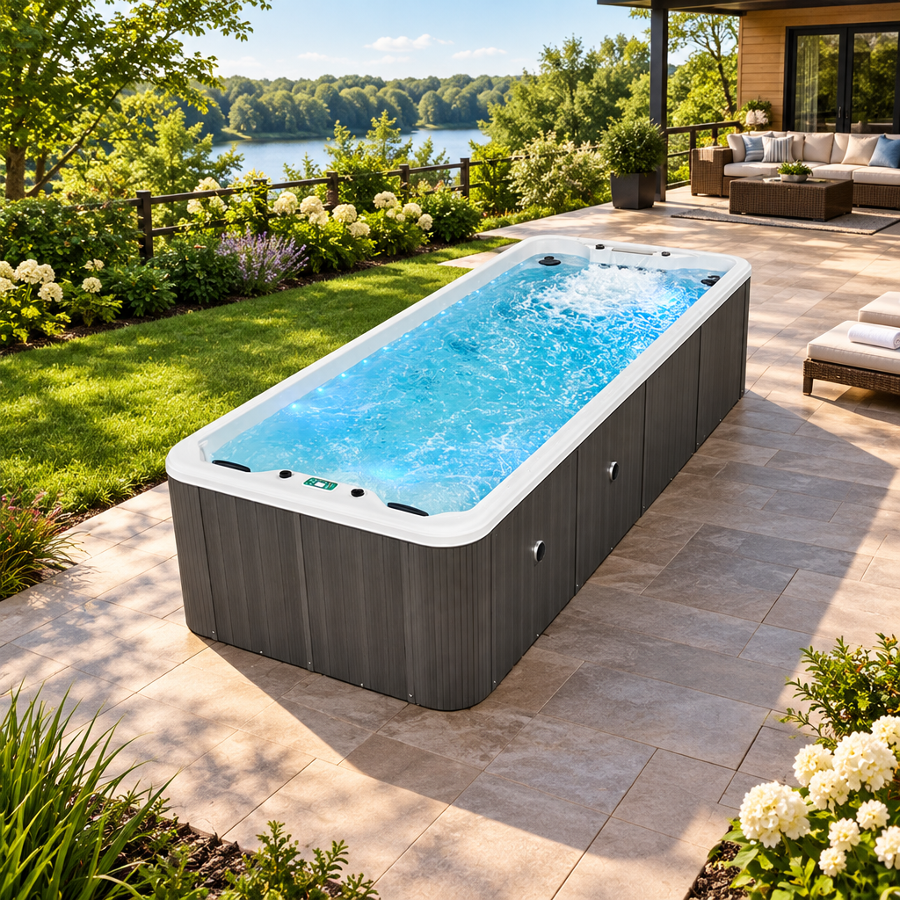
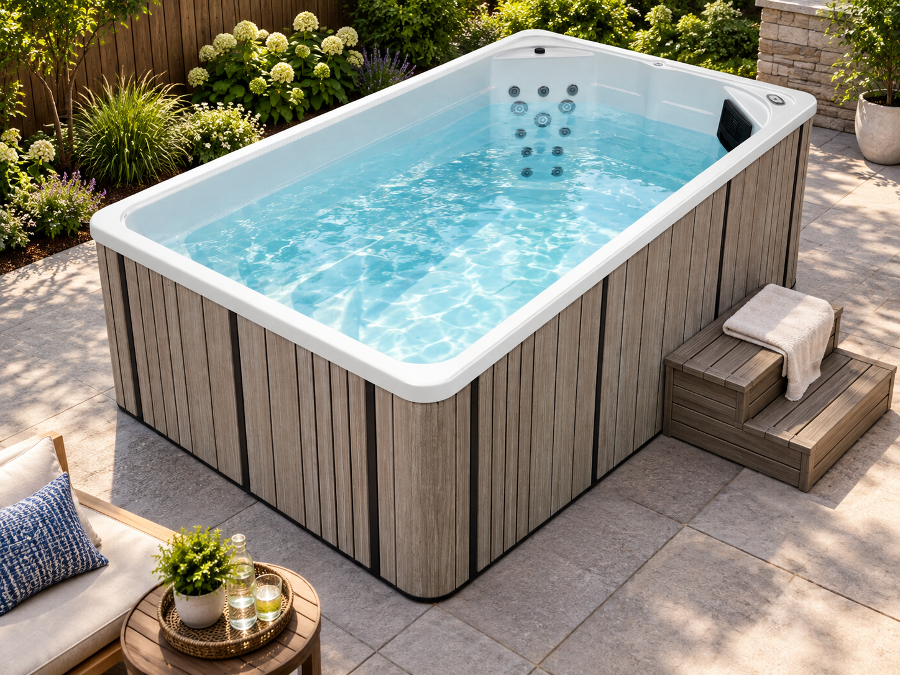
For readers seeking specific data points, the M-503 Above Ground Backyard Swim Spa showcases how dual exercise and relaxation zones can be integrated into one footprint. Manufactured by Foshan Gaoming Shiyi Sanitary Ware Technology Co., Ltd. under their Victoria Star brand, the M-503 measures 5,800 mm in length, 2,200 mm in width, and 1,250 mm in height (approximately 19′ × 87″ × 49″). These proportions provide an expansive swim lane without overwhelming residential outdoor spaces.
The vessel holds 7,890 liters of water when filled to operating level, which represents substantial physical mass on the supporting foundation. The interior shell is molded from smooth Porcelain acrylic, paired with exterior composite cabinetry available in Platinum or Midnight tones. This unified construction ensures structural rigidity across seasonal temperature shifts.
Multi-Pump Configuration and Counter-Current Swim Currents
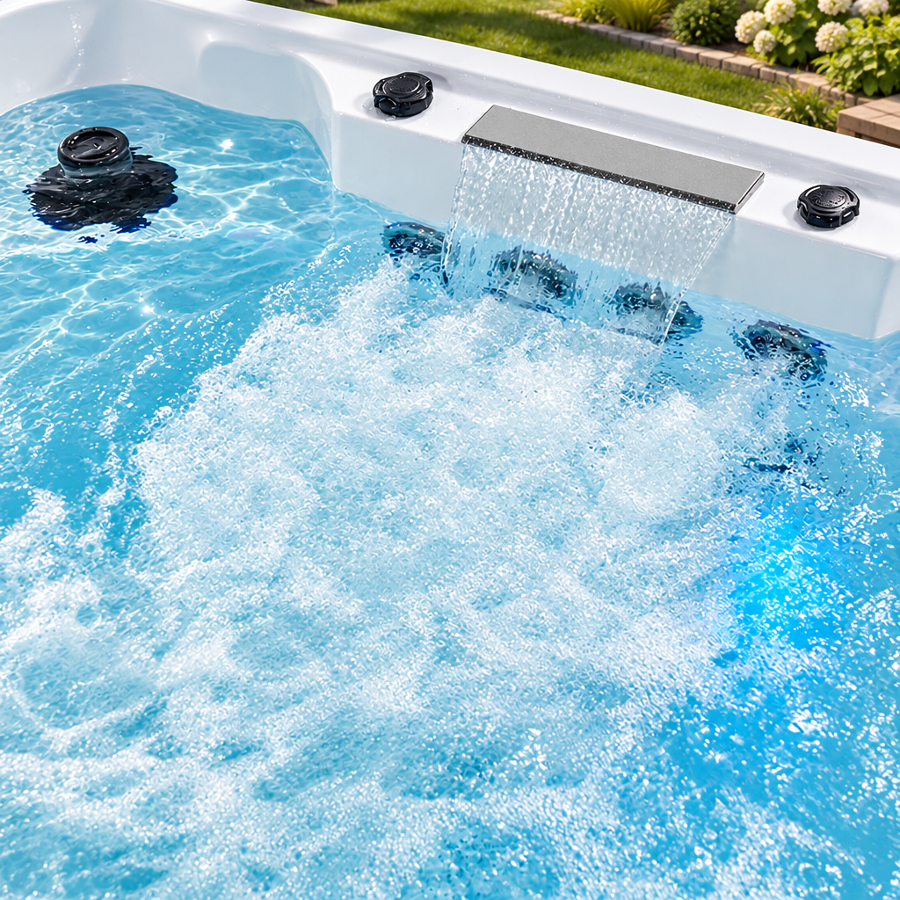
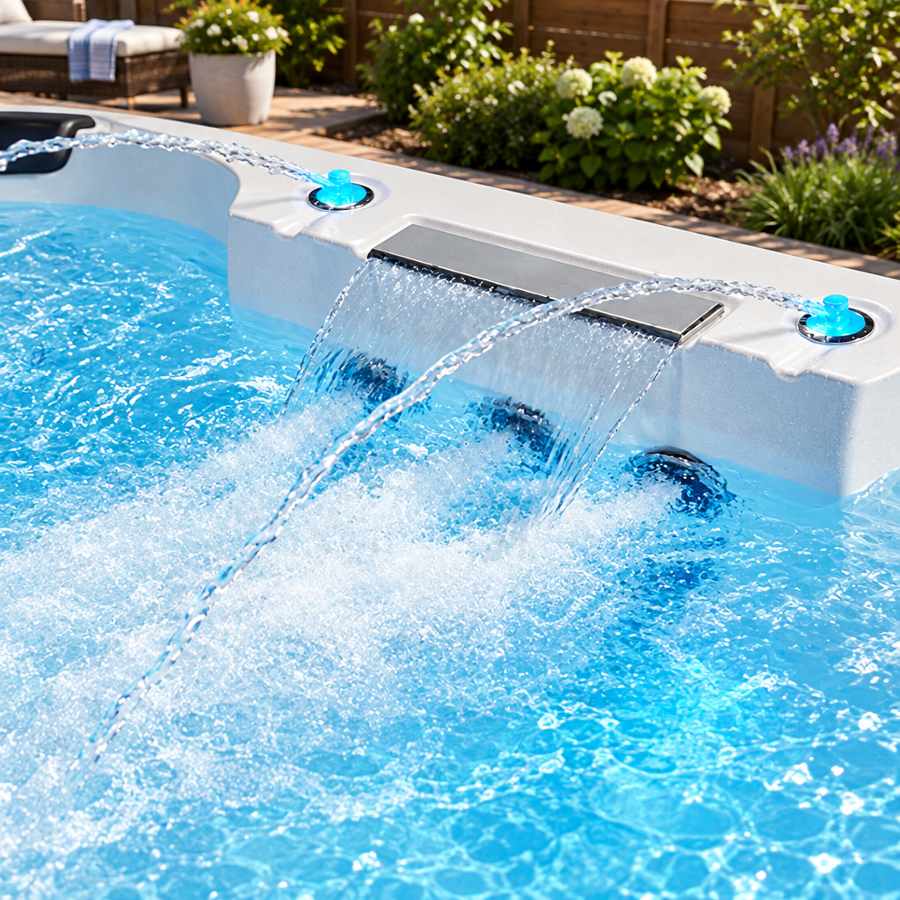
Generating a uniform swimming current requires substantial mechanical throughput rather than simple cosmetic water movement. The M-503 features three 3 HP water pumps that deliver continuous water flow for both counter-current swimming and hydrotherapy, alongside a dedicated 1 HP circulation pump for water filtration. This mechanical separation ensures high-volume water displacement without placing constant hydraulic strain on the primary filtration loop.
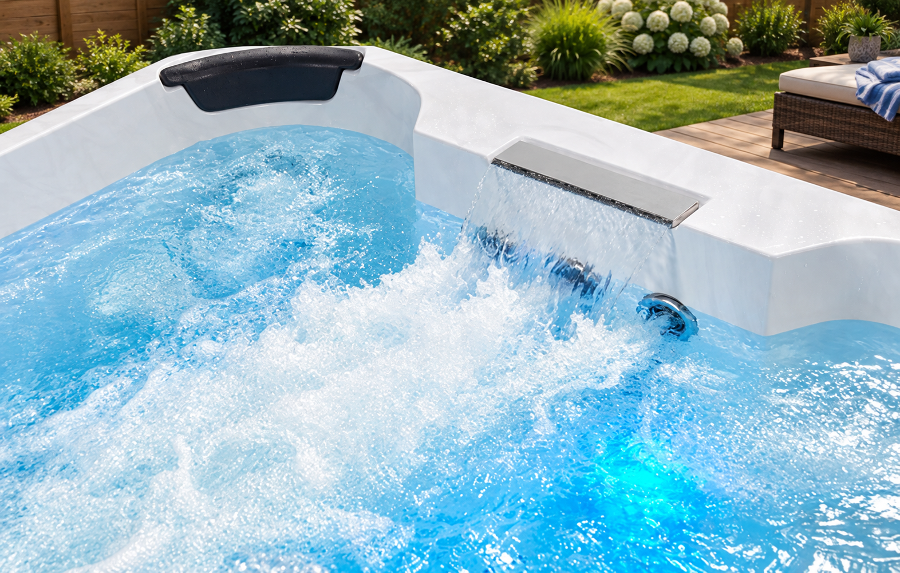
Water moves through counter-current swim jets engineered to produce continuous multi-speed resistance across the swim area. Swimmers can utilize this moving stream for cardiovascular swim training, stroke drills, or low-impact conditioning. The counter-current flow allows for uninterrupted exercise sessions directly in your backyard.
Dual-Seat Hydrotherapy Layout and Ergonomic Jet Distribution
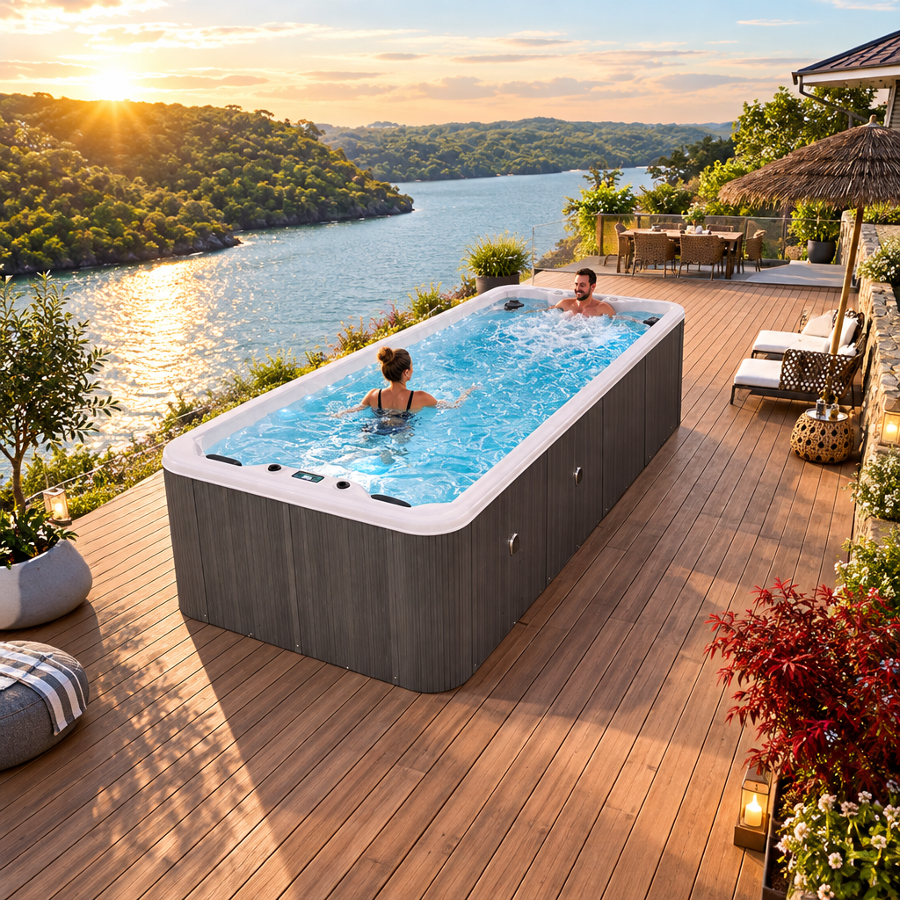
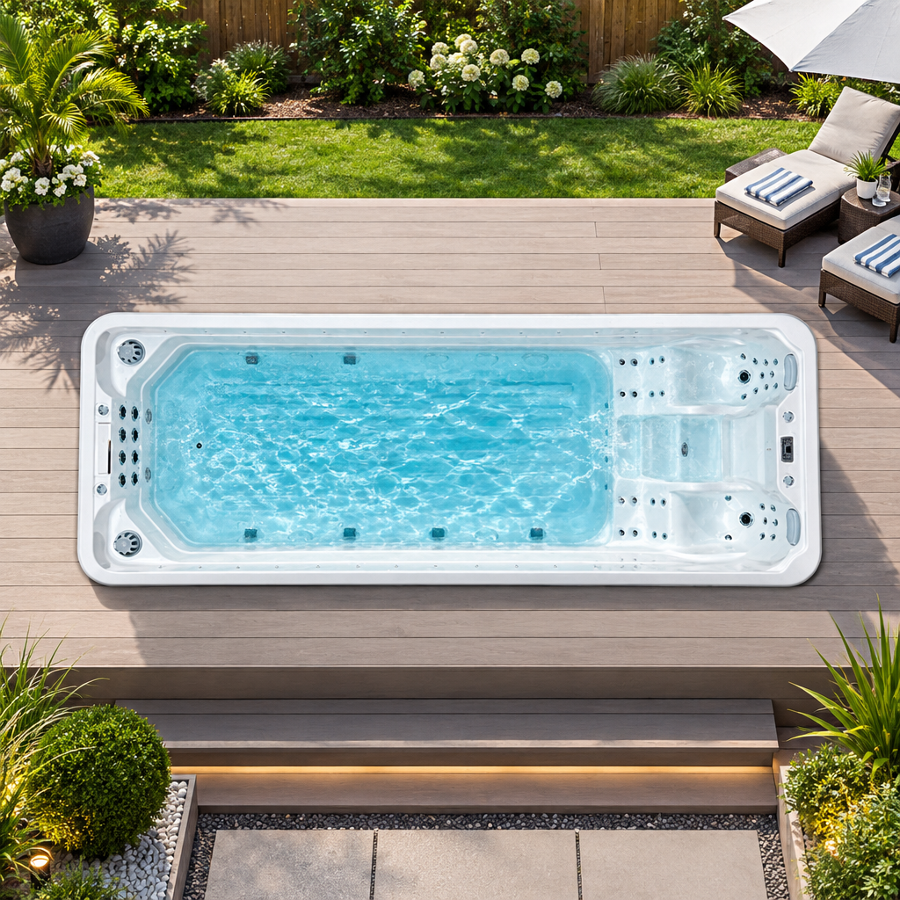
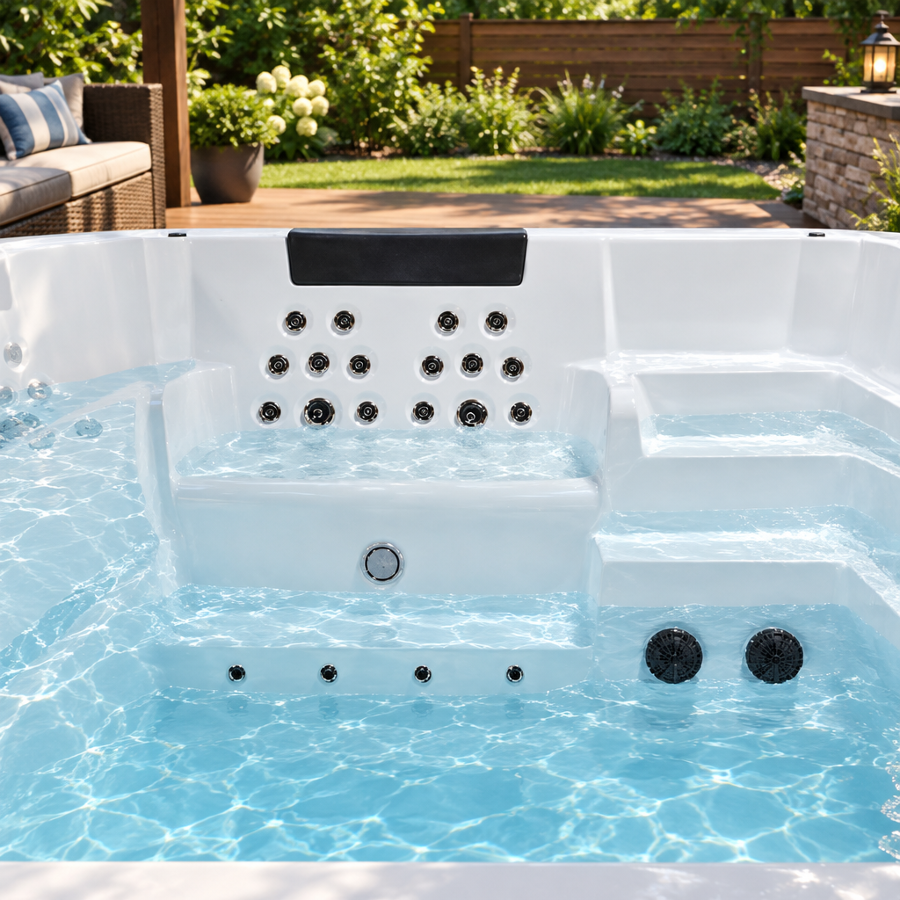
At the opposite end of the open exercise lane, the M-503 features two contoured hydrotherapy seats. A total of 48 targeted massage jets are placed across the back and leg areas, concentrating hydraulic pressure on key tension points. Padded headrests allow bathers to recline comfortably while the water massages the cervical and lumbar regions.
These chrome-trimmed jets deliver an invigorating water flow intended to help relieve muscle tension after training. Positioning the seats away from the swim current zone allows one person to exercise while a companion enjoys a gentle massage. It delivers two distinct wellness functions within a single continuous shell.
Control Systems, Dual Heaters, and Electrical Requirements
System management on the M-503 centers around an intuitive KL2020BT touchscreen interface. This digital control platform allows users to regulate water temperatures, adjust pump cycles, and manage lighting modes without handling manual bypass valves. Dual 3,000-watt heating elements work in concert to reach and sustain user-selected water temperatures efficiently.
The complete mechanical array operates on a total electrical demand rated at 13.35 kW. A licensed electrician must review the manufacturer’s technical specifications and local electrical codes to determine the appropriate service connection, wire gauge, and overcurrent protection. Proper electrical planning ensures that pumps, heaters, and electronics perform smoothly during extended training sessions.
Exercise and Wellness in a Compact Footprint
How Counter-Current Jets Support Continuous Lap Swimming
Stationary lap swimming in a swim spa relies on consistent fluid resistance. In an Olympic pool, momentum carries the swimmer through open water until the far wall interrupts the stroke. Inside an endless water stream, the swimmer matches stroke tempo to the velocity of the forward current, creating an unbroken rhythm.
This continuous training environment sharpens stroke symmetry and endurance. Swimmers do not lose body alignment by initiating push-offs or tumble turns every few strokes. The current supports the torso, encouraging proper horizontal balance through freestyle, breaststroke, or backstroke workouts.
Targeted Hydrotherapy for Lower Back and Leg Recovery
Strenuous training, long commutes, and desk work place ongoing tension on the spine and lower extremities. Hydrotherapy relieves this structural strain through hydrostatic buoyancy, warm water, and mechanical jet pressure. Water immersion provides buoyant support that reduces weight-bearing stress on spinal discs and lower-body joints.
In the M-503, the 48 massage jets are strategically distributed across the seating section to target key pressure points along the back and legs. Pressurized water streams deliver localized contact designed to loosen tight tissues and encourage post-workout relaxation. Alternating between active swim intervals and passive seat immersion creates a balanced recovery routine.
Creating a Structured Daily Aquatic Fitness Routine
A swim spa supports varied conditioning regimens beyond standard stroke laps. Its combination of open lane space and warm water creates a versatile environment for zero-impact calisthenics and mobility training. Users can craft balanced morning workouts without visiting a commercial fitness club.
Dynamic Warm-Up (5 Minutes): Light aquatic walking against low current speeds to loosen ankle joints, calves, and hip flexors.
Aerobic Resistance Blocks (15 Minutes): Sustained breaststroke or freestyle swimming set to a moderate pump output to build cardiovascular capacity.
Core and Balance Drills (10 Minutes): Aquatic lunges, high-knee lifts, and flutter-kick drills utilizing the buoyant water column to challenge core stability.
Hydrotherapy Cool-Down (10 Minutes): Passive soaking in the ergonomic seating zone, letting warm water relax worked muscle groups.
Adjusting Water Movement to Match Individual Swim Levels
Swimmers possess varied power outputs, stroke mechanics, and body weights. A counter-current stream suitable for competitive athletes can easily overwhelm a beginner, while an underpowered flow fails to challenge advanced swimmers. Effective aquatic training requires matching flow volume to individual capabilities.
The M-503 uses its multi-pump architecture to drive substantial water volume across the swim lane. Modulating the primary jet controls allows swimmers to fine-tune the stream’s intensity for their specific stroke rhythm and resistance needs. This adaptability ensures that every household member can exercise comfortably at their own pace.
Water Care, Filtration, and Maintenance Routines
Multi-Stage Filtration Versus Active Sanitizer Needs
Water care in a large backyard spa involves continuous physical mechanical filtration and residual chemical sanitization. The internal 1 HP circulation pump pulls surface water through high-density pleated fabric filters to remove suspended debris, lint, and organic particles. This mechanical filtration keeps water clear, though dissolved micro-contaminants require chemical neutralization.
Active sanitizers such as chlorine or bromine remain essential for neutralizing bacteria and preventing microbial growth. Physical filtration media alone cannot eliminate microscopic pathogens. Maintaining consistent filtration schedules alongside recommended chemical sanitizer levels preserves clear, hygienic water across all seasons.
The Operational Role of Supplemental Ozone Systems
The M-503 integrates an advanced ozone purification system to support routine chemical treatments. Ozone gas ($O_3$) acts as an oxidizer when injected into circulating water lines. It rapidly breaks down biological waste, bather oils, and micro-contaminants before reverting to oxygen molecules.
According to CDC healthy swimming guidance, supplemental systems like ozone support water quality but do not alter baseline chemical requirements. Because ozone dissipates rapidly and leaves no residual sanitizer in the main bather shell, homeowners must maintain active sanitizer residuals—such as at least 3 ppm of free chlorine—to protect bathers against cross-contamination.
Water Testing Frequencies for pH, Free Chlorine, and Alkalinity
Consistent water chemistry prevents shell staining, skin irritation, and the premature corrosion of internal metal heating elements. Operating a water vessel at higher temperatures speeds up organic decomposition and chemical consumption. Test your water regularly with a calibrated testing kit to catch imbalances early, adhering to manufacturer guidelines and applicable local standards:
pH Range: Maintain between 7.0 and 7.8 (CDC hot-tub standard) to protect equipment and optimize sanitizer effectiveness.
Free Chlorine: Keep at a minimum of 3 ppm for hot tubs as recommended by the CDC, or follow specific local regulations.
Bromine Residual: Maintain between 4.0 and 8.0 ppm if using bromine as your primary sanitizer.
Total Alkalinity: Keep within the manufacturer-recommended window, generally between 80 and 120 ppm, to buffer pH stability.
Draining, Shell Cleaning, and Seasonal Maintenance Practices
Over months of use, dissolved solids and treatment byproducts accumulate in the water. Even pristine-looking water eventually becomes chemically saturated, reducing sanitizer performance. In a 7,890-liter swim spa, replacing the water every four to six months restores clean baseline chemistry.
Drain the vessel using a submersible pump, then clean the Porcelain acrylic finish with non-abrasive, pH-neutral surface cleaners. Avoid harsh household bleaches or abrasive scrubbing pads that can scratch the smooth shell. Check the cabinet access seals and inspect internal pipe unions before refilling through the filter housing to prevent air locks.
Safety Standards, Temperature Guidelines, and Electrical Codes
Safe Operating Temperatures for Exercise and Passive Soaking
Water temperature control requires different operational targets for active cardiovascular exercise versus passive hydrotherapy. Soaking in a warm hot tub is comfortable around 100°F to 102°F (37.7°C to 38.8°C), with the CDC recommending a strict maximum bather ceiling of 104°F (40°C). These elevated temperatures soothe sore muscles during resting recovery.
However, strenuous swimming at temperatures above 85°F (29.4°C) can cause rapid overheating, dehydration, and early physical exhaustion. Because water conducts heat away from the body roughly twenty-five times faster than air, heavy exertion in hot water prevents normal core heat dissipation. Plan your workouts around 80°F to 84°F, then adjust the dual 3,000-watt heaters upward if an extended soaking session is planned.
Working with Licensed Electricians for Sub-Panel and GFCI Connections
Water and electricity demand strict, professional installation practices. Safely supporting an aggregate 13.35 kW electrical load requires dedicated line capacity and Ground Fault Circuit Interrupter (GFCI) protection. Never attempt to power a full-sized swim spa using extension cords or standard convenience outlets.
A licensed electrician must inspect your main service panel, verify conductor sizing, install weather-rated conduit, and establish proper equipotential bonding. Mounting an approved emergency disconnect within sight of the spa satisfies electrical safety codes. Following national and local electrical regulations protects both your household and your investment.
Physical Safety: Locking Thermal Covers and Non-Slip Surfacing
A rigid, insulated thermal cover is an indispensable component of any outdoor backyard tub pool setup. Beyond preventing heat dissipation and stopping wind-blown debris from entering the water, a locking cover acts as a structural physical barrier. It protects children, domestic pets, and local wildlife from unintended water immersion.
Similarly, address the deck area surrounding the spa cabinet. Wet bare feet on smooth composite lumber or polished stone tiles can cause accidental slip-and-fall injuries. Install slip-resistant decking materials, textured composite steps, and sturdy support handrails. These structural additions ensure family members can enter and exit the vessel safely in all weather conditions.
Health Precautions for Extended Soaking and Medical Conditions
While warm water hydrotherapy offers well-documented relaxation benefits, bathers must observe sensible personal health limits. Immersion in warm water dilates blood vessels, which naturally drops baseline blood pressure. Individuals diagnosed with cardiovascular disease, low blood pressure, or diabetes should speak with their physician before soaking in hot water.
Pregnant people should consult a healthcare provider before using a hot tub, particularly during early pregnancy. Keep soaking sessions around fifteen to twenty minutes, and keep drinking water nearby to stay properly hydrated. Listening to your body keeps every soaking session safe and comfortable.
Decision Framework: Is a Swim Spa the Right Fit?
Practical Checklist Before Placing an Order
Finalizing a swim spa purchase requires verifying several spatial, structural, and financial considerations. Take time to evaluate this practical readiness checklist before committing to a delivery schedule:
[ ] Structural Pad: Has a qualified professional designed an engineered, level concrete slab to support the vessel?
[ ] Electrical Service: Has a licensed electrician confirmed that your residential service can support a 13.35 kW load?
[ ] Crane Clearance: Are overhead delivery corridors free from low-hanging tree branches and power cables?
[ ] Municipal Permits: Have you confirmed local safety barrier definitions and secured municipal approvals?
[ ] Maintenance Buffer: Is there at least three feet of perimeter clearance around the cabinet for service access?
Scenarios Where a Separate Hot Tub or Plunge Pool Fits Better
A hybrid swim spa provides exceptional versatility, though it is not the ideal solution for every property layout. If your primary interest is weekend hospitality for large groups, an open plunge pool or an eight-person hot tub may prove more practical. The open swim lane in a swim spa prioritizes exercise mechanics over dense perimeter seating.
Similarly, properties with severely restricted access paths may face prohibitive crane rental fees. If crane setup is impossible due to local power infrastructure, smaller modular hot tubs remain far easier to transport. Carefully weigh your personal priorities, site access, and budget before choosing a design.
Essential Technical Questions to Ask Your Manufacturer
Engaging with a specialized manufacturer or distributor requires asking targeted technical questions. Inquire about internal plumbing configurations, frame insulation values, and pump horsepower ratings under continuous load. Understanding how a supplier builds their shells helps you separate premium craftsmanship from cut corners.
Ask about component parts availability, replacement cartridge filters, and direct customer support for your control electronics. Established builders provide clear engineering schematics and operational guidance. These straightforward conversations help ensure reliable performance throughout the ownership cycle.
Frequently Asked Questions (FAQs)
Is a backyard tub pool the same as a swim spa?
A backyard tub pool is a descriptive search term homeowners use to describe dual-purpose water vessels, whereas a swim spa is an engineered category. Swim spas combine directional resistance swim jets with hydrotherapy massage seating in an integrated cabinet. While hot tubs focus on heated soaking and pools focus on open swimming, swim spas bring both activities together in one self-contained footprint.
Can the M-503 swim spa be installed directly on a wooden deck?
The M-503 holds 7,890 liters of water, creating an aggregate weight that standard residential patio decks cannot support without reinforcement. It should rest on a flat, engineered concrete foundation designed to support the full operating load. If you prefer a wooden deck aesthetic, place the spa on its designated concrete pad and construct the timber decking around the cabinet structure.
How does an ozone system assist in swim spa sanitation?
An ozone purification system injects concentrated $O_3$ gas directly into circulating water lines to oxidize introduced organic matter, sweat, and oils on contact. This process helps maintain water clarity and reduces chemical oxidation demands. However, because ozone provides no persistent residual sanitizer in the pool basin, you must still maintain recommended free chlorine or bromine residuals according to health agency standards.
What electrical supply is needed to operate a swim spa like the M-503?
The M-503 Above Ground Backyard Swim Spa has a total electrical demand of 13.35 kW, which powers its three 3 HP pumps, 1 HP circulation pump, and dual 3,000 W heaters. A licensed electrician must determine the exact breaker size, supply voltage, and wire gauge based on the manufacturer’s installation manual and local electrical regulations.
How often should the water in a backyard swim spa be replaced?
Most swim spas benefit from a full water replacement every four to six months, depending on weekly bather load and chemical maintenance diligence. Over time, dissolved solids, minerals, and chemical byproducts accumulate, making the water harder to balance. Draining the shell gives you a clean baseline and restores sanitizer efficiency.
What water temperature is suitable for both swimming and soaking?
Lap swimming and passive soaking demand different water temperatures. For cardiovascular lap training, maintain water between 80°F and 84°F (26.6°C to 28.8°C) to keep from overheating during heavy exertion. For passive hydrotherapy soaking, temperatures between 98°F and 102°F (36.6°C to 38.8°C) are ideal, never exceeding the 104°F (40°C) health threshold.
Conclusion
Investing in a backyard tub pool bridges the gap between focused athletic conditioning and restorative hydrotherapy. Units like the M-503 show how balanced engineering brings powerful water pumps, ergonomic massage jets, and digital temperature control into a single residential footprint. Taking the time to calculate foundation load capacities, verify electrical panels, and understand water maintenance ensures your new installation operates reliably for years to come. With proper site preparation and quality equipment, your yard becomes a private wellness retreat tailored to your family’s daily health and recovery needs.
Victoria Star Swim Spa offers the perfect balance between exercise and relaxation, whether you want to swim for fitness or relax in the spacious seating.
Victoria Star Swim Spa offers the perfect balance between exercise and relaxation, whether you want to swim for fitness or relax in the spacious seating.