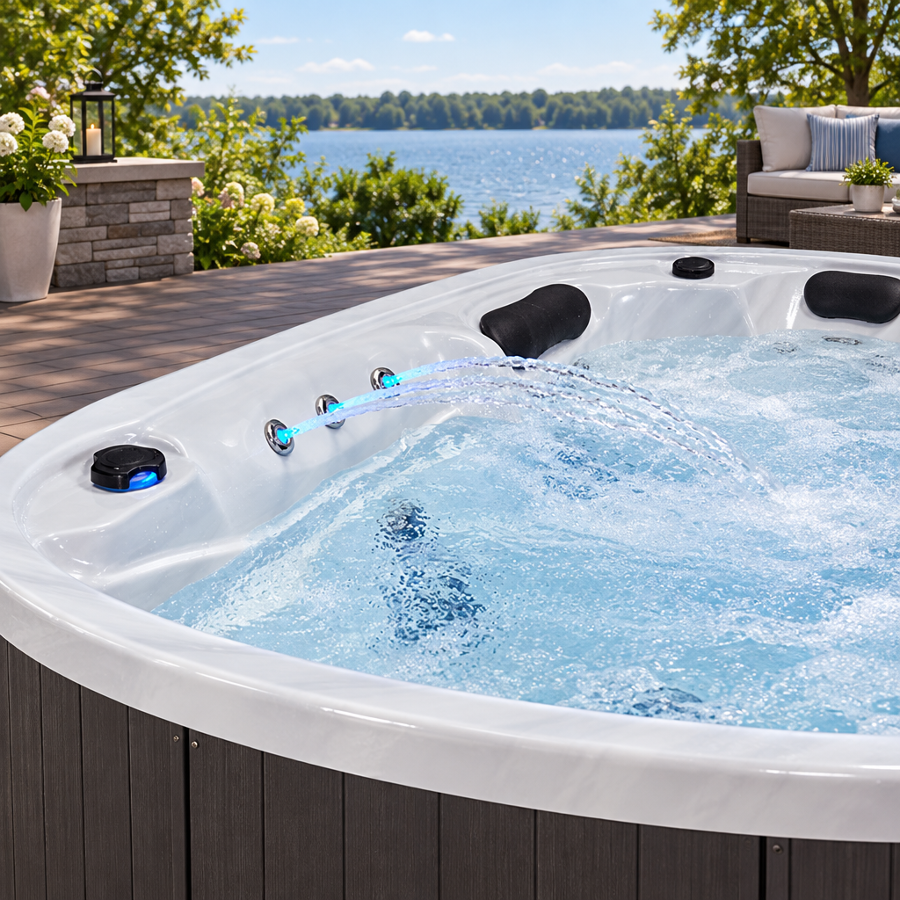
8 Person Jacuzzi: A Buyer and Installation Guide for Large Hot Tubs
Home / News / 8 Person Jacuzzi: A Buyer and Installation Guide for Large Hot Tubs
November 02, 2026
An 8 person jacuzzi can turn a patio into a real gathering place, but choosing one takes more planning than buying a compact two- or four-seat spa. Eight adults in one vessel mean more water, more weight, more electrical load and faster sanitizer use. A large hot tub for 8 people holds hundreds of gallons of water and sits on your property for years, so the decision deserves the same care as a small building project.
This guide looks past brochure photos. It covers seating layouts that work for eight adults, foundation and electrical planning, pump and jet design, and water care under heavy use. Whether you want an outdoor hot tub for weekend entertaining or a large spa for recovery after training, the sections below explain what to check and why it matters.
Understanding the 8 Person Jacuzzi: Category Versus Brand
Generic Terminology vs. Jacuzzi-Brand Spas
In everyday use, people call almost any jetted hot tub a jacuzzi. Jacuzzi® is a registered trademark of a specific company, whose founding family developed early whirlpool pump equipment in the twentieth century. Most shoppers searching for an 8 person jacuzzi are really comparing the whole category of eight-seat spas from many manufacturers, not one brand.
Keeping that distinction in mind helps you compare products on their specifications. Plumbing, warranties and shell construction differ between makers, so the useful questions concern shell fabrication, continuous pump ratings and how water is distributed to the jets. The name on the cabinet tells you much less than the data sheet does.
Defining the Scope of an Eight-Person Hydrotherapy Investment
Moving from a four-to-six-person spa to an eight-person model is a larger step than the seat count suggests. Large eight-person spas commonly hold several hundred gallons of water, and the exact figure varies by model, so check the spec sheet of any tub you consider. At that size, installation starts to involve a prepared base, a dedicated electrical circuit and delivery planning rather than simply placing equipment on the lawn.
All else being equal, a larger water volume generally takes longer to heat, though actual heat-up time depends on heater output, starting and target temperatures, insulation and other model and site conditions. Every extra bather also adds sweat, oils and other organic material to the water. Good selection means weighing the space you have against these running demands. The tub should fit your patio with room left for walking paths, the cover lifter and service access to the equipment bay.
Ergonomics and Spatial Layout: Does an 8-Person Spa Fit Eight Adults?
Footwell Clearance and Bather Collision Dynamics
A common complaint from owners of large spas is the tangle of knees and feet in the middle of the tub. A shell can have eight molded seats around its rim and still feel crowded if the central footwell is small. Seat count describes the perimeter, while the footwell decides whether eight people can actually sit at once.
Comfortable group use needs a generous open floor in the center. Seats at different depths help too, because people of different heights can find a seat where their shoulders sit under the water. When you test a spa, picture eight pairs of legs reaching toward the middle at the same time, since that is the real use case.
Circular Versus Rectangular Form Factors
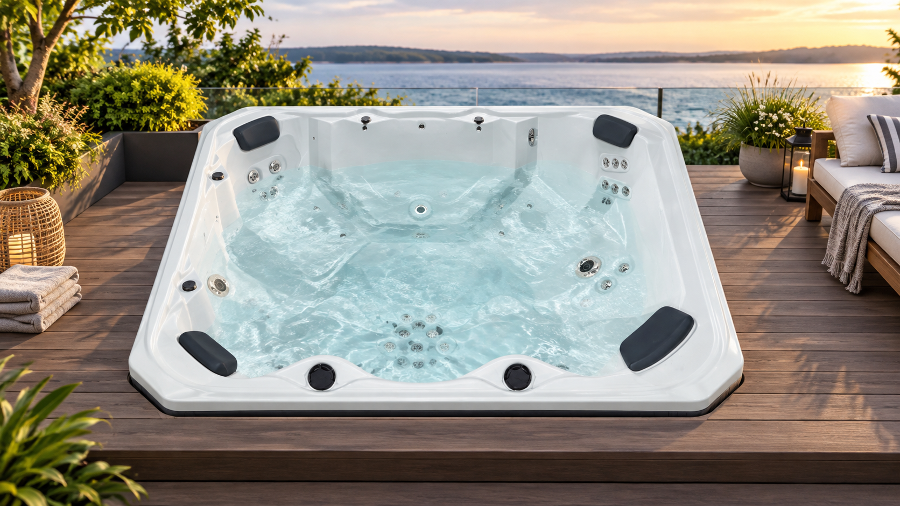
The shape of the shell shapes how people sit and talk inside it. Square and rectangular models use their corners for deep bucket seats or loungers, which creates separate stations. Those corners can take up floor area and make it harder for bathers to shift positions during a long soak.
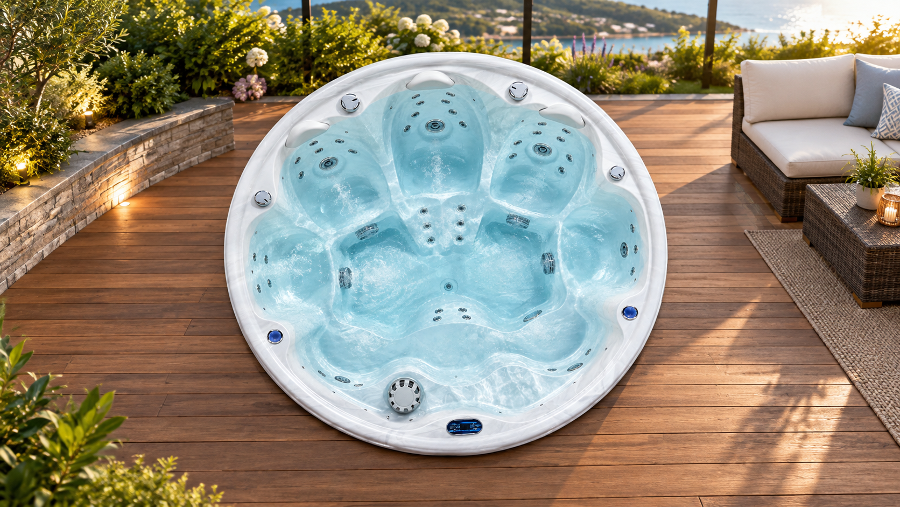
Round spas work more like a round dinner table. Everyone faces the center, nobody sits at the head, and conversation moves easily around the group. For social use, that layout is often the deciding factor. A rectangular tub, by contrast, fits more neatly against a wall or deck edge, so the right choice depends on your site as much as your guests.
Seating Configurations: Loungers, Bucket Seats, and Barrier-Free Benches
Full-body loungers look appealing in a showroom, but they cost space in a group spa. One reclining lounger can take up the area of about two upright seats. Because water makes the body buoyant, lighter bathers sometimes float out of a lounger unless they brace their feet against the end of it.
The table below compares common layouts by how many people they seat comfortably and what kind of soak they suit.
Configuration Type
Seating Density
Hydrotherapy Focus
Bather Mobility
Ideal Use Case
All-Seated / Perimeter Seats
Highest (full 8-person use)
Back and torso
High; easy entry and repositioning
Entertaining, large families, parties
Single Lounger + Seats
Moderate (about 6 to 7 in practice)
Legs and spine along the lounger
Moderate; footwell partly shaped by the lounger
Daily therapy with occasional hosting
Dual Lounger Layout
Lower (about 4 to 5 in practice)
Neck, lower back and calves
Limited; fixed body positions
Couples, dedicated recovery soaks
If you need genuine eight-person capacity, an all-seated layout gives the most usable space. Without loungers, nobody has to claim the best spot, and family members of different heights can choose seats that suit them.
Structural, Electrical, and Site Planning Fundamentals
Bearing Capacity and Wet Weight Calculations
A filled eight-person spa is very heavy. If the base underneath cannot carry it, the shell can crack, plumbing joints can leak, and a raised deck can sag or fail. Weight planning should come before color choices.
Total load has three parts: the dry weight of the tub, the weight of the water and the weight of the people inside. Water weighs about 8.34 pounds per gallon, or 1 kilogram per liter. As a hypothetical example, take a spa holding 450 gallons, which carries about 3,753 pounds of water. Assume a dry weight of 800 to 1,000 pounds for the shell, cabinet and equipment.
Now add eight adults averaging 175 pounds, or about 1,400 pounds more. In this example, the total comes to roughly 6,000 pounds. Spread over the roughly 38 square feet of a seven-foot round footprint, that works out to over 150 pounds per square foot. These figures are assumptions for illustration, not the specifications of any model in this guide, including the VS-001L. Repeat the calculation with the actual water capacity and dry weight from your chosen spa’s spec sheet.
Once you know the real load, plan the base around it. On the ground, the surface must be firm, level and designed for the filled spa. Concrete pads are a common choice, but the right thickness and reinforcement depend on the soil and the manufacturer’s instructions, so confirm the design with the manufacturer or a qualified local contractor. On a raised deck, have a structural engineer confirm the load capacity first.
Electrical Service Requirements and Thermal Recovery
Large spas with several pumps and an electric heater generally need a dedicated electrical circuit rather than a plug-in connection. An 8 person jacuzzi of this size will usually not run from a standard 120V household outlet. Many larger models are hardwired to 230V or 240V service with ground-fault protection. The exact voltage, conductor size and breaker or GFCI rating depend on the model and the local electrical code.
The circuit rating also affects how the spa behaves. Some control systems can be set up for a lower-amperage supply, and on those setups the heater may switch off while the jet pumps run on high. During a long soak in cold weather, the water can then slowly lose temperature. Get the manufacturer’s wiring instructions before installation, and have a licensed electrician size the circuit from them.
Delivery Pathway Clearance and Site Access Logistics
A round spa about seven feet across is usually moved on its side on a dolly. Gates, downspouts, air-conditioning units, fence posts and roof eaves can all block the route to the backyard. Measure the whole path before delivery day, because a tub stuck at the side gate is an expensive problem to solve.
Follow these steps when planning access:
Measure every gate width and height along the route, and include the height of the delivery dolly.
Check overhead for tree branches, cables and wall-mounted meters.
Look at the ground surface, including pavers, soft lawn and steps, to confirm it can carry the tub and crew.
Ask the delivery team about the minimum corridor width they need, and arrange a crane if the side yard is too narrow.
Evaluating Hydrotherapy Engineering: Pumps, Flow, and Jet Placements
Continuous Duty vs. Peak Horsepower Ratings
Some spa marketing quotes peak or brake horsepower, which can describe a short startup surge rather than steady output. A pump advertised with a high peak figure may deliver much less power during normal running. Comparing peak numbers between brands can mislead you.
For an eight-seat spa, ask for continuous-duty ratings and the number of jets each pump feeds. Supplying 45 to 50 jets takes a lot of water flow. Ask how the jets are divided between pumps and whether the manufacturer provides flow or pressure information for each seating zone.
Targeted Jet Zonation Across High-Bather Capacities
A high jet count means little if the plumbing restricts flow. Placement matters more than the total. Some designs combine jets of different sizes and types to target different muscle groups, so each seat offers a different feel. Check the actual jet positions in the model you are considering and test whether they suit your preferences.
Some models also include adjustable air controls on the rim, which let bathers change how much air mixes into the water stream for a bubblier sensation. Confirm whether the spa you are considering has this feature, since it varies by model.
Dedicated Circulation Pumps vs. Two-Speed Primary Pumps
Many entry-level spas use a two-speed jet pump on low speed for daily filtration and heating. In that design, the same large motor that powers the massage jets also runs through every filtration cycle. It accumulates running hours even when nobody is in the tub.
A separate small circulation pump takes over filtration and heating flow, so the large jet pumps run only when someone wants a massage. Whether this makes a particular spa quieter or extends pump life depends on the specific equipment and settings. Ask the dealer how filtration is configured and how long the cycles run each day.
Sanitation Systems Under Heavy Bather Loads
The Challenge of High Organic Load in Hot Water
Eight people in hot water bring in sweat, skin oils, lotions and cosmetics. These substances consume chlorine or bromine quickly. If the sanitizer runs low, warm water can support bacteria such as Pseudomonas aeruginosa, which is linked to hot tub rash.
Water care in a large spa therefore needs to be routine. Guidance from the U.S. Centers for Disease Control and Prevention for hot tubs recommends free chlorine of 3 to 10 parts per million, or bromine of 4 to 8 parts per million, with pH between 7.2 and 7.8. Water temperature should not exceed 104°F (40°C), a limit widely recommended to reduce the risk of overheating.
Integrating Mechanical Filtration, Ozone, and UV Sanitization
Because heavy use uses up sanitizer fast, many spas add secondary treatment to the circulation loop. Relying only on large manual chemical doses can leave water harsh on eyes and skin, and high chemical levels can wear down headrests and covers over time.
Common secondary layers include:
Filter Cartridges: Catch hair, debris and suspended particles before water reaches the heater and pumps.
Ozone Systems: Add ozone, a triatomic form of oxygen, to the water to help oxidize organic contaminants from bathers.
UV Systems: Pass water past ultraviolet light, which damages the DNA of many microorganisms and stops them from reproducing.
These layers are supplementary treatment. They only act on water as it passes through the equipment, so they do not replace a chlorine or bromine residual in the tub. Whatever secondary equipment a spa has, keep testing and maintaining sanitizer at the levels set by the manufacturer’s instructions and applicable local guidance.
Technical Spotlight: The VS-001L 8-Person Circular Spa
Engineering Specifications and Geometric Profile
At Victoria Star, our factory handles mold forming, manufacturing, assembly and wood product production in-house, and we design hot tubs and swim spas around relaxation and long-term wellness. The VS-001L from our Luxury Series shows how the round layout described above works in an eight-seat model.
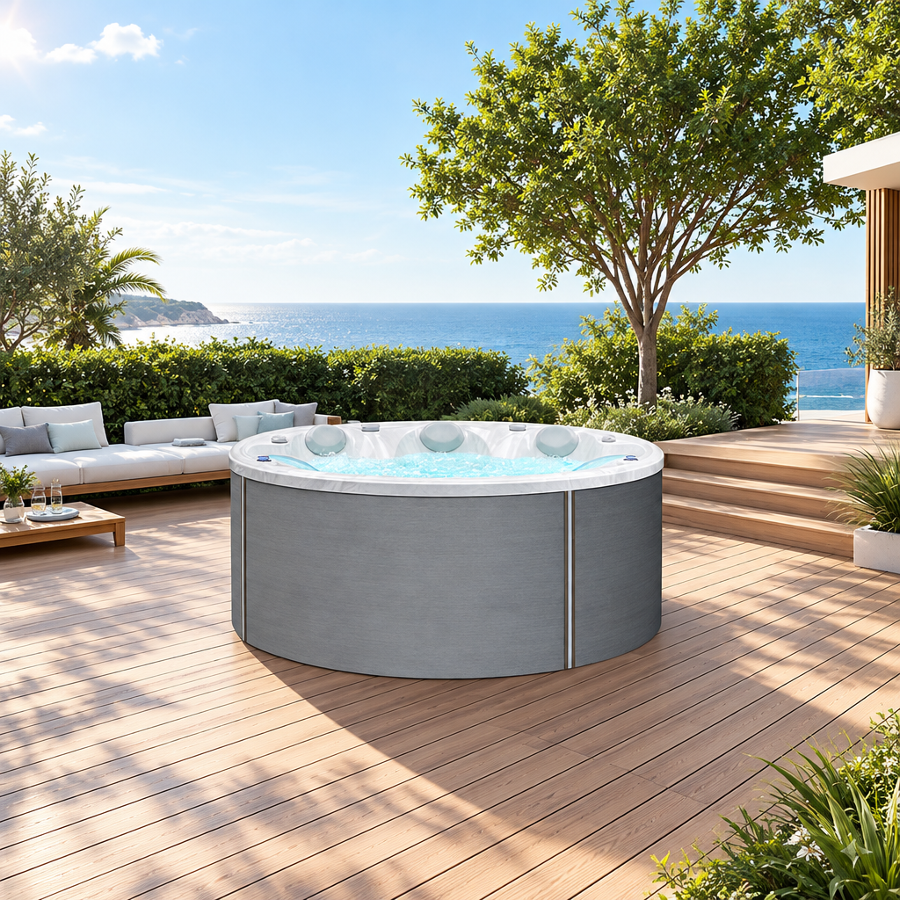
The VS-001L measures 2,200 mm across and 910 mm tall, listed as approximately 7 feet by 36 inches. The porcelain-colored shell has eight contoured seats around a round perimeter, so there are no corner seats or loungers taking space from the group. The aluminum-plastic cabinet skirt has integrated LED trim and comes in Platinum or Midnight.
Powertrain and Hydrotherapy Performance
The spa uses a KL2022 control system with a smart keypad. Its 49 jets are powered by two 2 HP water pumps, which matches the dual-pump approach described in the hydrotherapy section. Splitting the jets between two pumps avoids asking one pump to feed every seat.
A 1 × 3 kW heater warms the water, and a separate 0.35 HP circulation pump is listed for circulation duty. The product data gives the total power supply as 6.25 kW. That figure alone does not set the breaker size, so request the model’s wiring instructions and nameplate ratings, and have a licensed electrician size the circuit under local code.
Entertainment, Cabinetry, and Multi-Stage Water Purification
For gatherings, the VS-001L includes one Bluetooth system with four AV speakers built into the rim. The product data describes the audio as delivering 360-degree sound, which suits a round tub where guests face each other from every side.
Lighting includes perimeter and underwater LEDs, along with illuminated water fountain jets that arc back into the basin. For water care, the product data lists replaceable filter cartridges, ozone sanitization and UV light treatment, which follows the layered approach described earlier. Owners still need to test and maintain a chlorine or bromine level alongside these systems.
Long-Term Maintenance and Operating Economics
Thermal Insulation, Cabinet Seals, and Evaporative Heat Loss
Heating several hundred gallons of outdoor water is usually the largest running cost of a large hot tub. A large share of heat escapes from the open water surface, mostly through evaporation, and more passes through the cabinet walls and floor.
Insulation inside the cabinet reduces losses through the sides. The cover matters even more, because it sits over the surface where most heat escapes. A properly fitting, well-sealed cover is worth paying for, and the manufacturer’s guidance will tell you what construction suits your model. Think of it as a lid on a pot of soup: leave it off, and the stove works much harder to keep things warm.
Routine Water Balancing and Filter Maintenance Schedules
A spa used regularly by eight people needs a steady maintenance routine. Unbalanced water can leave scale on the heater, and low pH can corrode metal parts and seals over time. A simple schedule prevents most of these problems.
Test sanitizer and pH with test strips or a liquid test kit, then adjust as needed. Remove and rinse the filter cartridges with a garden hose regularly, and periodically soak them in a dedicated filter cleaner to remove oils. Check Total Dissolved Solids, and when TDS rises or the water becomes hard to balance, drain, clean and refill the spa.
Follow the testing and filter-cleaning frequency set by your spa manual and sanitizer instructions, adjusting the schedule for heavy use. CDC guidance emphasizes routine testing and manufacturer-directed filter maintenance.
Checklist: Step-by-Step Selection Workflow for an Eight-Person Spa
Before signing a purchase contract for an 8 person jacuzzi, work through these checks in order. Each step builds on the one before it, so a problem found early saves effort later.
Confirm Patio Clearances: Measure the placement area and leave space for walkways, the cover and the service clearance the manufacturer requires around the equipment panel.
Arrange Electrical and Structural Checks: Have a licensed electrician confirm your main panel can support the dedicated GFCI-protected circuit the model requires, and consult a structural engineer for any raised deck.
Test the Seating: Sit in a dry showroom model to check that seat depth and footwell space suit the tallest people in your household.
Review Pump and Filtration Specs: Ask for continuous-duty pump ratings, check whether the spa has a separate circulation pump, and confirm any ozone or UV systems.
Inspect the Shell and Skirt: Look at shell construction and cabinet materials. Composite skirts, such as aluminum-plastic, need less upkeep outdoors than untreated wood.
FAQs
Can an 8-person jacuzzi genuinely seat eight tall adults comfortably at the same time?
Comfort depends on the interior shape and footwell size. Round, all-seated models such as the VS-001L give the most shared legroom because no loungers or dividers break up the space. Even so, eight adults over six feet tall in a seven-foot tub will likely bump feet at times. For regular gatherings of tall adults, an all-seated round or large square layout works better than a model with big loungers.
What electrical service amperage is typically required for an 8-person spa?
There is no single figure. Large spas are commonly hardwired to 230V or 240V service on a dedicated GFCI-protected circuit, but the breaker rating depends on the model’s pumps, heater and control configuration, as well as local code. Ask the manufacturer for the wiring instructions and nameplate ratings, then have a licensed electrician size the circuit from them.
How often must water be replaced in an 8-person hot tub under frequent use?
A common guideline is to divide the spa volume in gallons by three, then divide by the average number of bathers per day. The result is the approximate number of days between water changes. For example, a 450-gallon spa used by two people daily comes to about 75 days. Heavy weekend entertaining shortens the interval, because organic material and dissolved solids build up faster.
Do UV and ozone systems completely eliminate the need for chlorine or bromine?
No. Ozone and UV systems treat water only as it passes through the equipment. They do not leave a lasting sanitizer in the tub itself, so germs introduced by one bather can still reach another. You still need to keep a measurable chlorine or bromine level, and CDC guidance for hot tubs lists 3 to 10 ppm free chlorine or 4 to 8 ppm bromine. Treat secondary systems as an extra layer alongside the sanitizer, not as a reason to run lower levels.
What type of foundation is mandatory for an 8-person hot tub?
The base must be flat, level and designed for the spa’s full filled weight, which you can estimate from the model’s water capacity, dry weight and expected bathers. In the hypothetical example earlier in this guide, that total came to roughly 6,000 pounds. Concrete pads are a common choice, but confirm thickness and reinforcement with the manufacturer or a qualified local contractor. Loose pavers or bare soil can settle unevenly, which twists the frame and stresses plumbing joints, and many manufacturers make proper support a warranty condition.
Conclusion
A well-chosen spa gives your household a place to unwind and a reason to invite friends over. Getting there means planning for the weight of the filled tub, a dedicated electrical circuit, a seating layout that fits real adults, and a water care routine that keeps up with heavy use. Measure your site, read the specifications, and sit in the tub before you buy. With those steps done, your 8 person jacuzzi can serve family and friends for many seasons.
Victoria Star Swim Spa offers the perfect balance between exercise and relaxation, whether you want to swim for fitness or relax in the spacious seating.
Victoria Star Swim Spa offers the perfect balance between exercise and relaxation, whether you want to swim for fitness or relax in the spacious seating.