8 Person Hot Tub Buying and Planning Guide: Layout, Engineering, and Site Readiness
Home / News / 8 Person Hot Tub Buying and Planning Guide: Layout, Engineering, and Site Readiness
November 02, 2026
An 8 person hot tub can turn an ordinary backyard into a place for weekend gatherings and quiet evening soaks. Choosing a spa of this size involves far more than picking a shell color. Large hot tubs place real demands on a home’s infrastructure, so buyers need to check structural support, the electrical supply, and how the jets and pumps actually perform.
Some buyers want room for frequent social evenings. Others want space to stretch out after a workout. Either way, physical dimensions need to be weighed against real soaking comfort. Understanding seating layout, pump configuration, and water care helps buyers choose an 8 person spa that suits both their household and their site.
Demystifying Capacity: Rated Seating vs. Usable Soaking Space
Physical Dimensions and the Footwell Collision Problem
Manufacturers usually rate capacity by counting molded seating positions, but a seat count does not always equal comfort. In a poorly laid-out tub, eight adults end up with knees and feet competing for the same space. The real limit of a large spa is often the open footwell below the seats rather than the rim above them.
When evaluating an 8 person hot tub, look closely at the lower basin rather than counting seats alone. A deep, open footwell lets people stretch their legs without shifting sideways. Without that legroom, a full tub turns into a slow game of musical chairs, with guests adjusting every time someone moves. If possible, sit in the tub with a few other adults during a showroom visit to see how the legs actually fit.
Calculating Realistic Group Dynamics and Bather Loads
Every person who steps into a hot tub displaces a volume of water roughly equal to the submerged part of their body. With eight adults seated, the water level rises noticeably. A tub filled close to the rim can spill over the edge, so it pays to fill to the manufacturer’s recommended level and leave room for full occupancy. A household that often seats all eight adults may need a slightly lower fill line than one that usually seats four.
Displacement is a separate question from weight. The rising water does not add load to the spa, because it is the same water that was already there. The occupants’ body weight does add load. That distinction matters later, when you work out whether a patio or deck can carry a fully occupied tub. Planning for eight adults at once gives a more realistic figure than the water-filled weight alone.
Heavy use can also affect water temperature. A long group soak with the cover open exposes the water surface to the air, and the heater has to make up the loss. How quickly the temperature recovers depends on outdoor conditions, cover habits, and the spa’s heater output. Buyers who plan long group sessions should ask how the model performs in their climate.
Shell Geometry: Circular Layouts vs. Square Configurations
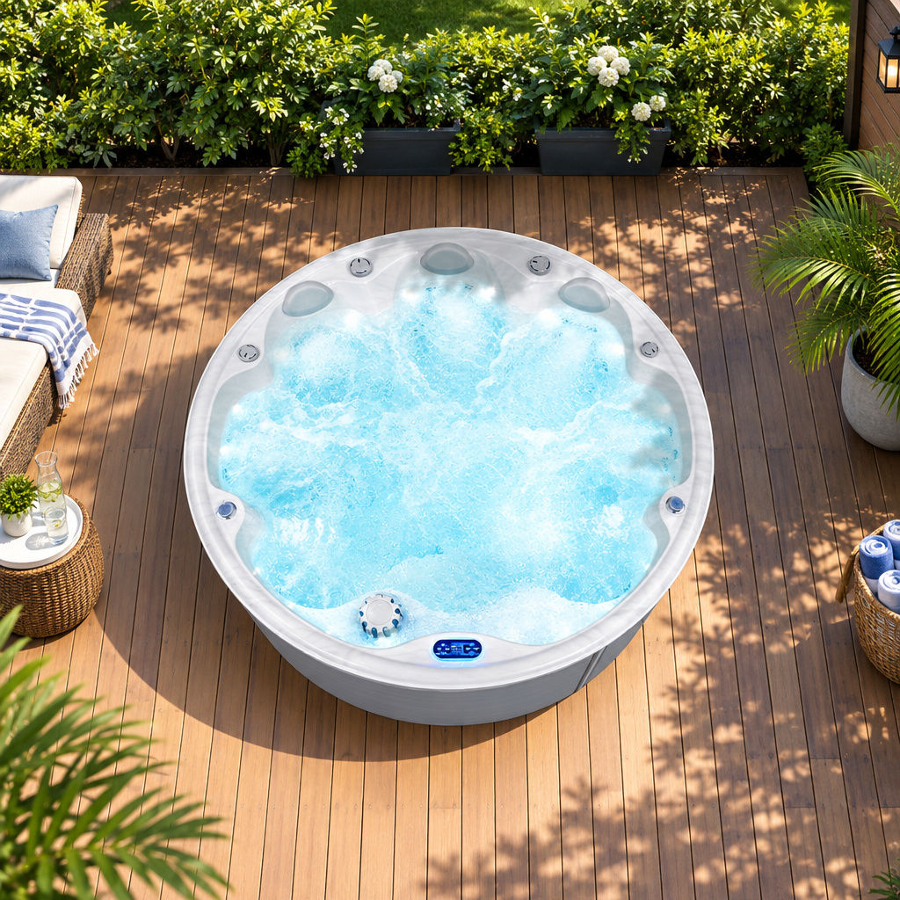
Radial Seating and Social Sightlines in Round Hot Tubs
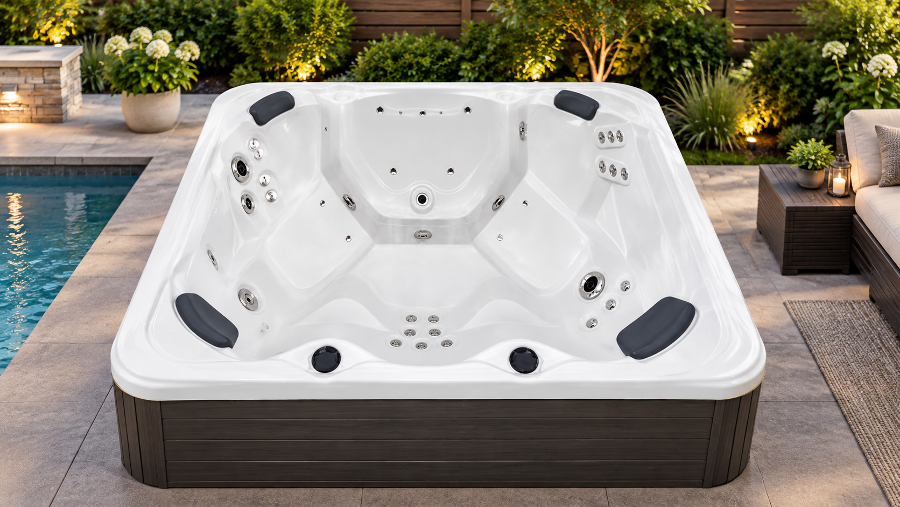
Shell shape affects how people interact during a soak. In a square tub, guests along a straight bench often sit side by side and must turn to talk. A circular tub arranges everyone around a shared center, so each person can see most of the group without twisting. For a group that spends most of a soak talking, that difference in sightlines can matter as much as the jet layout.
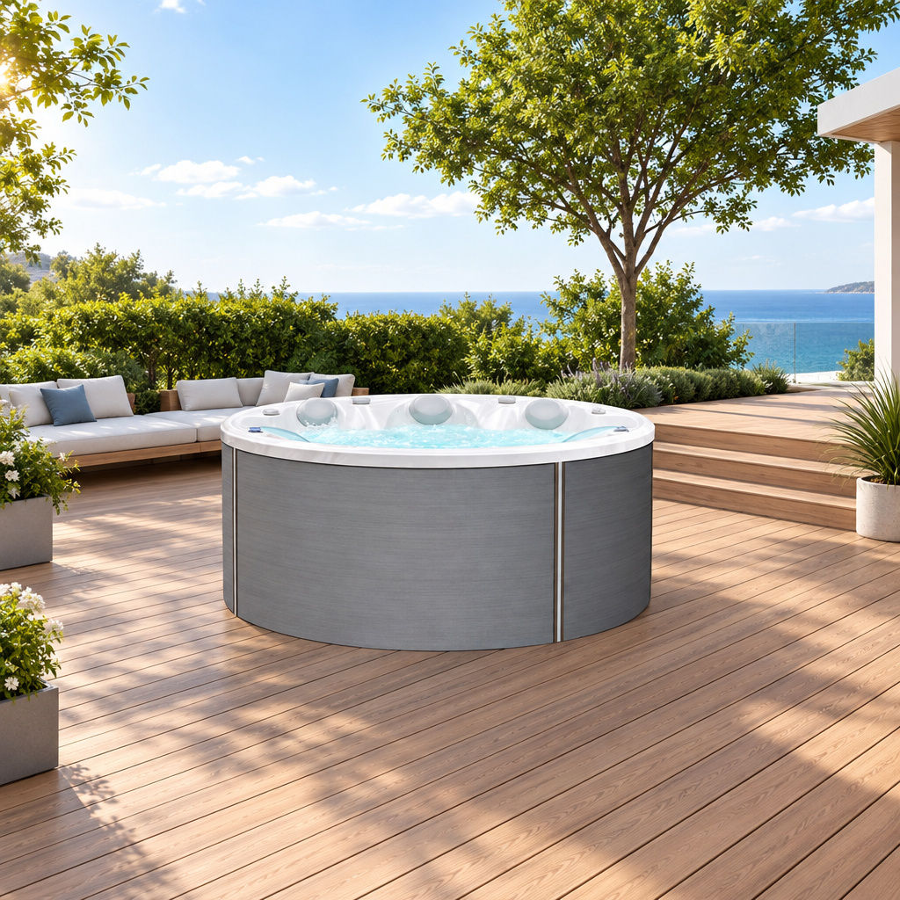
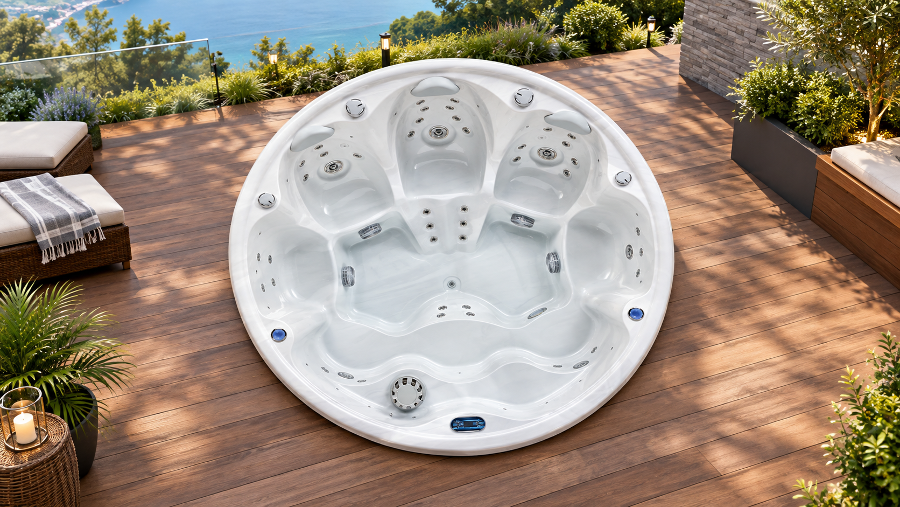
That arrangement suits households that use the spa mainly for conversation. In an 8 person round hot tub, seats sit at similar distances from the center, which gives the group a more even feel. Seat shapes and jet layouts still vary between positions, so it is worth sitting in each seat during a showroom visit before deciding.
Space Efficiency, Footprint, and Deck Integration
Whether a round or square tub fits better depends largely on the shape of the site. A circular spa can sit comfortably in a curved garden bed or a rounded patio. A square spa often lines up more neatly against a straight wall, railing, or rectangular deck edge. Neither shape wins in every case, because the result depends on the real dimensions of each model and the space around it.
Because the right choice depends on measurements, compare the actual footprint of each candidate model against the planned space. Mark the outline on the ground and check walking paths, cover storage, and access to the service panel. Leave enough room for people to step in and out without squeezing past furniture. A tub that technically fits but blocks the route to the house will be a daily annoyance.
Hydrotherapy Hydraulics: Pumps, Jets, and Flow Dynamics
Interpreting Jet Counts: Pressure vs. Total Numbers
A higher jet count does not by itself guarantee a stronger massage. The pressure at each jet depends on pump capacity, the plumbing layout, and how many jets run at once. A tub with fewer jets and enough pump power can feel stronger than one with many jets sharing the same flow. When comparing models, ask how many jets each pump serves and how the seats feel with everything running.
Because of this, a wet test is more useful than a spec sheet. Sit in each seat with the pumps running and notice where the streams land on your back, shoulders, and feet. Jet placement is a matter of fit as much as power, since people of different heights will feel the same seat differently.
Dual Water Pump Architectures and Dedicated Circulation Loops
Large spas often split their jets between two pumps rather than relying on one. With more jets in the tub, a second pump adds flow capacity for the full array. How the jets are divided between pumps varies by model, so ask the dealer which seats each pump serves. On some models, two pumps also let owners run one group of jets at a time when only a few people are soaking.
Many spas also include a small circulation pump. Its job is to move water through the filter and heater during routine cycles, so the larger jet pumps do not have to run for those tasks. A low-power circulation pump is generally quieter and draws less power than a jet pump, which suits frequent, scheduled filtration.
Water Hygiene Engineering: Multi-Stage Sanitation for Large Bather Loads
The Filtration Burden of High Organic Bather Loads
Eight people bring more sweat, skin oils, lotions, and cosmetics into the water than two people do. These contaminants use up sanitizer faster, so a busy evening can leave the water short of disinfectant by the end. Larger groups therefore call for more frequent testing and, when needed, extra sanitizer. Asking guests to shower before soaking also reduces how much oil and lotion enters the water.
Filtration handles the physical side of the problem. Cartridge filters trap particles and some oils as water circulates through them. Regular rinsing and timely cartridge replacement keep water moving through the system. When filters clog, flow drops, and the water tends to turn cloudy sooner. For a tub that regularly hosts eight people, a spare cartridge makes it easier to rinse one while the other stays in use.
Complementary Disinfection: Ozone and Ultraviolet Systems
Some spas add ozone and ultraviolet (UV) treatment alongside filtration and chemical sanitizer. Ozone is an oxidizer that helps break down organic contaminants in the water passing through the system. UV units expose water flowing through a chamber to ultraviolet light, which can inactivate many microorganisms. Both work on circulating water, so the amount of water treated depends on how long circulation runs each day.
Ozone treatment: Helps oxidize organic material in water that passes through the ozone injector.
UV treatment: Acts only on water inside the UV chamber, so it does not reach water sitting in the tub.
Cartridge filtration: Traps suspended particles and needs regular cleaning to keep working.
Residual sanitizer: EPA-registered chlorine or bromine remains necessary to protect bathers in the tub itself.
Neither ozone nor UV leaves a lasting disinfectant in the water. That is why public health guidance still calls for a residual sanitizer and balanced pH. Treat these systems as additions to routine water care, and keep testing on the same schedule whether or not a spa includes them. For a busy tub, they are best seen as a supporting layer that works alongside chlorine or bromine.
Technical Case Study: Engineering Overview of the VS-001L Round Hot Tub
Dimensional, Structural, and Hydraulic Specifications
A specific model shows how these planning points apply in practice. The VS-001L from Victoria Star, our own brand, is a circular eight-seat spa in the Luxury Series. It is designed for gatherings with family and friends, which makes it a useful example for checking seating, pump setup, water care, and site needs. The figures below come from the manufacturer’s product specifications.
Technical Parameter
Manufacturer Specification (VS-001L)
Listed Dimensions
2200 mm × 910 mm (about 7 ft 3 in × 35.8 in)
Seating Capacity
8 Seats
Total Jets
49
Water Pumps
2 × 2 HP
Circulation Pump
1 × 0.35 HP
Heater
1 × 3 kW
Total Power Supply
6.25 kW
Control System
KL2022 with Smart Keypad Control
Water Care
Replaceable filter cartridges, ozone, and UV
Shell Color
Porcelain
Cabinet Skirt
Aluminum-plastic skirt with integrated LED trim
Cabinet Colors
Platinum, Midnight
Audio
Bluetooth system with 4 AV speakers
The specification sheet lists two dimensions, 2200 mm and 910 mm, without labeling which is the diameter and which is the height. Before planning delivery or deck layout, ask for the dimensional drawing to confirm the orientation. That drawing also helps the installer plan the base and the delivery route. Accurate dimensions matter for cover sizing too, and for checking clearance under gates and eaves.
On the hydraulic side, the two 2 HP water pumps drive the 49 jets, and a separate 0.35 HP circulation pump is listed for routine circulation. The water care package combines filter cartridges with ozone and UV. As the previous section explains, a residual sanitizer is still required with this setup. The 3 kW heater and 6.25 kW total power figure feed into the electrical planning covered later.
Smart Automation and Ergonomic Control Systems
Controls matter more in a large spa, because more people may be adjusting settings during a session. The VS-001L uses a KL2022 control system with a smart keypad mounted on the rim. The owner’s manual is the best reference for which functions the keypad covers and how to set filtration schedules. Before buying, it is reasonable to ask the dealer for the manual so you can see how the controls work.
The model also includes features aimed at evening use. A Bluetooth audio system plays through four AV speakers. Multi-color LED lighting runs around the perimeter and under the water, and illuminated water fountain jets add moving light at night. These features suit the backyard gatherings and evening soaks that the product data lists as typical uses.
Site Preparation and Structural Engineering Requirements
Calculating Operating Wet Weight and Substructure Support
Before ordering an eight-seat spa, confirm that the chosen site can carry it. An empty shell may look manageable, but water and people add a great deal of weight. The operating load combines the dry weight of the spa, the weight of a full water fill, and the combined weight of all occupants. Getting these numbers early prevents the spa from arriving before anyone has confirmed the base.
Establish dry weight: Get the dry weight of the shell and cabinet from the manufacturer’s documentation.
Calculate water weight: Multiply the water capacity by about 8.34 pounds per gallon, or 1 kilogram per liter.
Add occupant weight: Include a realistic allowance for eight adults.
Divide by the footprint: Use the verified footprint to estimate load per square foot for the engineer or installer.
Confirm the base: Make sure the base is level and supports the full contact area of the spa.
Whether a deck can carry this load depends on how that particular deck was designed and built, so there is no general rule to rely on. Elevated decks in particular need review by a qualified structural professional. For ground-level installs, follow the manufacturer’s foundation requirements and get site-specific advice on soil and slab design. Sharing the full weight calculation with that professional gives them the inputs they need.
Dedicated Electrical Infrastructure and GFCI Safety
A spa with two jet pumps, a circulation pump, and a 3 kW heater needs a properly sized electrical supply. The VS-001L lists a total power supply of 6.25 kW. That figure alone does not tell you the required voltage, breaker size, or wiring method, so those details must come from the unit’s wiring documentation. Ask for that documentation before any trenching or panel work begins, since changing a circuit afterward costs more.
Electrical rules also cover GFCI protection and where the disconnect switch can sit. In the United States, the National Electrical Code generally calls for a maintenance disconnect within sight of the spa and at least 5 feet away horizontally, with some exceptions. Other jurisdictions use different rules. A licensed electrician should confirm the circuit, GFCI protection, and disconnect location, and handle any required permits.
Delivery Pathway and Service Access Clearance
Getting a large spa into a backyard takes planning. Spas are often moved on their side on a spa dolly, so the delivery route must allow for the tub’s largest dimensions. Low eaves, air conditioning units, gas meters, and narrow gates are common obstacles, and measuring each one ahead of time avoids surprises on delivery day.
Once the spa is in place, technicians need access to the equipment for pump checks, plumbing repairs, or winterization. Find out which side holds the service panel and follow the manufacturer’s access requirements. Building a deck or wall tight against that side can mean tearing out materials later just to reach a pump. Keeping planters and furniture on that side movable also makes routine service easier.
Energy Efficiency, Thermal Retention, and Maintenance Protocols
Managing Thermal Loss in High-Volume Spas
Hot tubs are commonly kept between 100°F and 104°F, and 104°F is the widely recommended upper limit. Keeping a large volume of water at that temperature outdoors takes ongoing energy. A large share of the heat escapes from the water surface, so a well-fitted cover makes a clear difference to running costs. Closing the cover whenever the tub is not in use is one of the simplest ways to control heating costs.
Insulated cover: A tapered cover with a foam core sheds rain and limits heat loss from the surface.
Cabinet insulation: Insulation inside the cabinet reduces heat loss through the sides of the spa.
Cover fit: A cover that seals well at the rim keeps cold air and rain out.
Scheduled circulation: Regular circulation keeps water moving through the heater so the temperature stays even.
The base matters too. A spa sitting on a cold concrete pad loses some heat downward, and insulation in the floor area of the cabinet can reduce that. Ask the dealer how the cabinet and base are insulated, especially if you live somewhere with freezing winters. A spot sheltered from strong wind can also help, since wind across the cover and cabinet increases heat loss.
Daily Water Testing and Periodic Drain-and-Refill Schedules
Regular testing keeps the water safe and comfortable and helps protect equipment from scale and corrosion. CDC guidance for home hot tub owners recommends testing sanitizer and pH at least twice a day, and more often when many people use the tub. Adjust the water based on each result and follow the sanitizer label. Heavy use consumes sanitizer quickly, so a crowded session calls for extra tests and, if needed, a shock treatment.
Free chlorine: CDC guidance for hot tubs calls for at least 3 ppm.
Bromine: CDC guidance also lists bromine targets for hot tubs; follow the sanitizer label if you use bromine.
pH: CDC guidance gives a range of 7.0 to 7.8.
Total alkalinity and calcium hardness: Common targets vary by product and source water, so follow the spa and chemical manufacturers’ recommendations.
Even with careful balancing, dissolved solids build up in the water over time. A common planning formula comes from CDC guidance: divide the spa volume in gallons by 3, then divide by the average number of users per day. The result is an approximate number of days between water changes. Use it as a guide, and change the water sooner if testing shows problems.
Frequently Asked Questions (FAQs)
How much clearance is required around an 8 person hot tub for installation and service?
The required clearance depends on the model and where its service panel sits. Check the manufacturer’s installation guide for access requirements on the equipment side. Also leave room for a cover lifter if you plan to use one, since the folded cover needs space behind the spa. Plan enough walking space for getting in and out safely, and keep the service side free of permanent structures.
Can a standard wooden patio deck support an 8 person hot tub?
It depends on how the deck was designed and built. Work out the spa’s filled weight plus eight adults, divide by the footprint, and give those numbers to a qualified structural professional. Many decks need added framing or support before they can carry a large spa, and some sites are better served by a ground-level base.
What electrical supply is needed to run both pumps and the 3 kW heater simultaneously?
The VS-001L lists a total power supply of 6.25 kW, but the exact voltage, breaker size, and wiring must come from the manufacturer’s electrical installation manual. Some spa control systems limit the heater while jet pumps run if the supply is undersized, so it is worth asking how this model behaves. A licensed electrician should confirm the circuit and GFCI protection for your location.
How often should the water be changed in a large-capacity hot tub?
Use the CDC formula as a starting point: divide spa volume in gallons by 3, then divide by the average number of daily users. A tub that hosts all eight seats often will need changing sooner than one used by two people. Change the water early if it resists balancing, foams persistently, or stays cloudy with clean filters, and follow any interval in the owner’s manual.
Do ozone and UV sanitizers eliminate the need for chlorine or bromine?
No. Ozone and UV treat the water passing through the equipment, but neither leaves a lasting disinfectant in the tub. Public health guidance calls for an EPA-registered residual sanitizer, such as free chlorine at 3 ppm or more, along with balanced pH. Test sanitizer and pH at least twice a day, as CDC guidance recommends, and adjust based on the results.
Conclusion: Strategic Selection and Value Realization
Choosing an 8 person hot tub means matching the seating layout, pump setup, and water care to how your household will actually use it. Sit in the seats, check the footwell, and look past jet counts to how the massage feels. Then confirm the site: filled weight, electrical requirements, delivery route, and service access. With those checks done, a large-capacity hot tub for 8 people can serve both family evenings and bigger gatherings for many seasons.
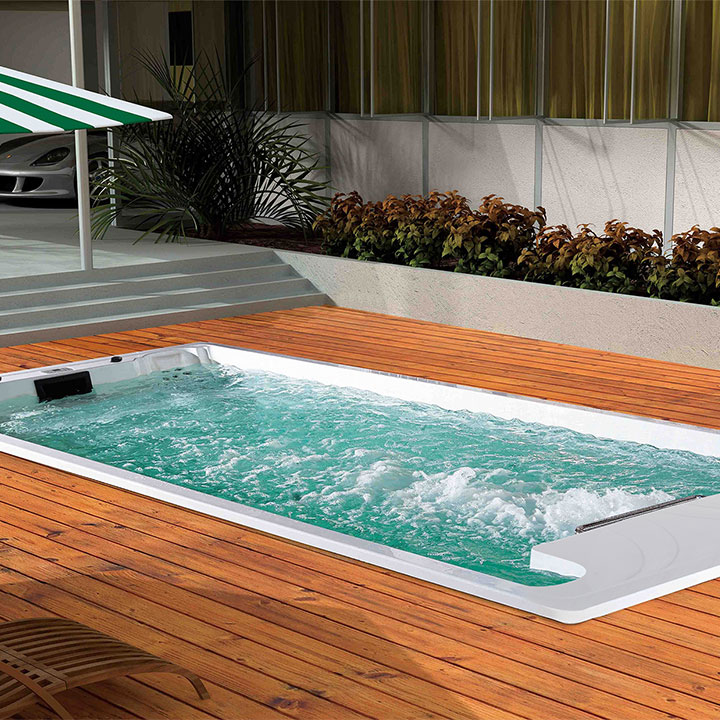
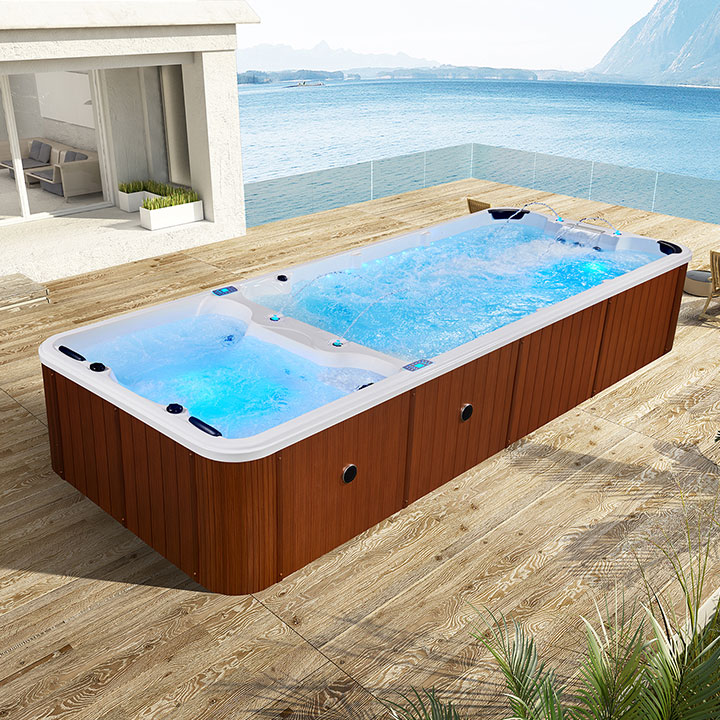
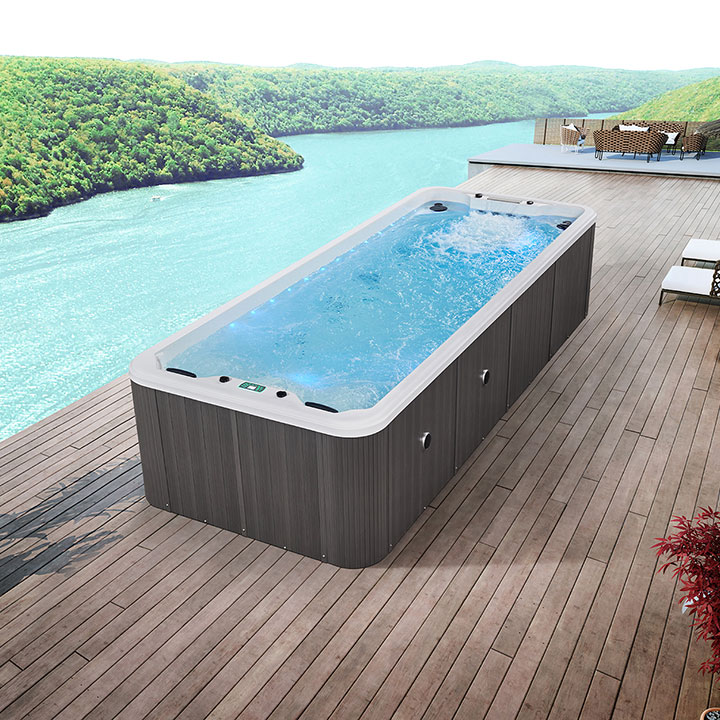
Victoria Star Swim Spa offers the perfect balance between exercise and relaxation, whether you want to swim for fitness or relax in the spacious seating.
Victoria Star Swim Spa offers the perfect balance between exercise and relaxation, whether you want to swim for fitness or relax in the spacious seating.