7 Seater Hot Tub Architecture and Engineering: The In-Ground Spa Guide
Home / News / 7 Seater Hot Tub Architecture and Engineering: The In-Ground Spa Guide
November 02, 2026
Investing in a 7 seater hot tub transforms residential outdoor environments, yet real-world satisfaction depends on engineering precision rather than marketing numbers. When multiple adults share a single body of water, volume displacement, dynamic pump loads, and structural sub-bases face rigorous physical demands. Selecting the right spa requires evaluating footwell geometry, hydraulic flow rates, electrical sub-panel requirements, and ongoing water hygiene.
Without an understanding of spatial boundaries and mechanical clearances, buyers risk compromised comfort and costly structural revisions. This guide analyzes hydraulic architectures, in-ground construction steps, and key specifications using the VS-PC303 octagonal spa to illustrate practical installation decisions.
Understanding 7 Seater Hot Tub Spatial Layouts and Ergonomics
Many buyers assume a hot tub rated for seven occupants accommodates seven adults comfortably under all circumstances. In reality, usable space hinges entirely on the shell mold’s internal geometry and the clearance allocated within the central footwell. Traditional square hot tubs often direct every bather toward an identical central point, creating awkward leg overlap and limited personal clearance.
Nominal Capacity Versus Usable Bather Footprint
Nominal seating counts frequently include shallow transition benches or cooling steps that prove uncomfortable for long therapy sessions. A functional spa for seven requires contoured, multi-level seating pockets that balance immersion depth with adequate lumbar support, though actual comfort depends on the vessel’s fill volume, bather load, and design.
Different body profiles require dedicated immersion levels to prevent taller bathers from feeling cramped while shorter occupants avoid drifting off the seat. Ergonomic shell molding resolves this by varying individual seat elevations, allowing users to select an immersion height that aligns hydrotherapy nozzles precisely against thoracic and lumbar regions.
The Geometry of Octagonal Shell Engineering
Octagonal spa configurations offer a distinctive seating arrangement by angling the perimeter positions. Rather than facing each other in direct perpendicular lines, bathers sit along angled planes that may open peripheral sightlines and redistribute leg space compared to conventional square formats.
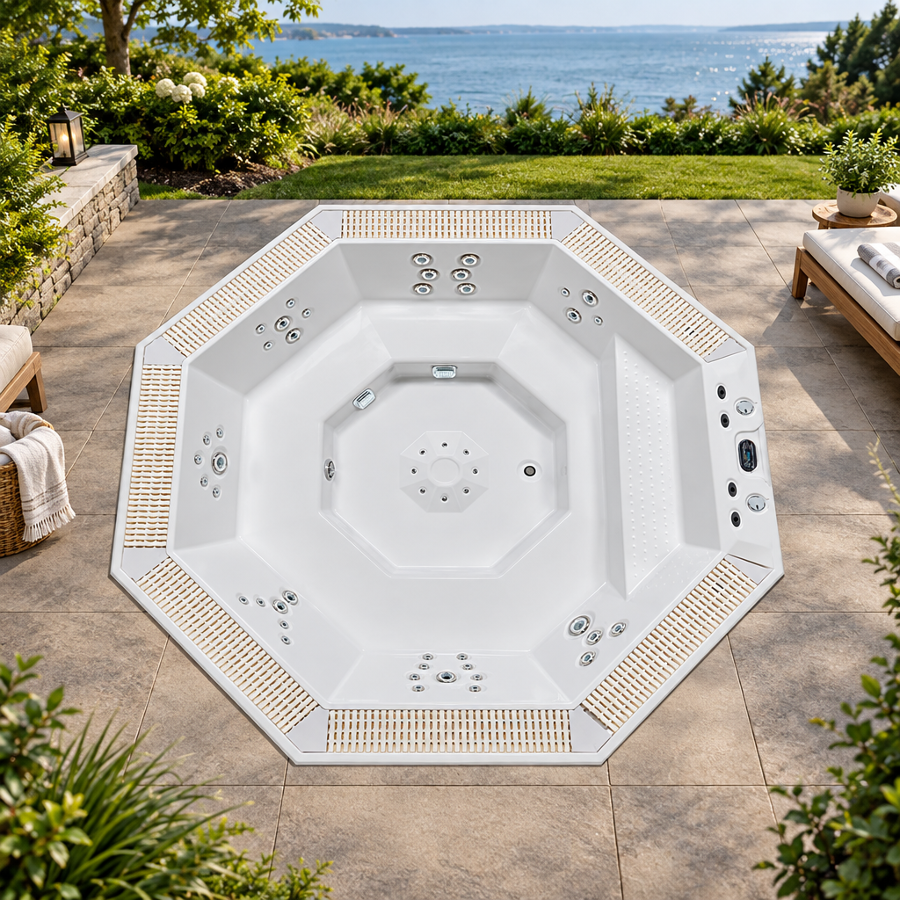
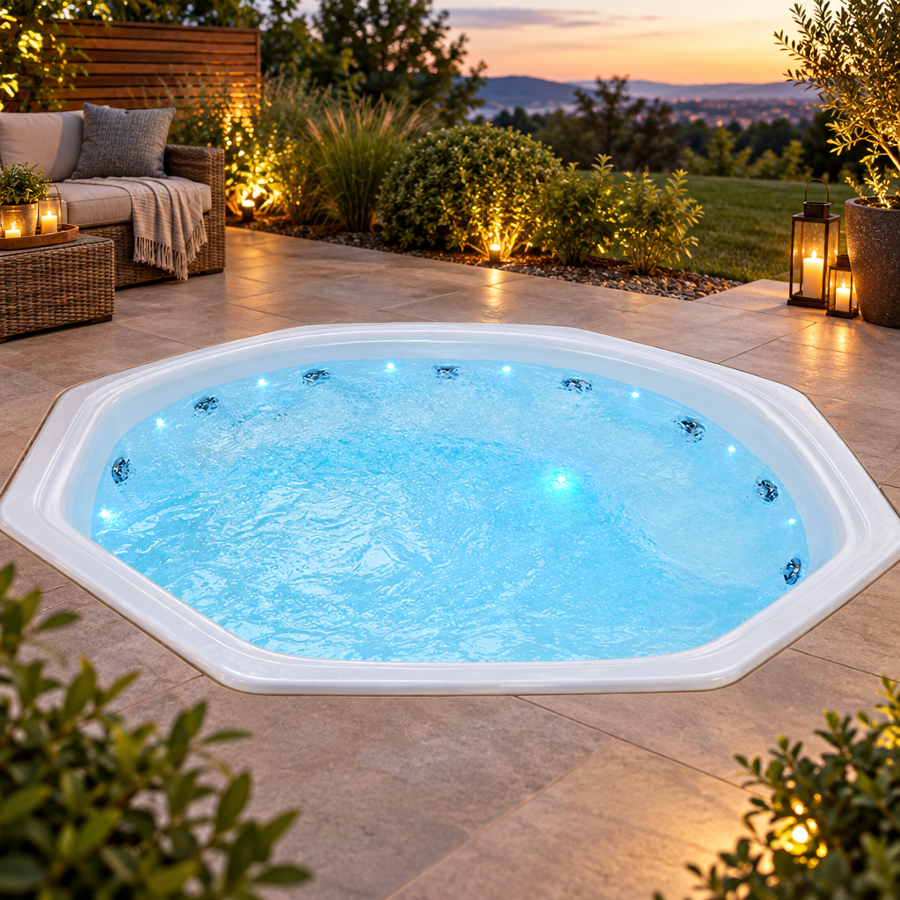
In an octagonal basin such as the VS-PC303, an overall footprint of 3000 × 3000 mm accommodates seating for up to seven occupants. The symmetrical octagonal layout distributes weight across an even geometric footprint.
In-Ground Sunken Spas vs. Portable Cabinet Hot Tubs
A pivotal architectural crossroad involves choosing between an above-ground portable hot tub and a sunken, flush-mounted in-ground installation. Portable self-contained units house components within exterior skirt cabinetry, whereas in-ground installations integrate seamlessly with finished hardscaping surfaces. Each approach presents contrasting aesthetic impacts, installation investments, and long-term maintenance requirements.
Architectural Presence and Deck Integration
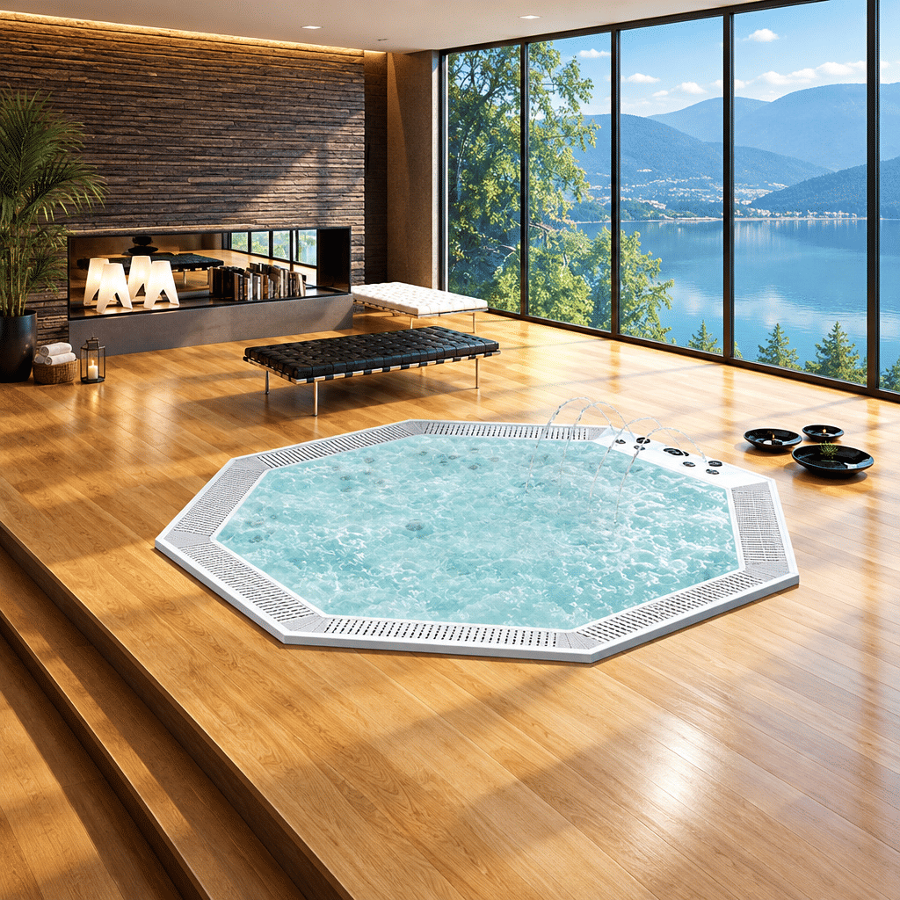
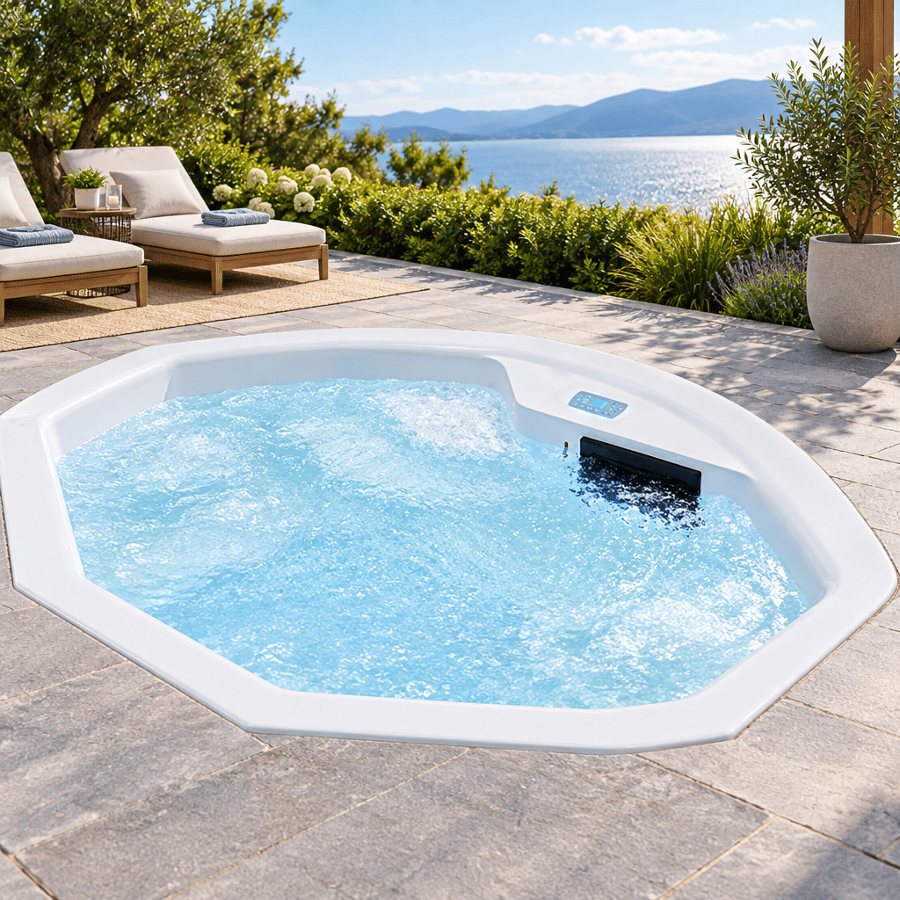
A flush-mount spa for seven eliminates the visual obstruction of a massive cabinet projecting above terrace floorboards. Aligning the spa rim directly with natural stone, porcelain tiling, or composite decking creates seamless visual continuity across outdoor pavilions. For luxury backyards and pool surrounds, an in-ground format delivers clean horizontal lines that preserve garden perspectives and open vistas.
Flush placement also alters entry dynamics, enabling bathers to step down into the water via integrated coping rather than climbing exterior access steps. However, designers must detail surrounding drainage channels diligently to keep surface runoff and patio wash water from spilling inward across the spa perimeter grates during storms.
Structural Vault Design and Mechanical Clearances
Locating hydrotherapy components below grade introduces specific mechanical requirements that surface-mounted spas do not encounter. Equipment subterranean vaults must accommodate circulation pumps, blowers, electrical controllers, and plumbing unions with generous physical clearance for routine inspection. Trapping these assemblies against damp soil invites premature corrosion, unmanageable moisture buildup, and difficult repair procedures.
Subterranean Vault Ventilation: Continuous airflow must circulate across mechanical pumps to prevent heat buildup and dissipate high atmospheric humidity.
Positive Gravity Drainage: The utility vault floor requires a dedicated drain pipe or an automatic submersible sump pump to prevent flooding during heavy rainfall.
Perimeter Access Clearance: Follow the manufacturer’s service-clearance drawings and confirm access needs with your installer to ensure technicians can reach union couplings, gate valves, and keypad wiring harnesses for diagnostics.
Thermal Sub-Base Considerations: Concrete vault floors may benefit from rigid insulation sheets to minimize thermal bridging from the warm water vessel directly into the cold surrounding earth.
Thermal Retention Realities Across Installation Styles
Thermal dynamics differ between self-contained units and sunken spas, but heat retention depends on the specific spa’s insulation, cover quality, and installation method. Standalone portable tubs enclose the shell inside an insulated cabinet cavity that may trap motor waste heat to warm the plumbing lines. Below-grade installations can lose conductive heat to the surrounding foundation soil depending on the shell insulation and cover system.
Both installation styles demand thorough insulation paired with a fitted thermal cover to minimize heat loss and maintain energy efficiency.
Technical Evaluation: Engineering Analysis of the VS-PC303
Evaluating a high-capacity hot tub requires inspecting structural materials, pumping capacity, and total electrical demand. The VS-PC303 represents an octagonal in-ground spa engineered for flush integration in premium indoor retreats or sunken outdoor patios. Examining its technical specifications clarifies how structural components harmonize to sustain hydrotherapy performance across seven seats.
Technical Parameter
Engineering Specification (VS-PC303)
Functional Application Impact
Layout Geometry
Octagonal Flush-Mount Form Factor
Angled seating arrangement for seven occupants
Physical Dimensions
3000 × 3000 × 1000 mm (approx. 118 × 118 × 39 in)
Broad multi-bather vessel volume with uniform perimeter support
Total Jet Complement
50 Targeted Hydrotherapy Jets
Balances water output across thoracic, lumbar, and leg zones
Primary Water Pump
1 × 3 HP High-Output Unit
Provides therapeutic massage pressure to main jet manifolds
Secondary Hydronic Pumps
1 × 1 HP Circulation / 1 × 0.4 HP Air Pump
Supports filtration and hydrotherapy functions
Thermal Heating Element
1 × 3 KW Electric Resistance Core
Maintains stable water temperature against ambient surface cooling
Total Connected Load
6.25 KW Electrical Infrastructure
Demands a dedicated sub-panel with appropriate distribution wiring
Shell Construction
One-Piece Acrylic Liner with PU Insulation
Ensures impervious barrier resistance with solid thermal retention
Acrylic Shell Substrate and Thermal Polyurethane Layering
Structural longevity in an in-ground spa starts with the primary contact barrier. The VS-PC303 features a one-piece formed acrylic shell, manufactured with a smooth Porcelain white surface texture. According to the product specification, high-density polyurethane insulation is incorporated alongside a heavy-duty support structure.
Buyers should consult the manufacturer for specific load ratings and installation requirements to ensure proper structural support for the filled spa and occupants.
Hydronic Flow Distribution and Multi-Pump Configuration
Delivering therapeutic massage pressure across 50 individual jets requires balanced flow dynamics rather than relying on a solitary overloaded motor. The VS-PC303 lists a 3 HP water pump alongside 50 hydrotherapy jets described as targeting the shoulders, back, waist, and lower extremities. Working in tandem, a 0.4 HP air pump contributes to the hydrotherapy experience.
A separate 1 HP circulation pump supports the multi-layer filtration system, maintaining water movement through mechanical filtration media.
Control Electronics, Lighting, and Audio Integration
Real-time spa operation relies on intuitive, weather-sealed digital interfaces that withstand persistent thermal steam and water contact. The VS-PC303 incorporates a KL2022 smart keypad control system mounted directly onto the perimeter rim. This control console manages the multi-color LED mood lighting package, which combines perimeter waterline point lights with a central underwater luminaire.
For immersive relaxation, a built-in Bluetooth audio module pairs with two AV speakers positioned along the spa rim. At Victoria Star, for us the primary objective remains pairing tactile physical controls with advanced manufacturing methods to deliver seamless operation across all indoor and outdoor wellness spaces.
Site Planning, Civil Foundation, and Installation Process
Installing an expansive 3-meter in-ground hot tub requires systematic civil and electrical planning before delivery. Because a filled spa represents several tons of concentrated mass, improper installation can lead to foundation cracking, moisture intrusion, and severe electrical hazards. The following structured sequence outlines essential project phases.
Structural Sub-Base Engineering: Excavate the pit according to the manufacturer’s dimensional prints, allowing ample perimeter space for mechanical access and drainage. Obtain the manufacturer’s installation and support requirements, then have a qualified local professional design and pour the foundation sized for the filled tub, occupants, soil conditions, and site characteristics.
Gravity Drainage and Sump Configuration: Form a dedicated containment pit with fall lines sloping away from the equipment footprint. Have the installer determine an approved drainage route under local codes and the manufacturer’s installation instructions, whether to stormwater systems, sanitary connections, or another permitted discharge point, or set up an automatic submersible pump with an independent float switch to prevent vault flooding during unexpected storms.
Dedicated Electrical Feed Preparation: Obtain the VS-PC303 wiring diagram and have a licensed electrician determine the conductor type, conduit requirements, supply voltage, phase configuration, overcurrent protection, disconnect specifications, and GFCI or RCD requirements for the installation according to local electrical codes. The manufacturer specifies a 6.25 KW electrical load.
Rigging, Crane Positioning, and Placement: Given the 3000 mm footprint of an octagonal unit, verify site overhead clearances for tree limbs, utility lines, and structural eaves. Utilize an overhead crane or specialized rigging straps to guide the spa shell into the sunken pit without twisting the frame or stressing protruding jet manifolds.
Hydraulic Interconnection and Vault Sealing: Connect pressure-rated plumbing unions. Have the installer determine required electrical bonding under local codes and the manufacturer’s wiring and installation instructions, and secure electrical conduits inside the utility box. Complete the final hardscaping deck edges using removable decking segments, ensuring technicians can access all plumbing unions in the future.
Water Management, Filtration Physics, and Hygiene Standards
A 7 seater hot tub experiences rapid shifts in bather waste, requiring proactive sanitization to maintain clear, hygienic water. Heat accelerates bacterial reproduction, while organic loads from perspiration and body oils deplete chemical sanitizers swiftly. Managing a large-capacity vessel demands disciplined filtration schedules alongside balanced sanitizer residuals.
Surface Skimming and Multi-Layer Mechanical Media
Suspended particles, hair, and surface oils must pass through mechanical filtration before water reaches the heater core and pump impellers. The VS-PC303 uses an integrated rim-level skimmer mouth to capture floating debris, paired with a multi-layer circulation filtration system. Owners should identify the supplied filter type and follow its manufacturer’s cleaning and replacement instructions to maintain necessary water flow rates and prevent hydraulic cavitation within the circulation pump.
Secondary Disinfection: Ozone and Ultraviolet Purification
To curb ongoing chemical consumption, advanced hot tub architectures incorporate secondary sanitizing systems. The manufacturer describes ozone or ultraviolet disinfection technology as an available complementary treatment system. Buyers should confirm which system option is included with their configuration.
While secondary systems reduce chemical demand, they do not provide a lingering residual sanitizer in the water. Bathers must maintain trace levels of free chlorine or bromine within the main tub to protect against cross-contamination during active soaking sessions.
Health Standards and Chemical Balance Protocols
Adhering to public health parameters shields bathers against waterborne pathogens. CDC guidance provides parameters for maintaining safe residential and commercial aquatic venues:
Water Temperature Ceilings: Operating temperatures should not exceed 104°F (40°C), as prolonged soaking in higher temperatures elevates core body heat and risks heat exhaustion.
Free Chlorine Concentration: CDC’s home hot-tub guidance recommends maintaining at least 3.0 ppm free chlorine. CDC’s Legionella-control toolkit identifies a range of 3.0 to 10.0 ppm for facilities implementing enhanced disinfection. Owners should follow their applicable health authority and product instructions.
Alternative Bromine Levels: For bromine-treated spas, active chemical residuals are generally held between 4.0 and 8.0 ppm for stable disinfection in elevated water temperatures.
Target pH Range: CDC’s Legionella-control toolkit identifies 7.2–7.8 as the target pH range. Owners should follow their applicable health authority and product instructions.
Standard protocols emphasize that water replacement frequency depends on overall spa volume and daily user load. A common calculation indicates: replacement frequency in days equals (spa volume in gallons divided by 3) divided by average daily bathers. Since the manufacturer leaves specific volume fields open for custom flush-mount integrations, owners should confirm exact fill volume with their supplier before scheduling periodic refills.
Suction Entrapment Mitigation and Regulatory Safety
High-volume hot tubs pull substantial water through floor drains to supply powerful jet pumps. If a bather blocks an active suction inlet, dangerous hydraulic vacuum forces can cause severe physical entrapment. Mitigating this risk requires strict compliance with modern drainage engineering standards.
Buyers should obtain documentation for the installed drain covers and suction system, and have the installer determine applicable federal, state, and local requirements. The VS-PC303 incorporates slatted perimeter overflow grates alongside a floor suction drain as part of its circulation architecture.
Pre-Purchase Verification Checklist for Prospective Buyers
Before finalizing procurement for an expansive sunken spa, prospective owners should confirm several project variables with their pool contractor, structural engineer, and supplier:
Engineering Drawings: Secure dimensioned foundation plans, plumbing schematics, and dry-weight metrics to design the concrete support pad properly.
Electrical Requirements: Obtain the VS-PC303 wiring diagram showing the 6.25 KW power specification, and have a licensed electrician determine all supply, protection, and disconnect requirements for the installation according to local electrical codes.
Certified Drain Fittings: Obtain documentation for the installed drain covers and suction system, and have the installer determine applicable federal, state, and local requirements to ensure proper suction-entrapment protection.
Service Clearance Hatches: Ensure decking designs include removable access hatches around all pump unions, heating elements, and the KL2022 control pack.
Sanitation Component Bundling: Clarify with the distributor whether the ozone generator or UV disinfection unit arrives as factory-standard equipment or an optional add-on.
Frequently Asked Questions (FAQs)
What electrical supply is needed to power a 7 seater hot tub?
A spa for seven with substantial heating and multi-pump systems requires careful electrical planning. The VS-PC303 carries a rated power demand of 6.25 KW as specified by the manufacturer. Buyers should obtain the VS-PC303 wiring diagram and have a licensed electrician determine all conductor, conduit, supply voltage, phase configuration, overcurrent protection, disconnect, and GFCI or RCD requirements for the installation according to local electrical codes. The circuit must never be shared with common household appliances.
Can a large in-ground spa like the VS-PC303 be installed on a raised deck?
Elevated-deck suitability depends on the filled spa’s total dynamic load and the deck’s structural design. A unit spanning 3000 × 3000 mm carries substantial dynamic mass when filled with water and occupied by seven adults. A qualified structural engineer must assess the load-bearing requirements and specify the appropriate structural framing method for the specific deck and site conditions before positioning an in-ground spa above grade.
How often should the water in a high-capacity hot tub be replaced?
Water replacement depends directly on the total bather load and maintenance diligence. Using a standard calculation—water replacement frequency in days = (spa volume in gallons ÷ 3) ÷ average daily users—provides an approximate maintenance timeline. Because the official VS-PC303 documentation leaves water capacity open for customized builds, consult your sales representative for the exact gallon rating of your configuration to set an accurate water dump-and-fill schedule.
What makes an octagonal hot tub layout advantageous for multiple bathers?
An octagonal layout positions individual seats along angled planes rather than traditional 90-degree corners. The VS-PC303 features an octagonal format accommodating seven adults. This geometric arrangement may offer design considerations around sightlines and seating distribution compared to conventional square spa layouts.
Are secondary sanitation systems like UV and Ozone able to replace chlorine entirely?
Secondary sanitation systems cannot eliminate residual sanitizers completely. These secondary treatment systems reduce chemical demand, but they do not provide a lasting chemical residual in the primary vessel. Bathers must maintain standard free chlorine or bromine levels to guard against immediate cross-contamination.
Building Your Wellness Space with Confidence
Integrating a high-capacity 7 seater hot tub into your home is an investment in personal health, family time, and lasting property value. Achieving a dependable installation requires balancing eye-catching sunken architecture with sound civil engineering, proper electrical wiring, and strict water chemistry control. By evaluating shell insulation, pump capacity, and maintenance clearances during the planning phase, you protect your investment from unforeseen surprises.
A well-engineered sunken spa like the VS-PC303 offers an exceptional blend of expansive social seating and therapeutic water massage, turning ordinary backyards into private wellness retreats. When supported by a level concrete foundation, dedicated electrical service, and diligent sanitation routines, your chosen spa will deliver years of comfort and peak hydrotherapy performance.
Victoria Star Swim Spa offers the perfect balance between exercise and relaxation, whether you want to swim for fitness or relax in the spacious seating.
Victoria Star Swim Spa offers the perfect balance between exercise and relaxation, whether you want to swim for fitness or relax in the spacious seating.