6 Person Hot Tub Cost: Complete Price, Installation, and Ownership Breakdown
Home / News / 6 Person Hot Tub Cost: Complete Price, Installation, and Ownership Breakdown
November 02, 2026
Calculating the real 6 person hot tub cost requires looking well beyond the initial showroom price tag. A mid-sized spa brings warm-water massage and social space to your home, but 6-person spa pricing involves several line items that rarely appear on the first quote. Equipment tier, freight delivery, pad preparation, electrical hookups, and ongoing energy use all shape the final number. Understanding this full picture helps homeowners make informed choices without stumbling into unexpected utility bills or costly site retrofits.
How Much Does a 6-Person Hot Tub Cost?
Setting a realistic budget for a six-person spa means comparing construction materials, plumbing systems, and expected service life. The figures in this guide are approximate U.S. consumer-market estimates. Actual prices and lifespans vary by brand, region, climate, usage, warranty coverage, and installation quality, so treat every range as a starting point for local quotes.
Typical Price Tiers: Entry-Level to Luxury
Entry-level portable spas often fall between roughly $3,000 and $5,000. These units are usually rotomolded plastic or inflatable structures. Many use 120-volt plug-and-play wiring, which keeps installation simple but limits heater output and the number of pumps that can run at once.
Mid-tier hot tubs generally range from about $6,000 to $11,000. These spas typically use reinforced acrylic shells, foam or perimeter cabinet insulation, larger heaters on a dedicated circuit, and electronic topside controls that hold a set water temperature. For many families, this is where the 6 person hot tub cost starts to reflect permanent backyard use rather than occasional soaking.
Premium and luxury six-person spas commonly start around $12,000 and can run to $18,000 or more. Spas in this tier tend to add denser insulation, composite exterior cabinetry, multi-pump plumbing, and integrated water purification modules. With proper maintenance, these spas may offer a longer service life, though climate and care habits matter as much as the price tier.
Purchase Price vs. All-In Outlay
The invoice price of the tub is only the baseline of your total project. In many projects, delivery, site preparation, and electrical work add a few thousand dollars on top of the spa itself. That total depends heavily on your site, so the installation ranges later in this guide are illustrative rather than standard add-ons.
Smaller setup purchases also belong in your initial plan. A replacement or upgraded thermal cover, a cover lifter, entry steps, and a starter chemical kit can add several hundred dollars at checkout. Asking which of these items the dealer includes is often the quickest way to compare two quotes fairly.
Spa Tier
Approximate U.S. Base Price
Typical Service Life (Varies)
Common Shell Material
Typical Insulation Approach
Entry-Level
$3,000 – $5,000
3 – 5 Years
Rotomolded Polyethylene
Partial Air Gap / Lightweight Foam
Mid-Range
$6,000 – $11,000
8 – 12 Years
Vacuum-Formed Acrylic
Perimeter Insulation / Partial or Dual-Layer Foam
Premium & Luxury
$12,000 – $18,000+
15+ Years with Good Care
Reinforced Acrylic
Full or Multi-Layer Foam
The service-life column reflects common industry rules of thumb, not guaranteed outcomes. A well-maintained mid-range spa in a mild climate can outlast a neglected premium unit in a harsh one.
Key Factors That Determine 6-Person Hot Tub Pricing
Two spas with identical exterior dimensions can carry very different price tags. Most of the difference sits inside the cabinet, in choices buyers rarely see on the showroom floor. The shell and its reinforcement are the first place to look.
Shell Construction and Insulation Engineering
Most acrylic spa shells start as a flat acrylic sheet that is heated, vacuum-formed over a mold, and then backed with fiberglass and resin for strength. Sheet thickness and backing quality differ between manufacturers. Thinner material can stretch thin around tight seat curves, which is one reason buyers should ask about shell warranties rather than rely on appearance.
Insulation, meanwhile, decides how much heat escapes between soaks. Some designs fill the cabinet cavity with foam, while others insulate the cabinet walls and floor and trap warm air inside. Either approach can work well when paired with a tight-fitting cover. Budget units with little insulation tend to lose heat faster in cold weather, which shows up on the power bill.
Hydrotherapy Architecture: Pump Power, Jets, and Flow Dynamics
Jet count alone is an unreliable guide to massage strength. Each jet shares the water flow available in its circuit, so how the jets are grouped and supplied matters as much as how many there are. Pump selection, jet grouping, and plumbing layout work together.
Pump Horsepower: A horsepower rating on its own does not tell you a pump’s flow or the pressure at each jet. Actual performance depends on the pump’s flow curve, the plumbing, the jet design, and the overall system layout, so compare the whole hydraulic design rather than a single number.
Separate Circulation Pump: A small dedicated circulation pump can handle routine filtration, so the main jet pump does not need to run for every filter cycle.
Jet Types: Rotating and directional jets create different sensations. Preference varies by person, so a wet test at the dealer is worth more than a jet count or horsepower figure on a spec sheet.
Cabinet Materials and Exterior Weatherproofing
Exterior cladding has to cope with sun, rain, and in many regions freeze-thaw cycles. Wood cabinets look warm and natural, but they often need periodic sealing or staining to stay in good shape. That upkeep is a small but recurring cost of ownership.
Composite skirts, including aluminum-plastic panels, offer an alternative. Many are molded or printed with a woodgrain finish and do not absorb water the way untreated timber can. For owners who want less hands-on maintenance, a composite cabinet usually removes the staining routine entirely.
Water Care and Sanitation Technology
Traditional water care relies on regular dosing with chlorine or bromine, plus pH and alkalinity adjustment. Overdosing or poorly balanced water can be hard on covers, pillows, and seals over time. Supplementary systems aim to ease this workload, though they do not replace a sanitizer.
Many modern spas pair cartridge filtration with ozone, UV, or both. These systems can help oxidize contaminants and may lower how much sanitizer an owner adds week to week. Results vary by model and bather load, so owners still need to test water and follow the manufacturer’s water-care schedule.
Installation Costs Beyond the Sticker Price
Preparing your property for a six-person spa means following the manufacturer’s installation manual and local electrical and building codes. Skipping proper site preparation can lead to shell stress, warranty problems, or unsafe wiring. This part of the 6 person hot tub cost varies more than any other.
Foundation and Structural Sub-Base Preparation
A filled six-person spa, with water and bathers, can impose several thousand pounds of load on its base. Placing it on soft turf or uncompacted soil can lead to settling and uneven support. Confirm the manufacturer’s dry weight, water capacity, and filled weight, then have a qualified contractor or structural engineer assess the deck or foundation.
A reinforced concrete pad is the most common ground-level base. As an illustrative range, many homeowners pay roughly $1,500 to $3,500, depending on pad size, regional labor, and site access. Prefabricated interlocking spa pads over compacted gravel can cost less, often a few hundred dollars, but check that the spa manufacturer accepts them under its warranty.
Dedicated Electrical Wiring and Safety Disconnects
Electrical requirements depend on the specific model, not on seat count alone. Some six-person plug-and-play spas run on 120 volts. Many permanently installed acrylic spas instead use a dedicated GFCI-protected circuit, often 230/240 volts. The required voltage and amperage must come from the manufacturer’s installation manual and local code.
Licensed Electrical Labor: Running a new circuit from the panel to the spa is often quoted somewhere around $800 to $2,200, though distance, panel capacity, and trenching can push it higher.
Disconnect Placement: Under applicable NEC provisions, a readily accessible disconnect is generally required within sight of the equipment and at least five feet from the inside wall of the spa. Confirm the exact placement with your electrician and local authority.
Permits: Many local building departments require an electrical permit and inspection. Fees vary widely, so check with your municipality before work begins.
Delivery Access and Placement Logistics
Basic delivery may mean the spa is dropped at the driveway, leaving the move to the backyard up to the owner. Full-service delivery crews use spa dollies or sleds to bring the tub through side gates and onto the pad, usually for an extra fee.
Tight fence lines, steep slopes, or raised decks may require a crane. Crane service is often quoted in the range of several hundred to about $1,500, depending on location and lift complexity. It costs more, but it reduces the risk of damage to the spa, fences, and landscaping.
Installation Item
Illustrative Planning Range
What Drives the Price
Reinforced Concrete Pad
$1,500 – $3,500
Pad size, local labor, access for concrete trucks
Prefabricated Spa Pad
A few hundred dollars
Pad system, gravel base preparation
Dedicated Electrical Circuit
$800 – $2,200+
Distance from panel, panel capacity, trenching
Permits and Inspection
Varies by municipality
Local fee schedules and inspection rules
Crane Lift (If Needed)
Several hundred – $1,500+
Lift height, distance, crane size
These ranges help you build a first budget. Only written local quotes reflect your actual site.
Monthly and Annual Running Costs
Recurring costs decide whether a spa stays affordable after the first year. Heating costs shift with the seasons, while chemicals and filters tend to be more predictable. Knowing how to estimate each one protects you from surprise bills.
Electrical Utility Consumption
Most of the monthly power bill comes from keeping water warm between soaks. Water holds heat well, so a spa with good insulation and a tight cover often uses less energy holding a steady temperature than repeatedly reheating from cold.
To estimate your own cost, multiply monthly kilowatt-hours by your local electricity rate. As an illustrative scenario, a well-covered spa using 200 kWh in a month at an assumed rate of $0.17 per kWh would cost about $34. Winter weather, uncovered use, a worn cover, or frequent reheating can raise consumption well above that example.
Water Balancing, Sanitation, and Consumables
Balanced water chemistry helps control bacteria and protects equipment. Water that stays out of balance can contribute to scale on heater elements and corrosion of metal parts, seals, and fittings. Regular testing is the cheapest insurance a spa owner can buy.
Monthly chemical costs often fall around $25 to $45, covering sanitizer, shock, pH adjusters, calcium hardness increaser, and test strips. Actual spending depends on bather load and local water. Pleated cartridge filters are commonly replaced every 12 to 24 months, typically at $50 to $100 each.
Water Fill and Periodic Drain-and-Refill Cycles
Over time, body oils, minerals, and sanitizer byproducts build up as total dissolved solids. High levels can make water cloudy or foamy and make sanitizer less effective. At that point, adding more chemicals rarely helps.
Drain and replace water according to the manufacturer’s instructions and your water test results. A usage-based schedule is more reliable than a fixed calendar interval, since a heavily used family spa needs fresh water sooner than a lightly used one. Drain earlier if chemistry cannot be maintained, the water turns cloudy, or contamination occurs.
The cost of each refill depends on the spa’s stated water capacity and your local water and sewer rates. Use the manufacturer’s capacity figure, multiply by your per-gallon rate, and include any sewer charge. For most households on municipal water, a refill costs far less than a month of electricity.
Estimating Your First-Year Total
A first-year budget is easier to trust when every cost sits on its own line. Working through the items in order also shows where a quote may be missing something, which is how most budget surprises begin.
Start With the Spa Price: Use the written quote and note which accessories, such as the cover, steps, and starter chemicals, are already included.
Add Site Work: List the pad, the electrical circuit, permits, and any crane lift as separate items, each priced by a local contractor.
Add Delivery: Confirm whether the dealer’s fee covers driveway drop-off only or full placement on the prepared pad.
Estimate Twelve Months of Power: Multiply your expected monthly kilowatt-hours by your local rate, and assume the winter months will run higher.
Add Water Care: Include monthly chemicals, at least one replacement filter, and the water and sewer cost of each planned refill.
A total that looks surprisingly low usually has a missing line, most often electrical work or backyard placement. Adding a contingency on top of the sum leaves room for issues that only appear once work begins, such as a full breaker panel or a softer patch of ground than expected.
Real-World Case Study: Victoria Star VS-603C Hydrotherapy Spa
Looking at a specific model shows how a spec sheet connects to ownership costs. For us at Victoria Star, a brand of Foshan Gaoming Shiyi Sanitary Ware Technology Co., Ltd., the VS-603C from our Comfort Series is a representative six-person design. The details below come from our product specifications.
Structural and Ergonomic Engineering
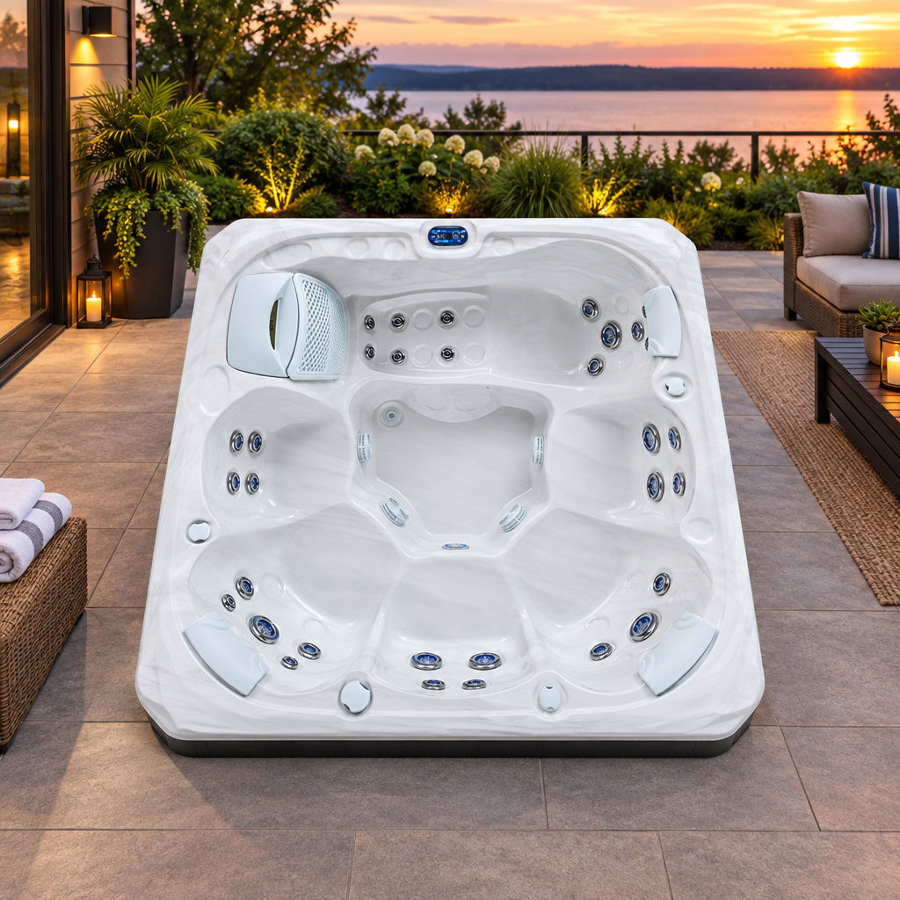
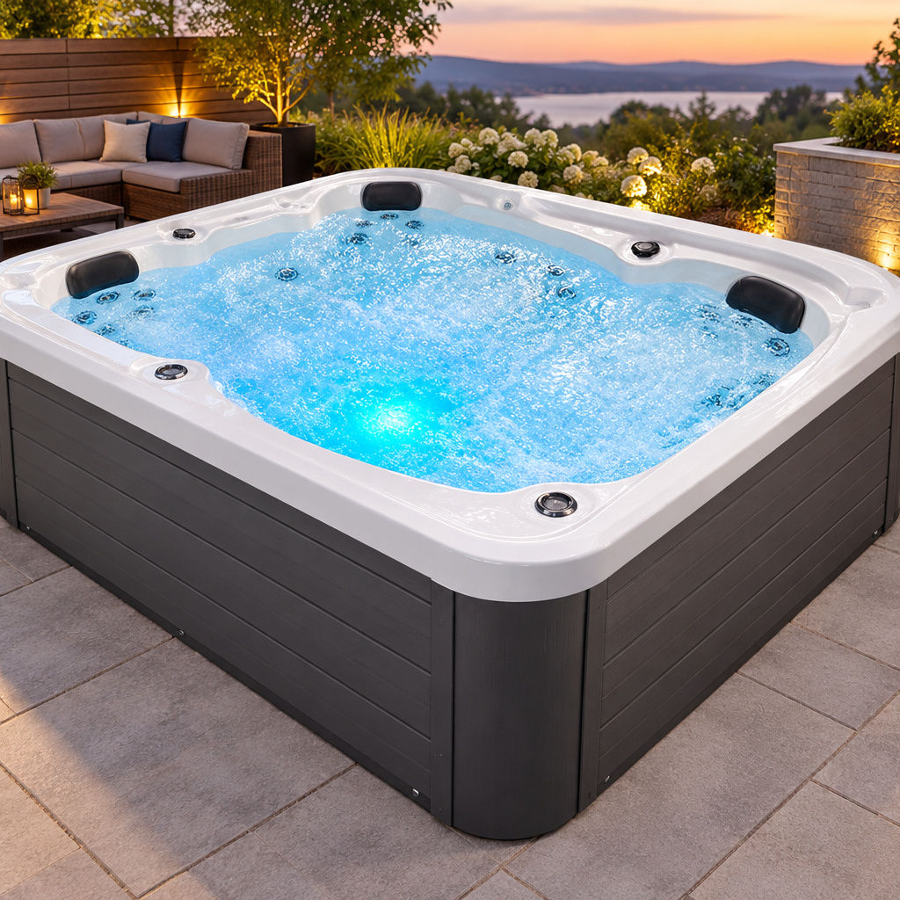
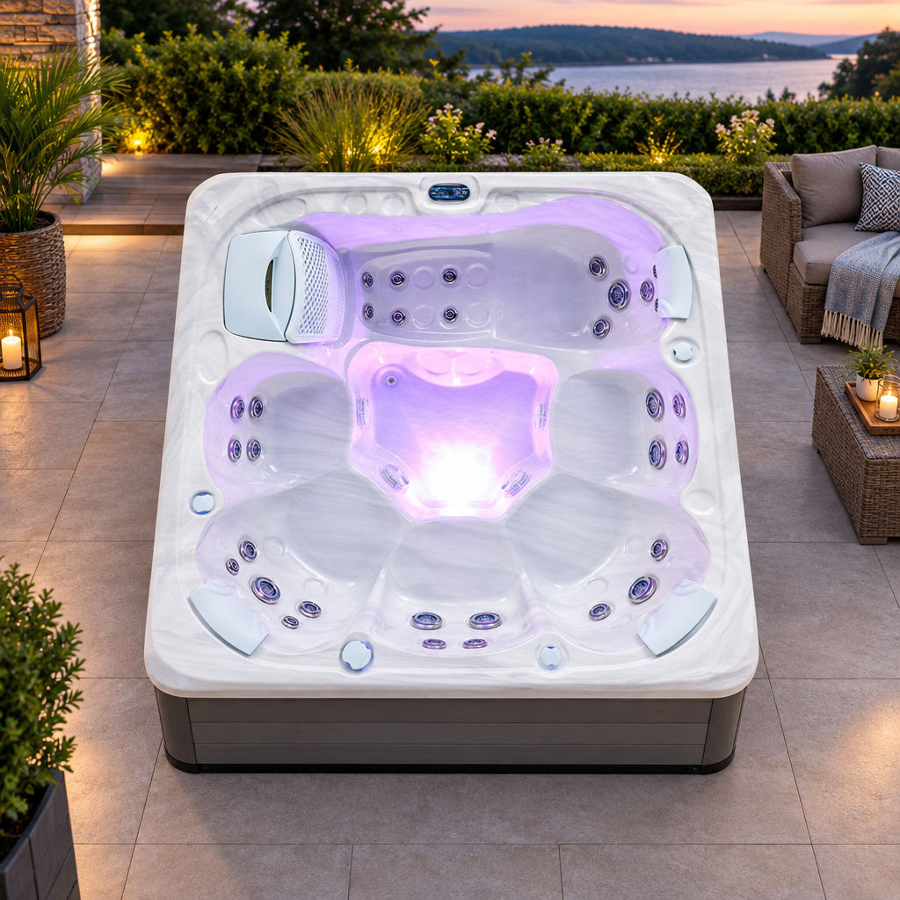
The VS-603C measures 2150 mm by 2150 mm by 900 mm, or about 7 feet by 85 inches by 35 inches. Its square footprint seats up to six adults in five contoured seats and one full-body lounger. Neck pillows sit in the corners, and the layout is intended for residential decks, patios, and gardens.
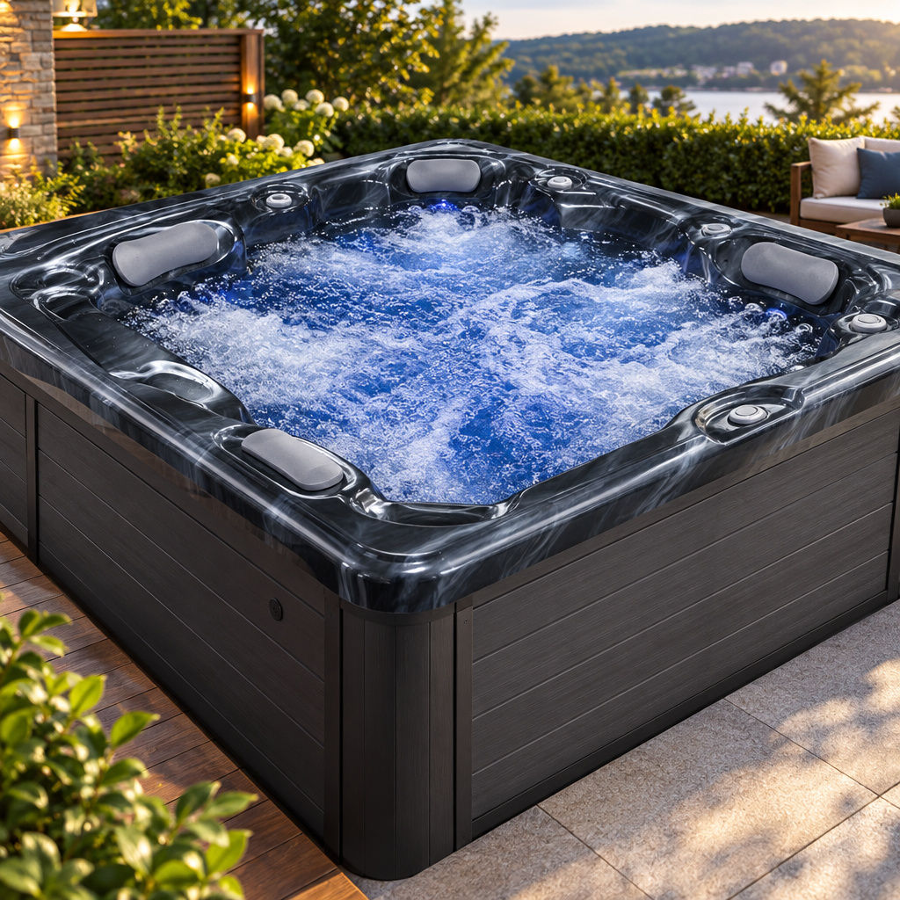
The supplied product specifications identify a porcelain-grade acrylic shell. The manufacturer describes the shell and cabinet as designed for thermal efficiency and outdoor use. The exterior uses an aluminum-plastic composite skirt in Platinum or Midnight, which avoids the staining routine that wood cabinets typically need.
Plumbing and Pump Architecture
The VS-603C has 34 jets in total, 32 of them massage jets. The manufacturer positions rotating and directional jets toward the neck, shoulders, back, and legs. Warm water and massage may feel relaxing, but buyers should judge comfort by sitting in the seats rather than by jet count.
A single 3.0 HP water pump drives the massage jets. Separately, the model includes a 0.35 HP circulation pump intended for water circulation and filtration. Having a dedicated circulation pump means routine filtration does not depend on running the larger jet pump. As with any spa, the pump rating describes the equipment rather than the massage feel, so a wet test remains the most reliable check.
Smart Controls and Power Management
The VS-603C uses the KL2022 control system with a smart touch keypad. According to the product data, it manages water temperature, jet intensity, LED mood lighting, and entertainment functions. The heater is rated at 3.0 kW.
The manufacturer lists the power supply at 5.45 kW. Actual circuit requirements, including voltage, amperage, and breaker size, must be confirmed from the installation documentation and your electrician before purchase.
For water care, the manufacturer describes a triple system combining mechanical filtration, ozone, and UV purification to reduce manual maintenance. Owners must still test and maintain sanitizer and pH levels and follow the manufacturer’s water-care schedule.
Technical Specification
VS-603C Data
What It Means for the Buyer
Seating Configuration
6 Persons (5 Seats + 1 Lounger)
Suits families or small groups; the lounger trades two upright seats for one reclined position
Jets
34 Total (32 Massage Jets)
Rotating and directional jets aimed at neck, shoulders, back, and legs
Water Pump
1 × 3.0 HP
One pump powers the massage jets; judge massage feel with a wet test
Circulation Pump
1 × 0.35 HP
Separate pump for circulation and filtration
Heater
1 × 3.0 kW
Heater rating; heat-up time depends on climate, cover, and start temperature
Manufacturer-Listed Power Supply
5.45 kW
Confirm circuit requirements from installation documents and an electrician
Exterior Skirt
Aluminum-Plastic Composite (Platinum or Midnight)
No wood staining routine
Water Care
Filtration + Ozone + UV
Described by the manufacturer as reducing manual maintenance; sanitizer still required
Is a 6-Person Hot Tub Worth the Investment?
Deciding whether a six-person tub fits your life means weighing space, how often you host, and how you plan to use it. Large spas give groups more room. They also hold more water, use more chemicals, and take up more patio space than compact two-person models.
Household Utility: Space vs. Social Entertaining
A six-person format suits households that regularly share the tub. Compact units can leave legs tangled in the footwell, while a roughly 7-foot square tub gives four to six adults room to stretch out.
If you often host friends or weekend gatherings, the extra space keeps seating comfortable. However, if only two people will use the tub without visitors, you will be heating and treating water that rarely gets used, which raises running costs without adding much value.
Hydrotherapy and Daily Wellness ROI
Many owners use a hot tub to unwind after work or exercise. Warm water, buoyancy, and jet massage may feel soothing for tired muscles. A spa should not be treated as a treatment for chronic pain, circulation problems, or sleep disorders, and anyone with a medical condition should check with a doctor before regular use.
The practical value is convenience. A spa a few steps from the back door tends to get used more often than a wellness center across town. Whether that convenience justifies the cost depends on how often your household actually soaks.
The Trade-Off: Dedicated Lounger vs. Open Seating
A molded full-body lounger lets one bather recline with jets along the back and legs, and many people enjoy it. However, the lounger takes up roughly the space of two upright seats.
Lounger Considerations: Water buoyancy can lift lighter or shorter bathers out of the lounger contour, so try it before buying.
Open-Seating Considerations: All-upright layouts usually leave more footwell space, making it easier to change seats and talk across the tub.
Strategic Buying Checklist to Prevent Budget Surprises
Dealers, online sellers, and local contractors each quote only their own part of the job. A simple checklist keeps the whole project on budget and helps avoid installation delays.
Survey Pathway Clearances: Measure gate widths, eaves, air conditioning units, and overhanging branches along the delivery path.
Get the Weight Data: Ask the manufacturer for dry weight, water capacity, and filled weight, then have a qualified contractor or structural engineer confirm your deck or pad can carry the load.
Hire a Licensed Electrician: Share the model’s installation manual and request a written quote for a GFCI-protected circuit at the specified voltage and amperage before you buy.
Confirm What Delivery Includes: Ask whether the quote covers driveway drop-off only or full placement on your prepared pad.
Read the Warranty Terms: Check coverage for the shell, plumbing, equipment, and controls, along with any installation conditions the warranty requires.
Frequently Asked Questions (FAQs) About 6-Person Hot Tub Cost
How much does an average 6-person acrylic hot tub cost?
In the U.S. market, a mid-tier six-person acrylic hot tub often sells for roughly $6,000 to $12,000. Higher-end models with more pumps, denser insulation, and composite cabinetry can reach $13,000 to $18,000 or more. Prices vary by brand, region, and included accessories.
What is the typical monthly electricity bill for a 6-person spa?
There is no single typical figure. Estimate it by multiplying monthly kilowatt-hours by your local electricity rate. Cold weather, set temperature, how often the tub is used, and the condition of your cover all change consumption, so winter bills are usually higher than summer ones.
Can a 6-person hot tub run on a standard 110V household outlet?
Some can. Plug-and-play six-person models are designed for 120-volt outlets, though they usually limit heater and jet use at the same time. Many permanently installed acrylic spas require a dedicated GFCI-protected 230/240-volt circuit. Always follow the specific model’s installation manual and local code.
How much does site preparation typically add to the final cost?
Site preparation often adds a few thousand dollars, but the range is wide. A concrete pad, a new electrical circuit, permits, and any crane lift are separate costs that depend on your site. Get written local quotes for each item rather than relying on a single average.
How often do hot tub filters and water need replacement?
Drain and refill according to the manufacturer’s instructions and water test results, and sooner if chemistry cannot be held or the water turns cloudy. Pleated cartridge filters typically need regular rinsing, periodic soaking in a filter cleaner, and replacement every 12 to 24 months.
Conclusion
Planning for your true 6 person hot tub cost means looking past the dealer quote to budget for the foundation, electrical work, delivery, and seasonal running costs. Compare insulation, pump layout, cabinet material, and water care, as listed for models like the VS-603C, and confirm weight and electrical requirements from the manufacturer’s documents. With local quotes in hand and the site prepared properly, your six-person backyard spa can deliver reliable relaxation for years at a cost you planned for.
Victoria Star Swim Spa offers the perfect balance between exercise and relaxation, whether you want to swim for fitness or relax in the spacious seating.
Victoria Star Swim Spa offers the perfect balance between exercise and relaxation, whether you want to swim for fitness or relax in the spacious seating.