4 Person Jacuzzi: The Complete Buyer’s Guide to Sizing, Seating, and Compact Swim Spas
Home / News / 4 Person Jacuzzi: The Complete Buyer’s Guide to Sizing, Seating, and Compact Swim Spas
November 04, 2026
Shopping for a 4 person jacuzzi often begins with a straightforward mental picture of warm water, gentle bubbles, and relaxing evenings with family. Yet homeowners quickly discover that practical ownership requires evaluating physical clearances, hydraulic hardware, and electrical capacity before taking delivery. Finding the best 4 person jacuzzi tub for your backyard means looking past marketing buzzwords and understanding how water volume, pump dynamics, and ergonomics converge.
Understanding the 4 Person Jacuzzi Search Intent
The Reality of Seating Capacity vs. Adult Comfort
In the hydrotherapy industry, nominal seating capacity often diverges from comfortable physical occupancy. A spa advertised for four bathers might fit four adults only if everyone sits completely upright with knees touching in a compact central footwell. True usability depends on ergonomic depth, seat width, and how individual lounge positions are oriented.
When evaluating a 4 person jacuzzi, consider the personal space required when all positions are active. If two bathers are tall, overlapping legroom can make prolonged soaking awkward. Examining shell contours and footwell clearance prevents the uncomfortable surprise of a crowded vessel.
Traditional Hot Tub vs. Multi-Functional Compact Swim Spa
Many buyers begin their journey seeking a standard soak tub, unaware that modern compact swim spas offer dual utility in a similar footprint. Traditional tubs prioritize static hydrotherapy, whereas compact swim spas integrate aquatic fitness with dedicated massage zones.
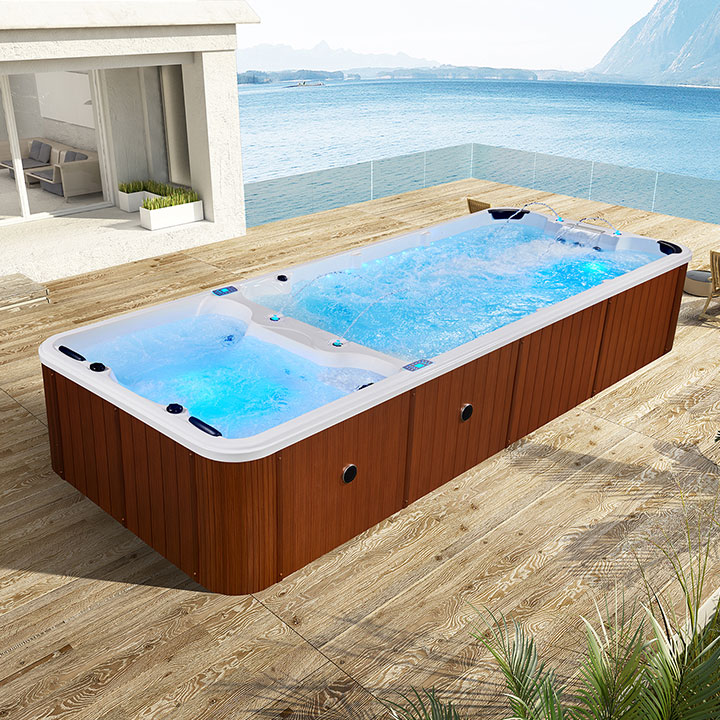
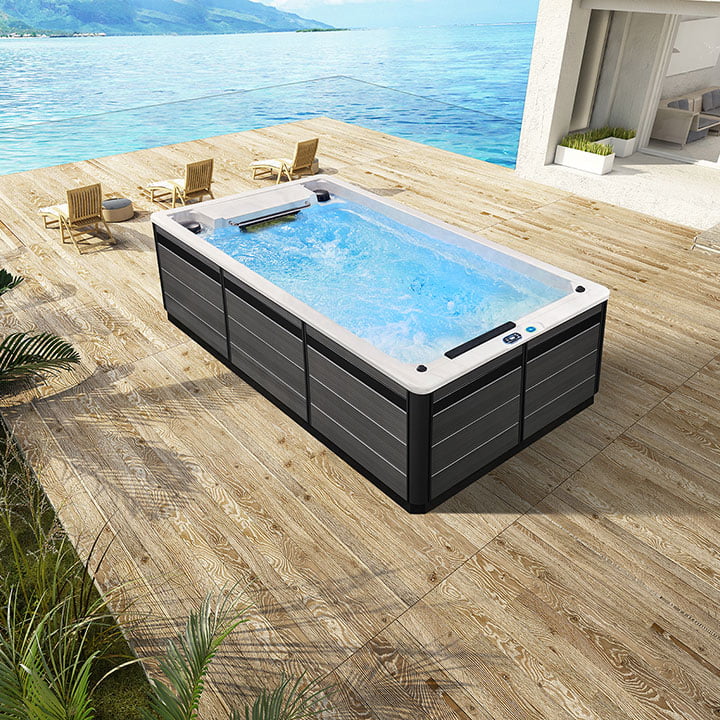
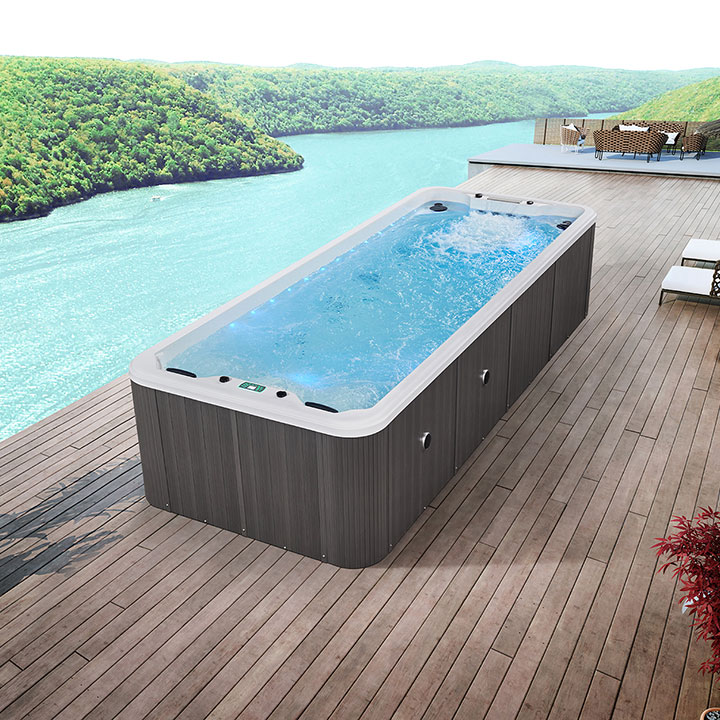
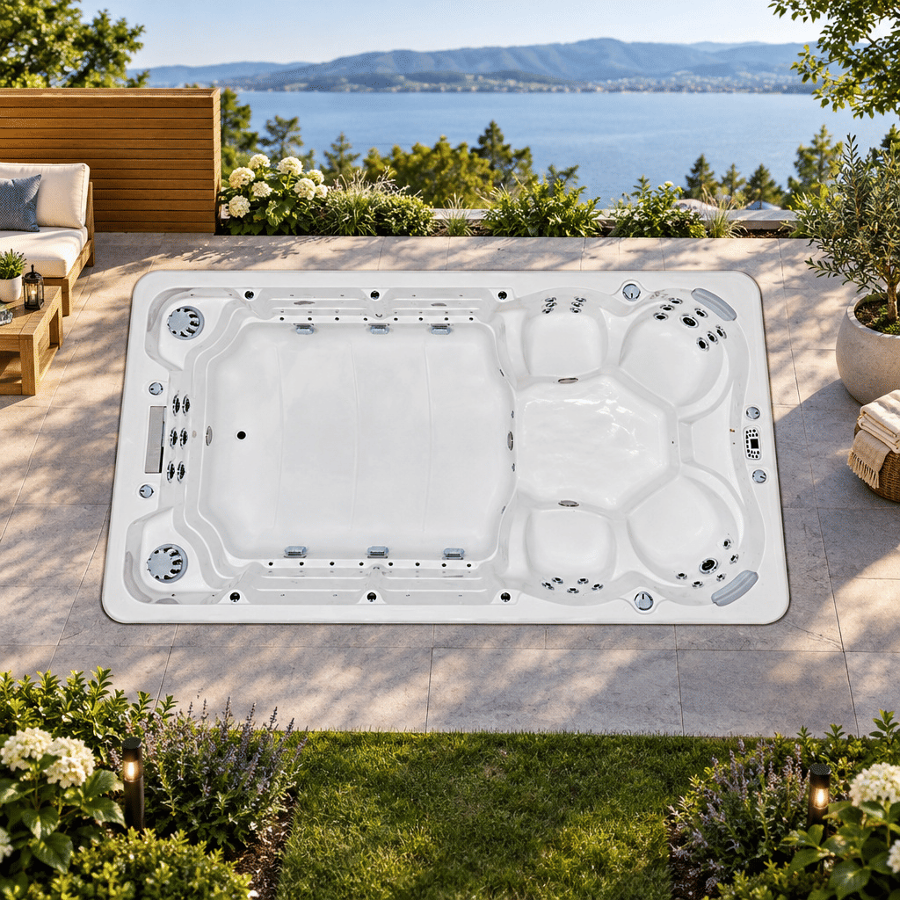
Products like the 4 Seater Small Swim Spa M-300 from Victoria Star bridge this exact gap. Instead of confining four users to a compact soaking basin, a compact swim spa merges an open countercurrent channel with four dedicated hydrotherapy bucket seats. This dual-zone layout transforms a passive relaxation vessel into an active wellness center.
Site Planning: Measuring and Engineering Before You Buy
Footprint, Clearance, and Backyard Placement
Every installation site demands precise spatial planning. You cannot simply measure the outer shell dimensions and assume the unit will fit neatly into an existing landscape corner without adequate breathing room.
Follow the manufacturer’s required service clearances, paying particular attention to the equipment-panel side, and confirm access requirements before installation. Without this buffer, you risk blocking essential maintenance access.
Structural Foundation and Ground Load-Bearing Realities
Water weighs approximately 8.34 pounds per gallon, transforming filled spas into dense structural burdens. A deck designed only for ordinary residential loads may not support a filled spa safely; concentrated hot-tub loads require project-specific structural review.
Homeowners must place these units on a level, adequately engineered foundation designed for the filled weight, with the final specification confirmed by the manufacturer and a qualified contractor or structural professional. Soft clay or sandy substrates often require compacted gravel sub-base layers before concrete pouring begins.
Electrical Service and Dedicated Circuit Requirements
High-performance spas demand robust power systems. Compact equipment running multiple high-horsepower pumps and multi-kilowatt heating elements cannot run on standard 120-volt household outlets without tripping domestic breakers.
For example, the M-300 platform operates with a power supply specification of 14.05 kW, driven by two 3,000 W heaters and four distinct pump assemblies. Have a qualified electrician review the M-300’s installation requirements and applicable local code; licensing requirements vary by jurisdiction. Attempting DIY electrical hookups presents serious fire and electrocution hazards.
Seating Ergonomics and Jet Configuration
Open Seating vs. Contoured Hydrotherapy Loungers
Interior layout dictates how bathers interact within the vessel. Open bench seating allows users to shift positions freely, offering flexible socializing space during family gatherings.
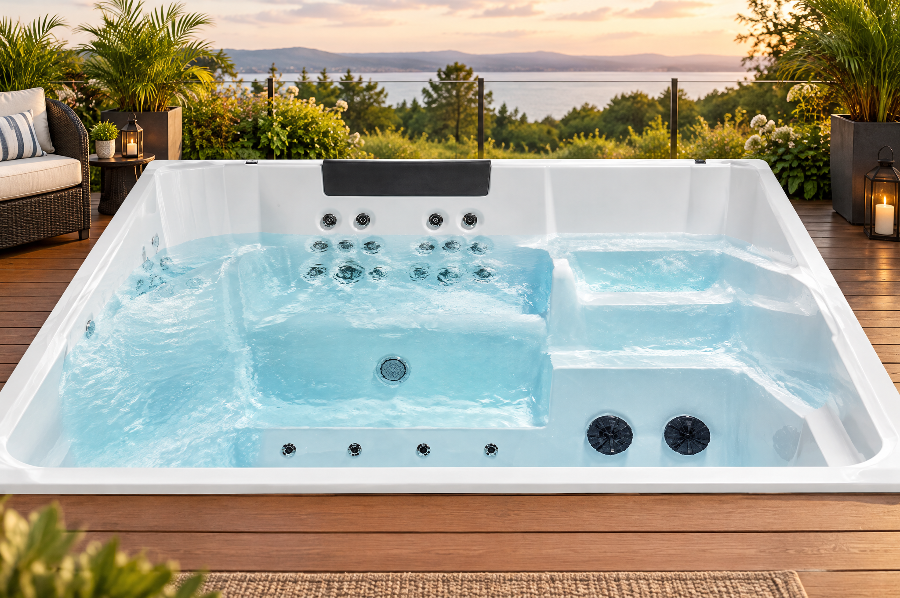
Conversely, molded ergonomic loungers lock the body into semi-reclined postures that cradle the torso and calves. The trade-off is fixed spatial distribution; loungers consume substantial floor area, which can reduce central foot space for other seated guests. Families who rotate between soaking and active swimming benefit more from flexible bucket seat arrangements.
Jet Placement and Targeted Muscle Recovery
A common industry myth equates total jet count with therapeutic quality. In practice, plumbing diameter, water line balance, and anatomical positioning matter far more than an arbitrary number stamped on a brochure.
The M-300 features 51 targeted hydrotherapy jets arranged around the ergonomic seating areas to provide targeted water massage. Exact coverage depends on the bather’s position and the selected jet settings.
Pump Output and Hydrodynamic Balance
Feeding dozens of jets simultaneously requires substantial fluid propulsion. If a plumbing circuit pairs an underpowered pump with excessive jet nozzles, bathers experience disappointing trickles rather than therapeutic hydromassage.
The M-300 has three 3 HP water pumps and a separate 1 HP circulation pump for filtration and circulation. This multi-pump configuration supports both high-pressure massage and continuous water movement.
Feature Comparison: Traditional Hot Tub vs. M-300 Compact Swim Spa
Side-by-Side Specifications and Architectural Differences
Comparing traditional hot tubs to advanced hybrid units clarifies which design best matches your recreational goals. The M-300 dimensions and specifications below illustrate how a compact swim spa diverges from conventional models. Four-person hot tubs vary substantially across manufacturers, and dimensions should always be verified with the specific model you are considering.
Specification / Feature
Reference Information
M-300 4 Seater Small Swim Spa
External Dimensions
Varies by model
3,760 × 2,080 × 1,110 mm (12′ × 82″ × 44″)
Water Capacity
Varies by model
3,680 Liters
Seating Layout
4 Bench or Bucket Seats (typical)
4 Bucket Hydrotherapy Seats + Open Swim Lane
Total Jet Count
Varies by model
51 Targeted Hydrotherapy Jets
Pump Hardware
1 or 2 Dual-Speed Pumps (typical)
3 × 3 HP Water Pumps + 1 × 1 HP Circulation Pump
Heating Capacity
Varies by model
2 × 3,000 W Dual Heating Assemblies
Primary Function
Passive Soaking & Hydrotherapy
Aquatic Fitness, Swimming & Hydrotherapy
User Control
Basic Push-Button Keypad (typical)
KL2020BT Digital Touchscreen System
The Swim Current Advantage: Training Meets Relaxation
Standard hot tubs limit physical activity to stationary soaking. In contrast, a swim spa introduces countercurrent swim jets that project a continuous stream of water against the swimmer.
The countercurrent is designed to support in-place swimming and water-based exercise; ask the manufacturer about current adjustment and suitability for your preferred strokes. The buoyancy and adjustable countercurrent can support low-impact exercise, but users recovering from an injury should follow advice from an appropriate healthcare professional. For fitness-minded homeowners, integrating an aquatic workout area alongside four hydrotherapy seats elevates the installation into a personal wellness facility.
Aesthetic and Sensory Additions: Lighting and Water Arches
Hydrotherapy engages sight and sound alongside temperature and pressure. Modern installations use ambient sensory elements to create tranquil evening environments.
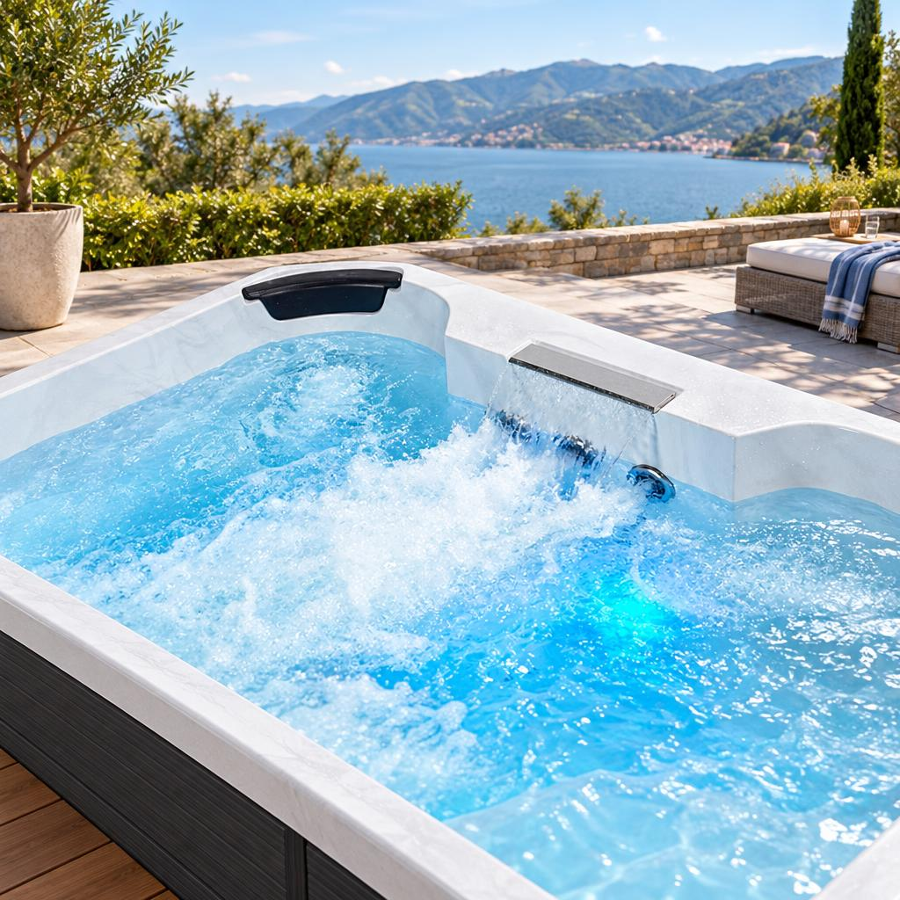
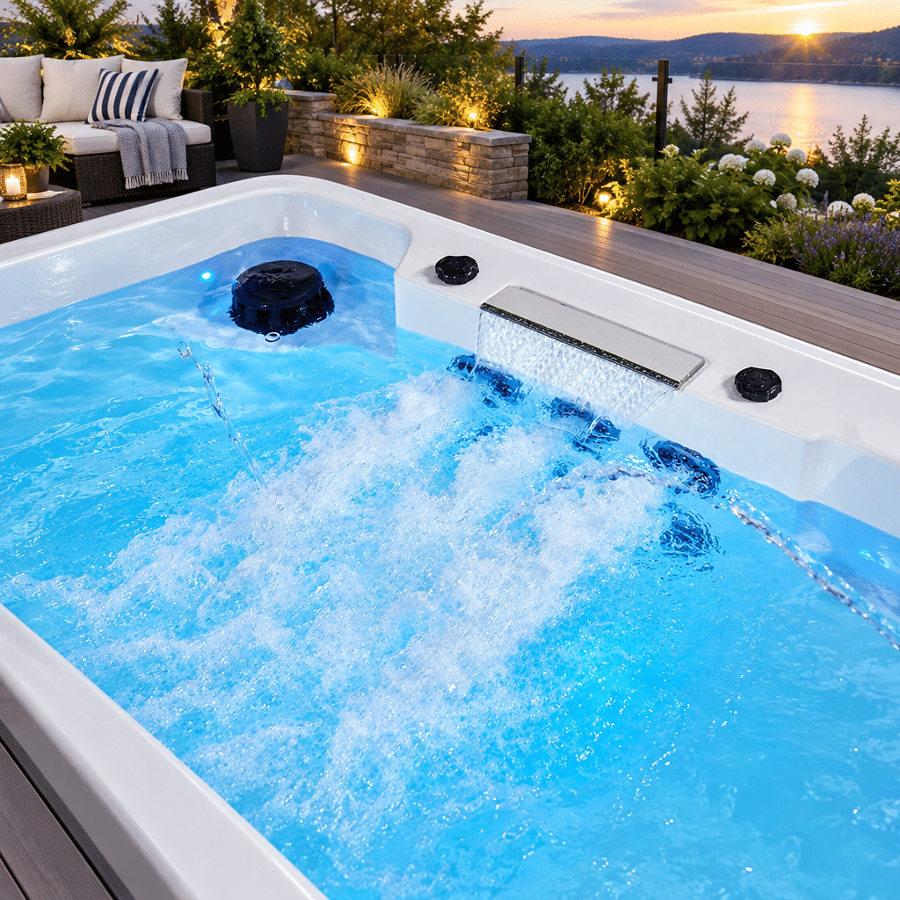
The M-300 integrates multi-color underwater LED lighting paired with illuminated laminar fountain streams and a waterfall weir. The water features add visual movement and may provide a gentle water sound during evening use. The visual interplay between colored light and moving water transforms routine soaking into immersive relaxation.
Water Sanitization, Shell Durability, and Daily Maintenance
Multi-Stage Water Care: Ozone, UV, and Physical Filtration
Maintaining pristine water clarity in a 3,680-liter spa requires coordinated physical and chemical stages. Relying strictly on chemical shock treatments can cause skin sensitivity, harsh chemical odors, and premature equipment corrosion.
The M-300 incorporates multi-stage purification combining ozone disinfection, ultraviolet sanitation, sand filtration, and cartridge filtration. Ozone and ultraviolet light are supplemental systems whose effectiveness depends on correct operation, circulation, filtration, and residual sanitizer maintenance. Sand filtration captures suspended particulates, and cartridge filtration polishes residual debris.
While supplemental ozone and UV systems significantly reduce manual chemical demand, they do not eliminate testing. Follow the manufacturer’s instructions and local requirements; CDC guidance for hot tubs recommends at least 3 ppm free chlorine or 4–8 ppm bromine, with pH maintained in the recommended range, while maintaining water temperatures at or below 104°F (40°C) for safe, hygienic soaking.
Acrylic Shell Engineering and Weather-Resistant Cabinetry
Exterior durability dictates the operational lifespan of any outdoor spa. The structural shell must withstand thermal expansion, intense UV solar degradation, and fluctuating internal hydraulic pressures without micro-cracking.
The M-300 is listed with a porcelain shell color and Platinum or Midnight cabinet-color options. Confirm shell construction, cabinet material, weather exposure limits, and winterization requirements with the manufacturer to ensure the unit meets your climate and installation expectations.
Comprehensive Pre-Purchase Checklist for Buyers
Key Questions to Clarify with the Manufacturer
Before finalizing any investment, verify specific logistical and engineering parameters directly with the manufacturer or authorized supplier:
Confirm the complete dry weight and filled operational weight to verify pad engineering calculations with your contractor.
Inquire whether the delivery service provides drop-shipping to the curb or backyard placement via boom truck or mobile crane.
Verify exact voltage, wire gauge requirements, and amperage ratings with a licensed electrician using the technical schematics.
Ask about freeze-protection software within the control system to safeguard internal lines during winter power outages.
Calculating the Real Cost of Ownership
Smart budgeting accounts for variables beyond the sticker price. Operating an outdoor spa involves ongoing environmental and mechanical maintenance costs:
Site Preparation: Concrete excavation, gravel sub-base compaction, and pouring a level, steel-reinforced structural slab.
Electrical Infrastructure: Dedicated GFCI subpanels, underground conduit runs, and heavy-gauge copper wiring installed by an electrician.
Water Treatment Supplies: Sanitizer granules, pH balancers, alkalinity buffers, calcium hardeners, and multi-parameter test strips.
Periodic Filter Replacement: Routine cleaning and seasonal swapping of filtration media to ensure clean pump suction.
Energy Consumption: Monthly electrical draw needed to power dual 3,000 W heaters during cold winter months.
FAQs
Is a 4 person jacuzzi actually spacious enough for four adults?
Whether four adults are comfortable depends on the shell layout, seat dimensions, and body size. Review the manufacturer’s seating dimensions and, if possible, test the seating before purchase. If four tall adults plan to soak simultaneously on a regular basis, selecting an open bench design or a compact swim spa with an extended footwell prevents knee contact and cramped postures.
What is the primary difference between a 4 person hot tub and a compact swim spa like the M-300?
A conventional hot tub focuses entirely on stationary hydrotherapy within a compact footprint measuring around seven feet square. A compact swim spa like the M-300 expands the frame to over twelve feet (3,760 mm), integrating countercurrent swim pumps for fitness training while retaining four hydrotherapy bucket seats.
What type of electrical setup is required for high-power spa equipment?
Equipment demanding 14.05 kW, such as the M-300, requires review by a qualified electrician. Voltage, conductor size, overcurrent protection, disconnect configuration, and GFCI protection must follow the manufacturer’s installation manual and locally adopted electrical codes.
Can multi-stage UV and ozone purification completely eliminate chlorine?
No, ozone and UV systems are supplemental sanitation tools that oxidize contaminants and reduce chemical consumption. Homeowners must still maintain a baseline residual sanitizer, such as chlorine or bromine, along with proper pH levels to ensure water safety.
What site preparation is necessary before the delivery day?
You must prepare a flat, level foundation capable of supporting the spa’s filled weight, install a dedicated electrical disconnect per code requirements and manufacturer specifications, and ensure clear, unobstructed clearance from the driveway to the backyard pad for crane or dolly transport.
Conclusion
Investing in a 4 person jacuzzi or expanding into a versatile swim spa transforms your backyard into an everyday sanctuary for recovery, connection, and fitness. By prioritizing ergonomic bucket seating, assessing realistic electrical demands, and understanding comprehensive water purification protocols, you can make a sound purchasing decision tailored to your home. Whether selecting an intimate traditional hydrotherapy tub or a performance-engineered hybrid like the M-300, thoughtful site planning ensures your family spa delivers rejuvenating, reliable hydrotherapy for years to come.
Victoria Star Swim Spa offers the perfect balance between exercise and relaxation, whether you want to swim for fitness or relax in the spacious seating.
Victoria Star Swim Spa offers the perfect balance between exercise and relaxation, whether you want to swim for fitness or relax in the spacious seating.