2 Person Outdoor Soaking Tub: Complete Buyer Guide and Installation Blueprint
Home / News / 2 Person Outdoor Soaking Tub: Complete Buyer Guide and Installation Blueprint
November 02, 2026
Finding the right 2 person outdoor soaking tub requires balancing physical footprint, ergonomic comfort, and installation feasibility. Urban terraces, garden patios, and compact decks need equipment that delivers warm-water relaxation without crowding the available outdoor living space. When space is tight, the shell layout, the heater rating, and the filled weight all matter.
This guide covers compact tub design, water care, load planning, and site preparation. It draws on published product specifications and practical outdoor installation considerations to show what buyers should check before a two-person spa arrives at their home.
Understanding the 2 Person Outdoor Soaking Tub Category
Terminology Breakdown: Soaking Tub vs. Portable Hot Tub vs. Built-In Spa
Shoppers often meet conflicting labels when researching compact tubs. A traditional outdoor soaking tub usually means a deep vessel without jets, such as a Japanese ofuro or a cedar tub. These tubs are intended mainly for still, hot-water immersion, and many have no built-in circulation system.
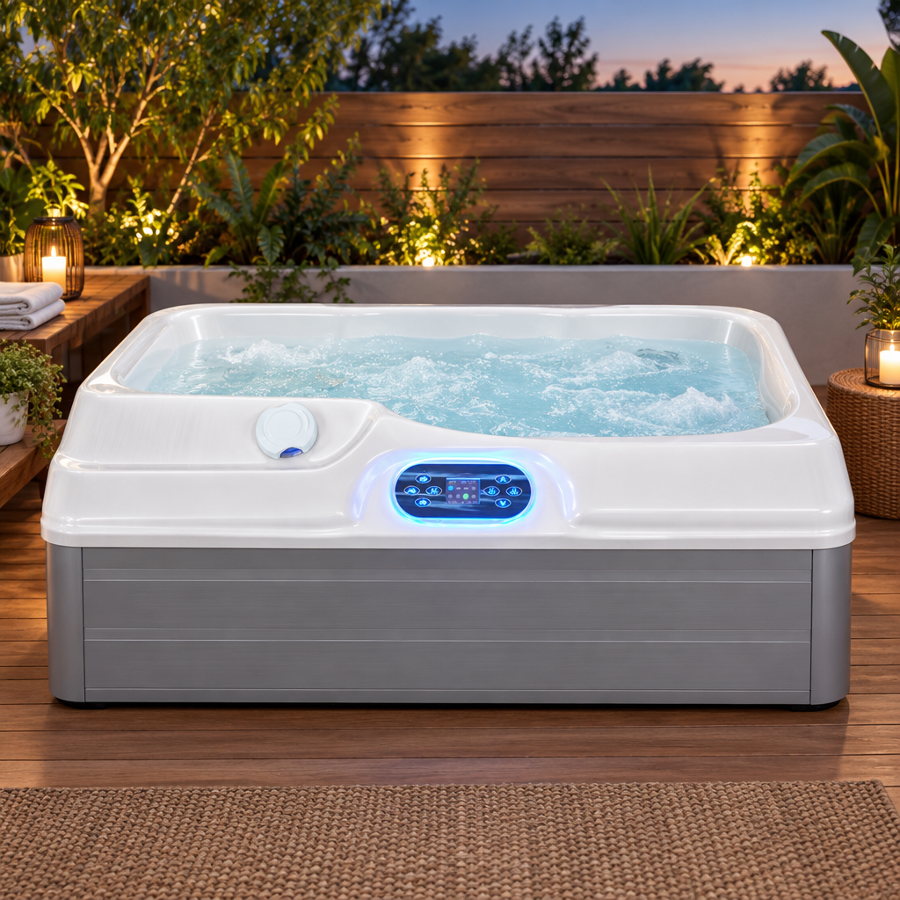
A portable hot tub, by contrast, is a self-contained appliance with its own pumps, filtration, electric heater, and cabinet skirt. The VS-201C from Victoria Star belongs to this self-contained category. It combines hydrotherapy jets with two reclining seats, so it covers both soaking and massage in one unit.
Built-in spas are usually in-ground installations connected to separate pool equipment. For compact residential properties, a self-contained spa avoids excavation work. It also arrives with its pumps, heater, and plumbing already assembled, which simplifies planning compared with a custom build.
Why Compact Two-Person Models Match Small-Footprint Outdoor Living
Larger hot tubs built for six or eight bathers bring larger operating demands. They often need bigger foundations, higher-capacity electrical service, and much more water to fill and heat after each drain-and-refill cycle.
A two-person model reduces some of these demands. A smaller tub may use less water and energy than a larger spa. Actual consumption, however, depends on insulation, ambient temperature, cover use, temperature settings, and how often the tub is used.
For couples or solo bathers who soak regularly, a smaller water volume usually means smaller chemical doses. It also means less water to replace when the tub needs a fresh fill.
Key Pre-Purchase Determinations Addressed in This Guide
Evaluating a compact spa requires looking past exterior styling. Buyers should first assess the supporting surface, the electrical supply, the delivery route, and ongoing water care.
The sections below work through each of these topics. They explain which figures come from the product data, which details must be confirmed with the supplier, and which decisions belong to a licensed professional.
Critical Selection Criteria for a Two-Person Outdoor Spa
1. Spatial Geometry and Access Clearances
Exterior dimensions tell only part of the story when laying out a patio or balcony. A unit about 6 feet long still needs room for cover removal, steps, and perimeter access during maintenance.
Service technicians reach the pumps, heater, and control pack through removable cabinet panels. Follow the manufacturer’s service-clearance requirements for the equipment side, and confirm the exact dimensions with your installer before the pad or deck is built. A tub pushed tight against a wall may have to be drained and moved for a simple repair.
Cover lifters also need space behind the spa. The required swing room depends on the lifter design, so check the lifter manufacturer’s instructions before you finalize the layout.
2. Ergonomics: Dual Loungers vs. Bench Seating
Seat design decides how relaxing a soak will actually feel. Upright bench seating keeps bathers sitting fairly straight, which saves perimeter space but places most body weight on the seat itself.
Reclining loungers spread body weight along the back and legs. In a small outdoor soaking tub, well-shaped loungers can also help bathers stay in place, because the bend at the knees and the footwell give the body something to brace against.
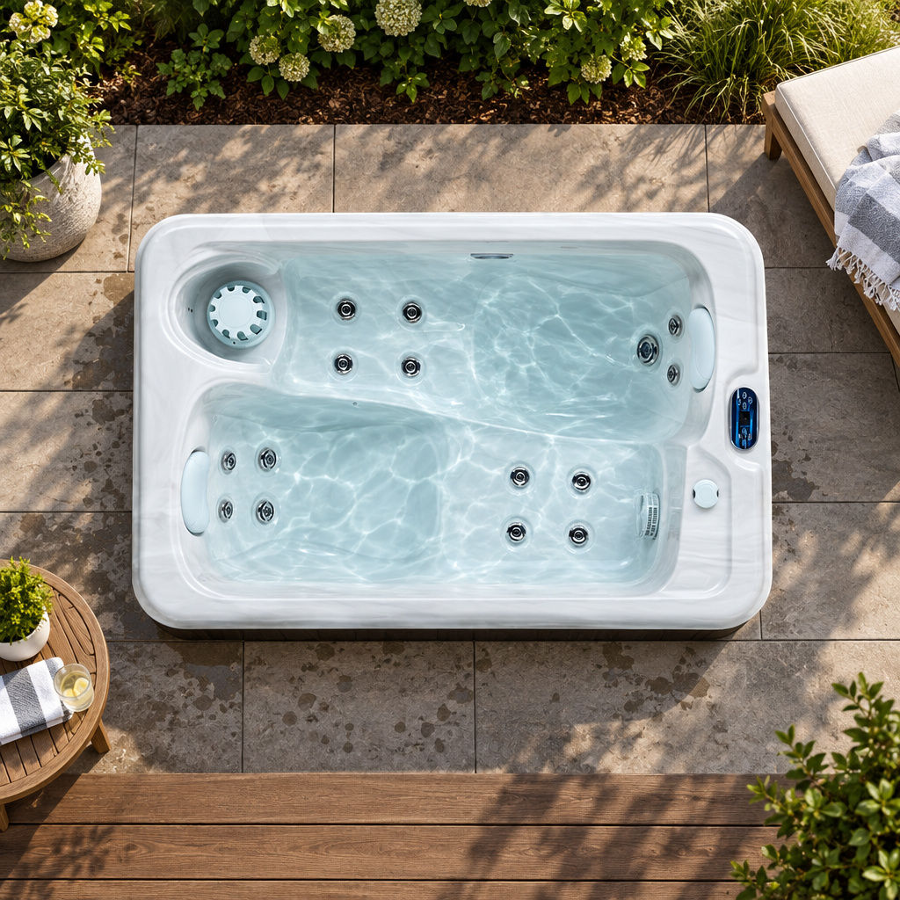
The VS-201C uses a dual-lounger layout. According to the product data, both seats are contoured to fit the body’s curves so that two bathers can recline at the same time.
3. Hydrotherapy Dynamics Beyond Raw Jet Counts
A common assumption in hot tub shopping is that more jets mean better massage. Jet count alone says little. The pump’s capacity and the plumbing layout determine how much water reaches each jet.
When many jets share one pump, the available flow is divided among them. Buyers should therefore look at where the jets sit and what drives them, instead of comparing totals.
The VS-201C lists 15 jets and a 2 HP water pump. The manufacturer describes its rotating back jets as targeting the muscles along the spine and shoulders.
4. Water Care Architecture: Filtration, Ozone, and UV
Warm water is a demanding environment for water care. Sweat, body oils, and lotions enter the water with every soak, and they consume sanitizer over time if filtration cannot keep up.
Many modern spas pair filtration with secondary treatment. Ozone is an oxidizer that breaks down organic material, and UV light can inactivate microorganisms as water passes the lamp. Both act only on water flowing through the equipment.
Because of that limit, secondary systems do not replace a sanitizer residual. CDC hot tub guidance still calls for maintaining chlorine or bromine in the water, even when ozone or UV equipment is installed.
5. Mechanical and Electrical Infrastructure
Heating and pumping equipment shape daily usability. In cold weather, a heater works harder to hold temperature, especially when the cover stays off and cool air moves across the water surface.
The VS-201C lists a 3 kW heater and a 0.35 HP circulation pump. Actual heating time and operating noise depend on the starting water temperature, insulation, ambient conditions, and operating mode.
The model also lists a 4.5 kW total power supply. A licensed electrician must determine the supply voltage, conductor sizing, overcurrent protection, disconnect, and GFCI requirements. Those decisions follow the local electrical code and the manufacturer’s final wiring instructions.
Engineering and Site Placement: Decks, Balconies, and Patios
Structural Weight Distribution: Calculating the True Wet Load
Placing an outdoor spa on an elevated wooden deck or apartment balcony needs careful structural review. Water weighs about 8.34 pounds per gallon (1 kilogram per liter), so even a compact tub becomes a heavy load once filled.
Before any structural review, gather these inputs:
Dry Equipment Weight: The weight of the shell, cabinet, pumps, and control pack, taken from the manufacturer’s documentation.
Filled Water Capacity: The tub’s capacity in liters or gallons, which converts directly to water weight.
Occupants and Accessories: The weight of the bathers, plus steps, covers, and any planters or furniture nearby.
Support Details: The framing, joist spans, connections, and the location of the tub on the deck or slab.
A simple pounds-per-square-foot figure is not enough for an elevated structure. A qualified structural professional should evaluate concentrated loads, load paths, deflection, and connections using the actual filled weight.
Local rules also apply. Portland’s residential guidance, for example, identifies additional structural requirements for elevated decks more than 30 inches above grade. Requirements vary by jurisdiction, so check with the local building department and obtain professional structural review where required.
Moisture Management, Drainage, and Splash Containment
Water leaves a soaking tub through splash-out, dripping bathers, and scheduled drain-and-refill routines. On an unsealed balcony or a flat wood deck without a drainage plan, that water can damage the structure over time.
The tub needs a level, structurally adequate base. Plan drainage and waterproofing around the manufacturer’s installation instructions and local building, plumbing, and waterproofing requirements, so that water moves away from the building.
Avoid setting the tub directly on soil or an unpaved lawn. A soft surface can settle unevenly, and constant dampness around the base works against the cabinet and the equipment inside it.
Delivery Route Logistics and Rigging
Moving a rigid acrylic spa from the curb to a secluded backyard or rooftop terrace is often the hardest part of installation. Unlike sectional furniture, an acrylic spa cannot be taken apart for the trip.
Ask the supplier for the shipping dimensions, including packaging. Then measure every gate opening, roof overhang, downspout, and outdoor air conditioning unit along the route. Spas are often moved on their side, so check both the path width and the overhead clearance for that position.
For balcony or rooftop installations, consult professional riggers. A crane or material lift may be the safest way to reach an upper terrace, and it avoids carrying the unit through interior stairwells.
Product Evaluation: VS-201C Rectangular Hot Tub
Design Profile and Architectural Dimensions
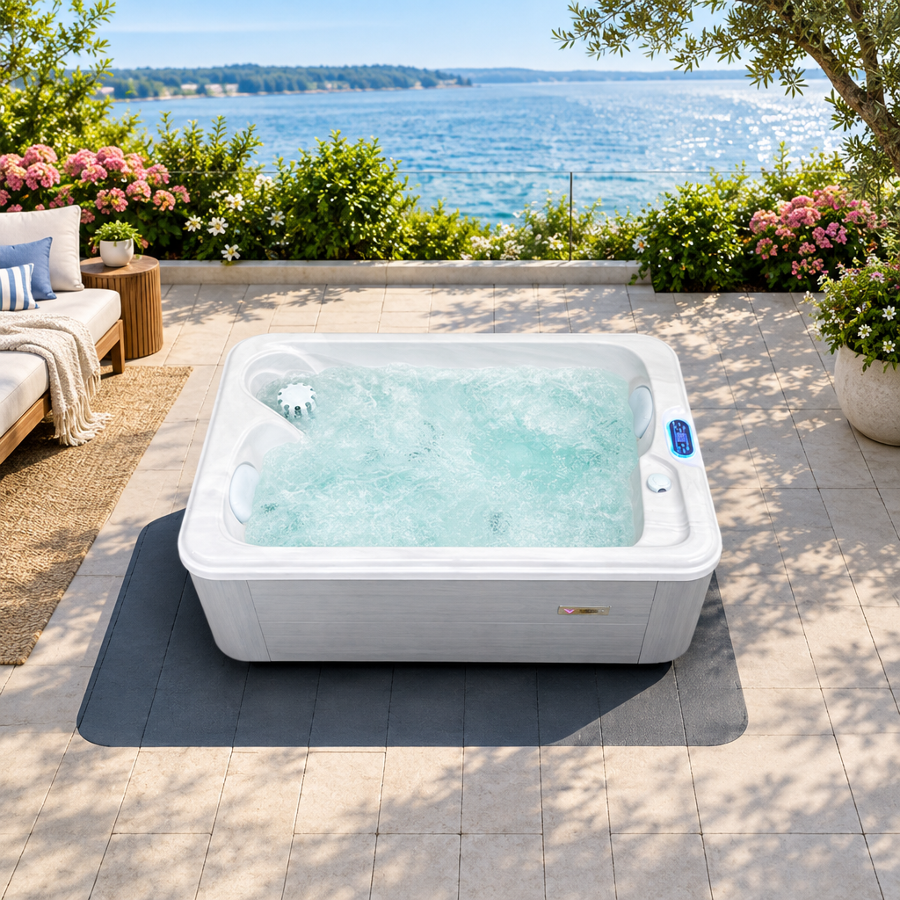
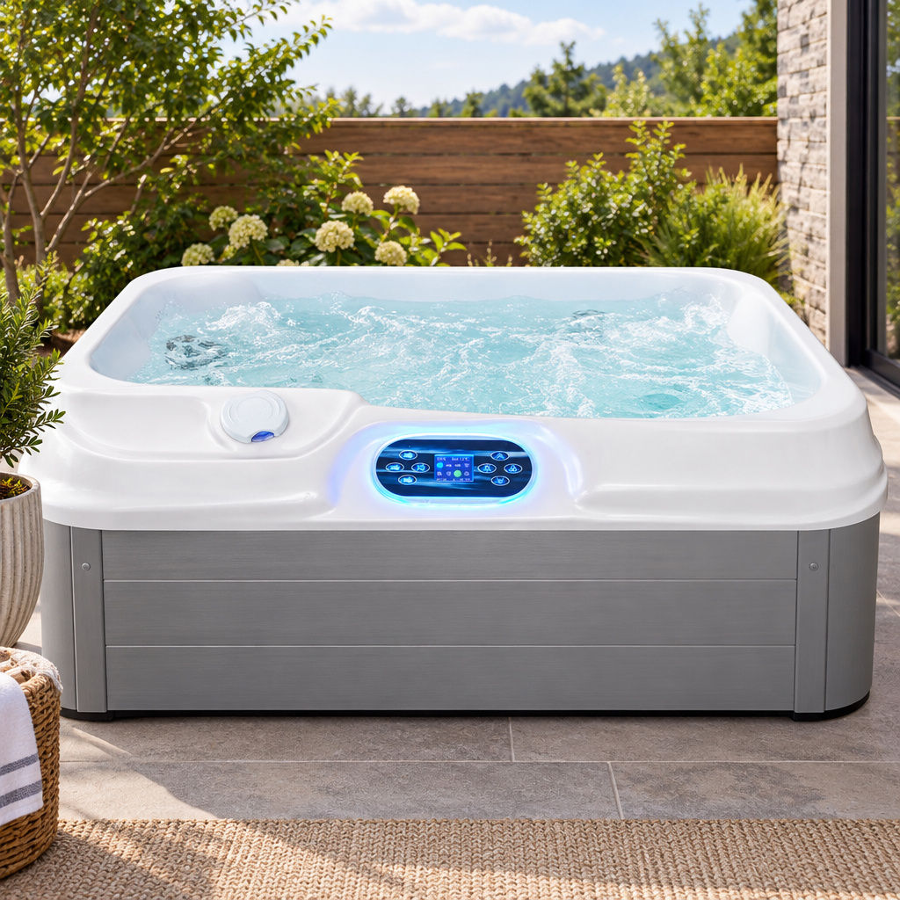
The VS-201C belongs to the Comfort Series. The product data describes it as designed for intimate, space-efficient relaxation on balconies, courtyards, and patios. Its listed dimensions are 1,750 × 1,150 × 750 mm (approximately 6′ × 45″ × 30″), and the rectangular profile suits narrow outdoor areas.
The model uses an aluminum-plastic cabinet skirt available in Platinum or Midnight. Buyers who want the skirt to match nearby decking or cladding should request physical samples, because finishes can look different on screen.
Inside, the model is listed with an acrylic shell in a Porcelain color. Follow the manufacturer’s cleaning and water-care instructions to keep the surface in good condition.
Hydrotherapy Layout and Comfort Back Massage
The VS-201C lists 15 jets in total. The manufacturer describes strategically placed rotating jets for back and shoulder massage, under a feature called Comfort Back Massage.
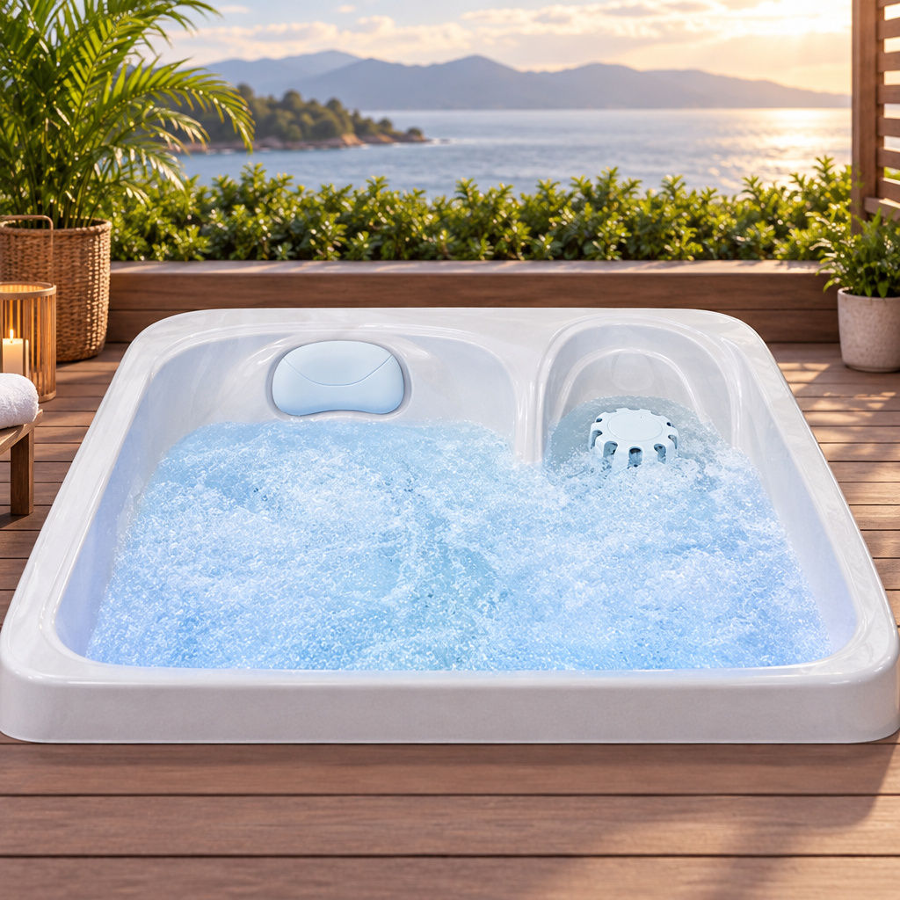
Both loungers include cushioned headrests, as shown in the product images. The contoured seats are intended to let two bathers recline at once, each in a separate seating zone.
A single 2 HP water pump drives the jets, according to the specification sheet. Buyers who want a stronger or softer massage should ask the supplier how jet intensity is adjusted on this model.
Sanitation System and Daily Upkeep
The manufacturer describes a system, called the Hassle-Free Clean Water System, that combines multi-layer filtration, ozone oxidation, and UV sanitation. Together, these stages are intended to keep water clear with less day-to-day effort.
A separate 0.35 HP circulation pump is listed alongside the main water pump. A dedicated circulation pump moves water through filtration without running the larger jet pump.
Ozone and UV support water care, but they do not replace a sanitizer. Chlorine or bromine must still be maintained according to the manufacturer’s instructions and applicable guidance.
User Interface and Ambient Features
Settings on the VS-201C are managed through a KL2022 smart digital keypad set into the top rim. According to the product data, the keypad adjusts water temperature, jets, and lighting.
For entertainment, the product data lists integrated Bluetooth audio with surround speakers, so bathers can stream music from a phone. Keep the phone itself away from the water.
VS-201C Specification Blueprint
Manufacturer-Provided Technical Data
The table below lists the specifications published by the manufacturer for the VS-201C:
Specification Parameter
Value / Dimension
Details
Model & Series
VS-201C (Comfort Series)
Self-contained 2-person rectangular hot tub
Metric Dimensions
1,750 × 1,150 × 750 mm
Length × Width × Height
Imperial Dimensions
6′ × 45″ × 30″
Compact rectangular footprint
Seating Layout
2 Loungers
Contoured full-body seats with headrests
Jet System
15 Total Jets
Includes rotating back-massage jets
Water Pump
1 × 2 HP
Drives the massage jets
Circulation Pump
1 × 0.35 HP
Circulates water through filtration
Heater
1 × 3 kW
Electric heater
Power Supply
4.5 kW
Voltage and breaker size to confirm with supplier and electrician
Data Points Requiring Manufacturer Confirmation Prior to Order
Several details needed for installation are not in the published specifications. Confirm them with the manufacturer or an authorized distributor before ordering:
Dry Weight and Water Capacity: These figures are needed for any structural assessment of a deck, balcony, or rooftop.
Electrical Configuration: Confirm the supply voltage, frequency, and recommended breaker size for the 4.5 kW rating in your region.
Insulation Package: Ask about shell and base insulation if the tub will run through sub-freezing winters.
Market-Specific Compliance: Confirm that the complete spa meets the requirements of your market. For example, UL 1563 is a safety standard for electric spas, UL and ETL are certification marks, and CE is a separate conformity marking.
Comparative Assessment: VS-201C vs. Alternative Compact Options
Dual-Lounger Acrylic Spa vs. Non-Jetted Soaking Tub
Choosing between a jetted spa and a passive soaking vessel comes down to how you want to use it. Many non-jetted soaking tubs rely on manual heating and more frequent water changes. A self-contained spa integrates heating, circulation, filtration, and jets.
Comparison Dimension
VS-201C
Traditional Non-Jetted Soaking Tub
Massage
15 jets, including rotating back jets
Usually none; still-water immersion
Heating
Built-in 3 kW electric heater
Varies; often filled with hot water or heated separately
Water Treatment
Multi-layer filtration, ozone, and UV, plus sanitizer
Often drained and refilled frequently
Surface Care
Acrylic shell and aluminum-plastic skirt
Wood tubs typically need periodic care and leak checks
Infrastructure
Dedicated electrical supply
Hot water source and drainage access
Compact Two-Person Unit vs. Standard Four-to-Six-Person Family Spa
Family-sized hot tubs seat more people. In exchange, they usually need more yard space, more electrical capacity, and a stronger base, because they hold more water.
A compact 2 person outdoor soaking tub like the VS-201C may need less water, energy, and sanitizer than a larger spa. The actual difference depends on the competing model’s dimensions, water volume, insulation, climate, and usage. A smaller tub also fits courtyards where a large square spa would block walkways.
For households that rarely host guests, the seats in a large tub often go unused. Those households still pay to heat and treat the full volume of water.
Permanent Acrylic Spa vs. Inflatable Plug-and-Play Tub
Inflatable hot tubs appeal to budget-conscious buyers and renters because of their low purchase price. Many plug into a standard outlet and need no permanent installation.
Many inflatable tubs have less insulation, and their air-bubble systems may increase heat loss during operation. Performance varies by model, so compare published heater ratings and insulation details before buying.
A rigid acrylic spa like the VS-201C uses water jets driven by a dedicated pump, a fixed cabinet, and an acrylic shell. It requires more planning up front, including electrical work and a suitable base.
Safe Operation and Water Maintenance Protocols
Water Temperature Boundaries and Bather Health
Warm water and massage may feel relaxing for some users, but hot water carries real risks. CDC guidance sets 104°F (40°C) as the maximum hot tub water temperature.
Soaking in water that is too hot, or for too long, can cause overheating and dizziness. Many users choose a setting a few degrees below the maximum, such as 100°F to 102°F (about 37.8°C to 38.9°C).
Follow the manufacturer’s guidance on session length and keep sessions shorter at higher temperatures. Avoid alcohol before or during use, and supervise children closely. Anyone who is pregnant or has a heart condition or other relevant medical condition should consult a clinician before using a hot tub.
Routine Water Sanitation and Chemistry Balance
Clean water in a compact spa depends on regular testing. Because a two-person tub holds relatively little water, each soak has a noticeable effect on water balance.
The routine below reflects common practice. Where the manufacturer’s instructions or local rules differ, follow those:
Test pH and Total Alkalinity: Test the water several times per week. CDC guidance for hot tubs gives a pH range of 7.0 to 7.8. Total alkalinity is commonly kept between 80 and 120 ppm.
Maintain a Sanitizer Residual: Keep free chlorine at a minimum of 3 ppm, or bromine at 4 to 8 ppm, whether or not ozone or UV equipment is installed.
Clean Filter Media: Clean or replace filter media as directed by the manufacturer, more often after heavy use.
Shock After Heavy Use: A non-chlorine shock such as potassium monopersulfate helps oxidize organic residues after busy sessions.
Drain and Refill: Drain and refill according to the manufacturer’s instructions and your water-quality results. Increase the frequency with heavier use or persistent water-balance problems.
Buyer Step-by-Step Selection and Preparation Checklist
Pre-Purchase Verification Workflow
Before ordering an outdoor spa, work through this site preparation checklist to avoid installation delays:
Survey the Installation Space: Confirm that the 1,750 × 1,150 mm footprint fits, along with the manufacturer’s required service and cover-lifter clearances.
Evaluate Delivery Access: Measure gates, doors, stair turns, and roof eaves from the street to the final position.
Verify the Supporting Structure: Obtain structural review and any required permit if the spa will sit on a raised deck, balcony, or rooftop.
Plan the Electrical Service: Have a licensed electrician assess your panel and design the supply, including GFCI protection, under the local electrical code.
Review Local Rules and HOA Bylaws: Check setback requirements, privacy rules, building-management approvals, and any requirement for a lockable safety cover.
Essential Clarification Questions for the Supplier
When ordering a compact hot tub from the manufacturer or a regional distributor, ask these questions in writing:
What are the dry weight and filled water capacity of the VS-201C?
What supply voltage and breaker size does the 4.5 kW rating require in my region?
What filter media does the model use, and is it stocked locally?
What does the warranty cover for the shell, surface finish, plumbing, and electronics?
Does delivery include offloading from the truck, or must I arrange a forklift or moving crew?
Who Should (and Should Not) Choose the VS-201C?
Ideal User Profiles
The VS-201C fits several residential situations, in line with the application scenarios listed in the product data:
Balcony and Terrace Owners: Residents with a verified, approved outdoor space who want jets and heating in a compact footprint.
Couples and Empty Nesters: Households that want a two-seat tub instead of heating and treating a six-person spa.
Villa and Vacation Rental Hosts: Property managers who want a private guest amenity without giving up much garden space.
Scenarios Requiring Alternative Solutions
Some situations call for a different product:
Social Entertaining: If you plan to host groups regularly, a larger spa with more seats is a better fit.
Rental Properties with Strict Lease Rules: Renters without permission for dedicated wiring or a permanent base may be better served by a portable inflatable.
Unverified or Restricted Balconies: A filled spa should not go on a balcony that building management prohibits or that has not been assessed. A structural professional must evaluate the specific building and installation.
Frequently Asked Questions
What is the primary difference between a two-person soaking tub and a hot tub?
A traditional soaking tub is built for still, warm-water immersion and often has no built-in heater, pumps, or jets. A hot tub such as the VS-201C includes a 3 kW electric heater, filtration with a circulation pump, and massage jets driven by a 2 HP pump.
Can the VS-201C be installed safely on a residential balcony or timber deck?
A balcony or timber-deck installation may be feasible only after structural, electrical, drainage, access, and local-permit requirements are confirmed. Obtain the dry weight and water capacity from the supplier, and have a structural professional assess the specific structure before delivery.
What is the maximum safe operating water temperature for an outdoor spa?
CDC guidance sets 104°F (40°C) as the maximum hot tub water temperature. Many users choose a lower setting, such as 100°F to 102°F, and keep sessions shorter when the water is hotter.
Does an ozone and UV sanitation system eliminate the need for water treatment chemicals?
No. Ozone and UV treat water as it passes through the equipment, but they do not leave a lasting sanitizer in the tub. Maintain free chlorine at a minimum of 3 ppm or bromine at 4 to 8 ppm, following the manufacturer’s instructions.
How much clearance is required around the VS-201C for regular maintenance?
Follow the manufacturer’s service-clearance requirements for the equipment side and the cover lifter. Confirm the exact figures with the supplier and your installer before building the base, so a technician can open the panels without moving the tub.
What electrical specifications must be confirmed before ordering the VS-201C?
The VS-201C lists a 4.5 kW power supply, a 3 kW heater, a 2 HP water pump, and a 0.35 HP circulation pump. Confirm the supply voltage, frequency, and breaker size with the supplier, and have a licensed electrician design the circuit under the local code.
Conclusion
A two-person spa can turn a small patio, balcony, or courtyard into a regular place to unwind. The VS-201C combines two contoured loungers, 15 jets, and integrated filtration, ozone, and UV in a footprint of 1,750 × 1,150 mm, without the size of a family spa.
Long-term satisfaction with a 2 person outdoor soaking tub depends on planning before delivery. Confirm the filled weight and have elevated structures reviewed, have a licensed electrician design the supply with GFCI protection, and test the water on a steady schedule. With those steps handled, a compact outdoor hot tub can deliver comfortable soaks through every season.
Victoria Star Swim Spa offers the perfect balance between exercise and relaxation, whether you want to swim for fitness or relax in the spacious seating.
Victoria Star Swim Spa offers the perfect balance between exercise and relaxation, whether you want to swim for fitness or relax in the spacious seating.