14-Foot Swim Spa: Buyer’s Guide, Fit Checklist, and Model Comparison
Home / News / 14-Foot Swim Spa: Buyer’s Guide, Fit Checklist, and Model Comparison
November 06, 2026
Investing in a 14 ft swim spa represents an appealing middle ground for homeowners who want daily aquatic exercise without sacrificing their entire backyard footprint. A full-sized lap pool demands substantial excavation, extensive structural permitting, and ongoing chemical overhead, whereas a compact swim spa delivers a stationary swimming experience alongside hot tub recovery in a self-contained shell. Selecting the right unit requires navigating critical nuances in shell length, usable swim current volume, and structural foundation requirements before scheduling delivery.
Understanding what makes an aquatic exercise vessel functional helps buyers avoid costly sizing mistakes. While the search for a 14 ft swim spa often begins with overall outer shell dimensions, the usable interior swimming lane varies considerably between manufacturers. Exploring pump power, seating ergonomics, mechanical access, and electrical infrastructure early in the research phase ensures that your chosen model matches your physical height, fitness goals, and outdoor patio layout.
What Buyers Usually Want to Know About a 14-Foot Swim Spa
Is a 14-Foot Swim Spa Long Enough for Your Intended Use?
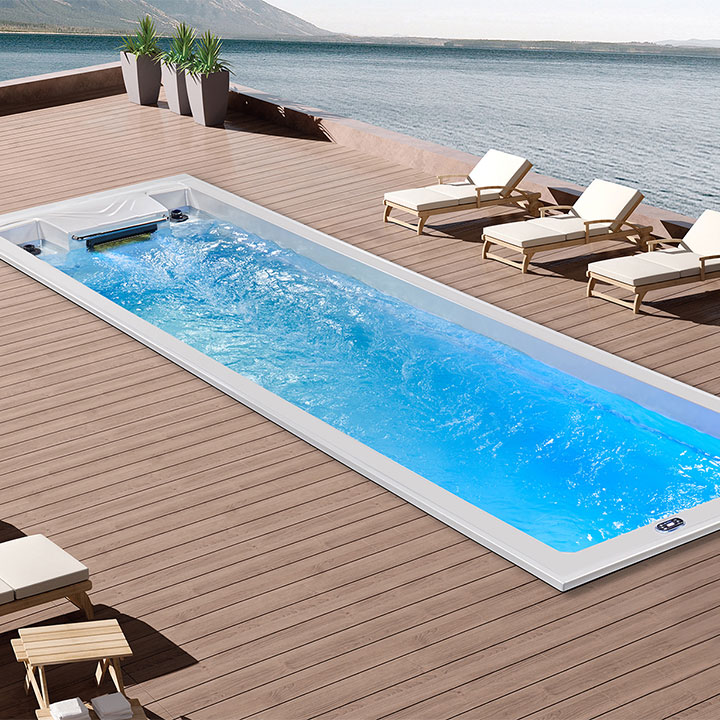
A standard swim spa in the 14-foot category is designed primarily around a continuous countercurrent rather than open lap turns. Instead of gliding through thirty feet of still water, your body remains suspended against an adjustable stream generated by high-output hydrotherapy pumps. This stationary dynamic means that an aquatic vessel does not need the physical length of a traditional pool to support a rigorous workout.
Taller swimmers must evaluate stroke mechanics against internal boundaries. If your reach extends past six feet, forward fingertip extension and trailing flutter kicks require careful assessment. Check the model’s interior dimensions and, if possible, test the current and stroke space for your own height and swimming style before committing to a purchase.
What Does "14 Feet" Tell You—and What Does It Not?
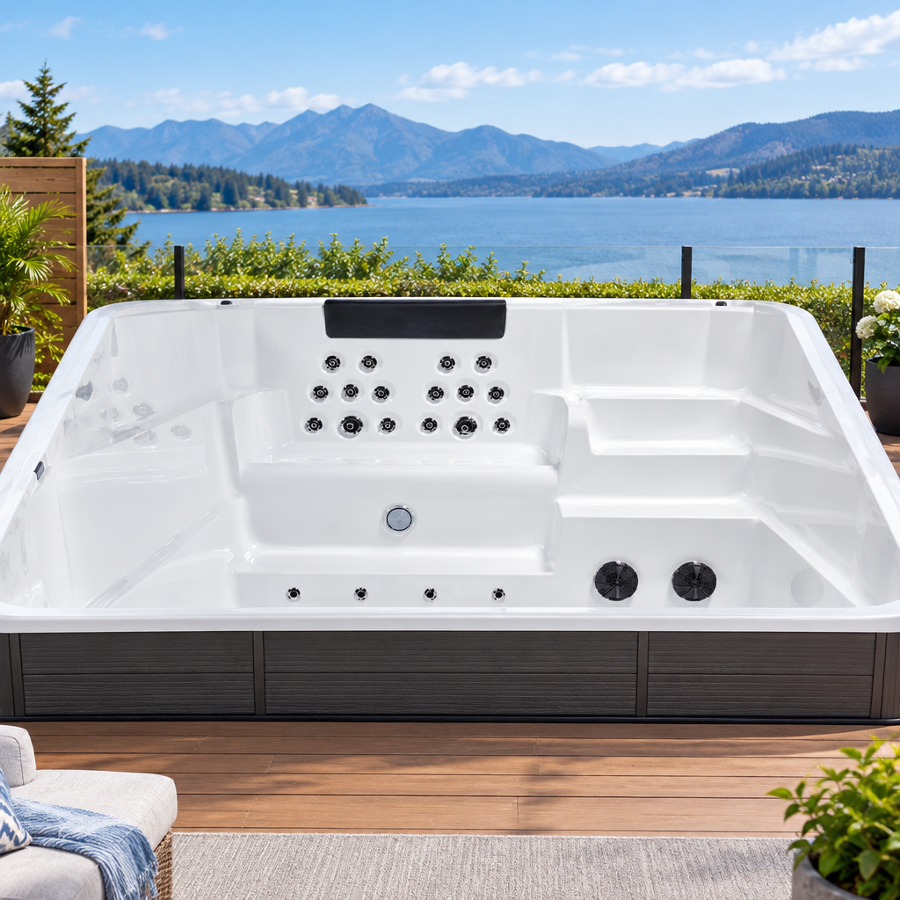
A 14-foot label is a model-size category; check the manufacturer’s published exterior dimensions for the actual length, width, and height. It does not indicate the unobstructed swim lane length inside the water basin. A unit advertised under this dimension might include molded bench steps, dual lounger seats, or raised headrests that intrude directly into the open swimming channel.
Public specifications across the industry illustrate these structural differences clearly. An American Whirlpool RL4 model, cataloged at 14 feet, measures 168 by 90 inches with an open three-person footprint and approximately 1,550 gallons of water. Conversely, a Cal Spas F-1437 lists exterior dimensions of 170 by 93 inches with four ergonomic seats and 37 total jets. Outer length provides only an initial sorting metric rather than a guarantee of internal volume.
How to Compare 14-Foot Swim Spa Designs
Countercurrent Swimming and Current Adjustment
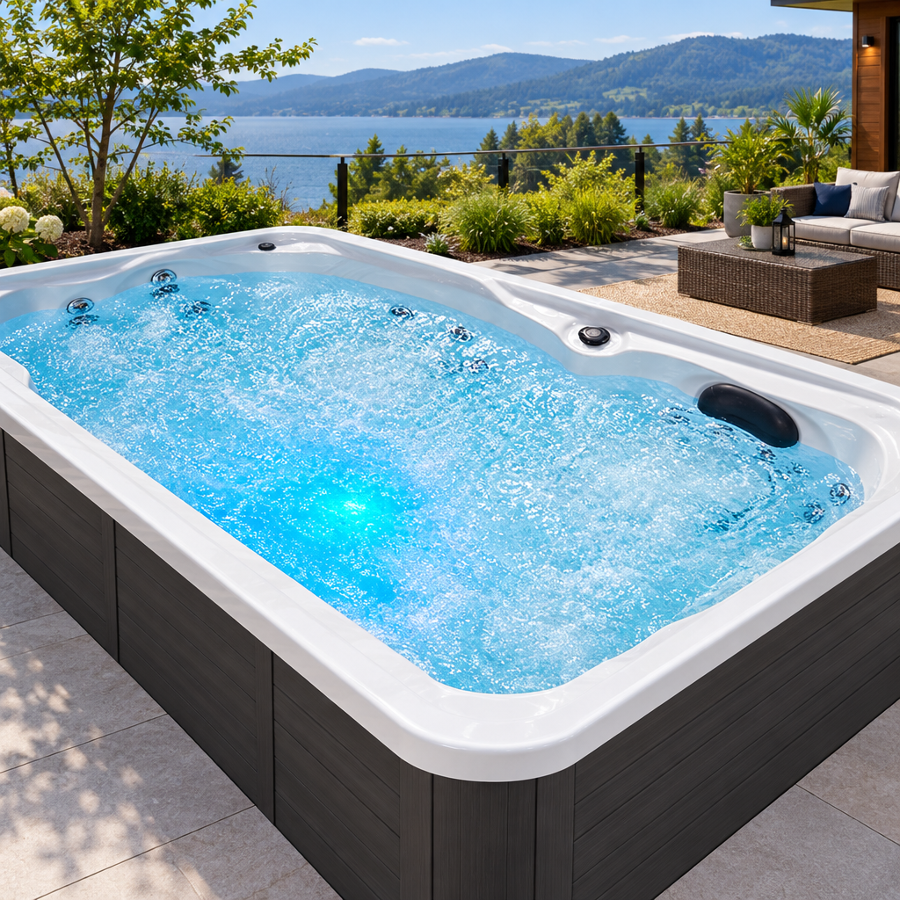
Countercurrent flow determines the physical feel of every swim stroke. Current width, stability, and adjustability depend on the particular system’s design and operation. Assess current width, stability, adjustability, and feel on the specific model rather than infer performance from nozzle type alone. Some configurations use wider output housings or multi-pump manifolds designed to broaden the resistance surface across your shoulders and chest.
Check whether the unit lets users adjust current intensity for different workout types. Testing those settings in person helps confirm that the flow matches your stroke pace and training goals. Evaluating the balance between water pump volume and intake grate placement reveals whether the system can maintain steady buoyancy throughout an extended workout session.
Swim-Only Layouts Versus Swim-and-Hydrotherapy Layouts
Backyard aquatic installations typically follow two structural layout philosophies: dedicated open fitness shells and dual-purpose hybrid configurations. Choosing between them depends on whether your daily routine prioritizes uninterrupted stroke drills or social soaking sessions with family members.
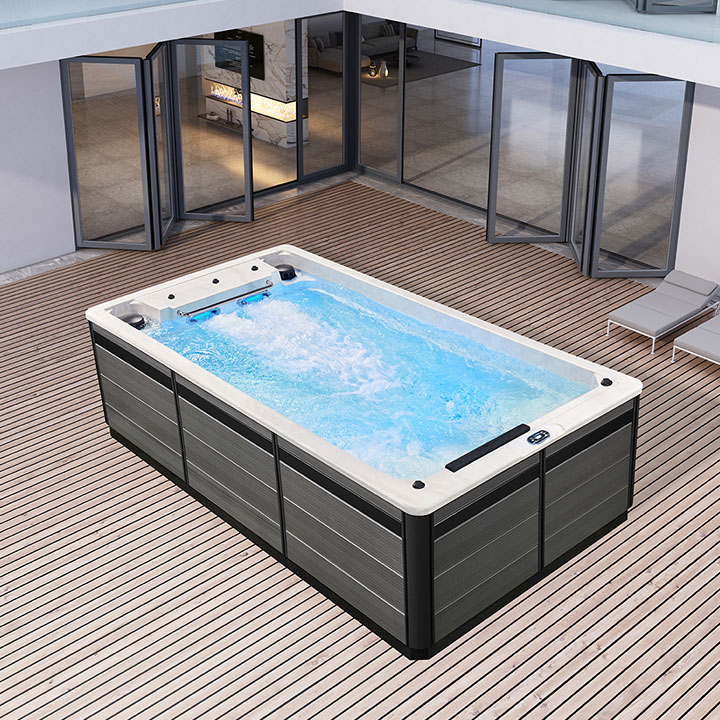
Open fitness layouts maximize unobstructed basin length by minimizing molded seating, giving taller athletes wide clearance for butterfly and backstroke kicks.
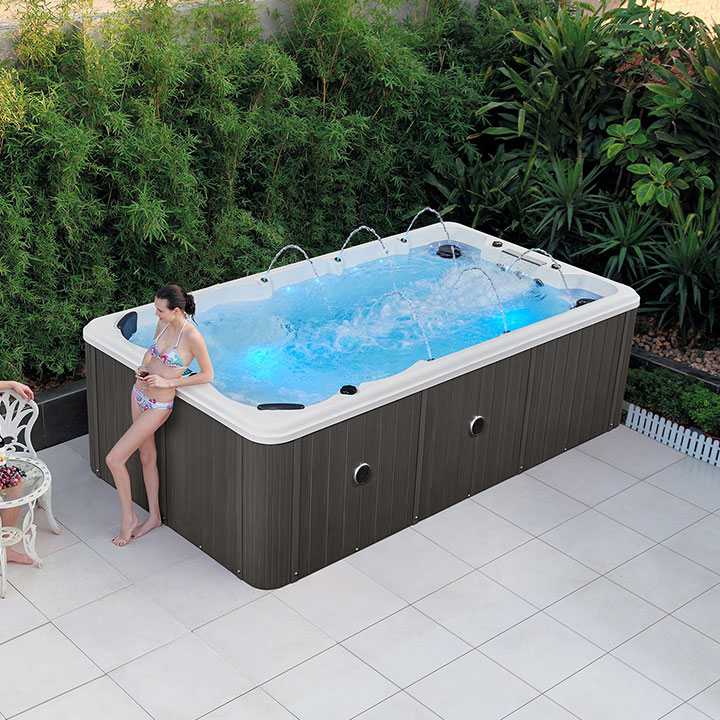
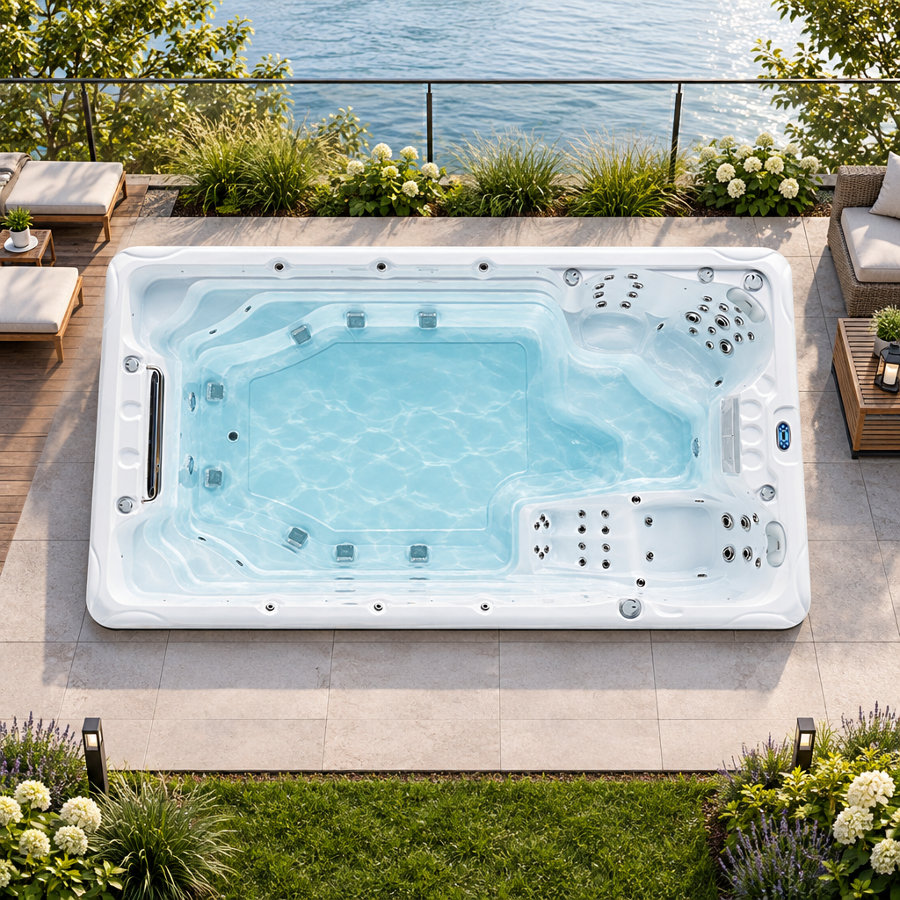
Dual-purpose hybrid designs integrate molded therapeutic captain chairs, foot massage recesses, and multi-tier entry steps directly into the shell cavity.
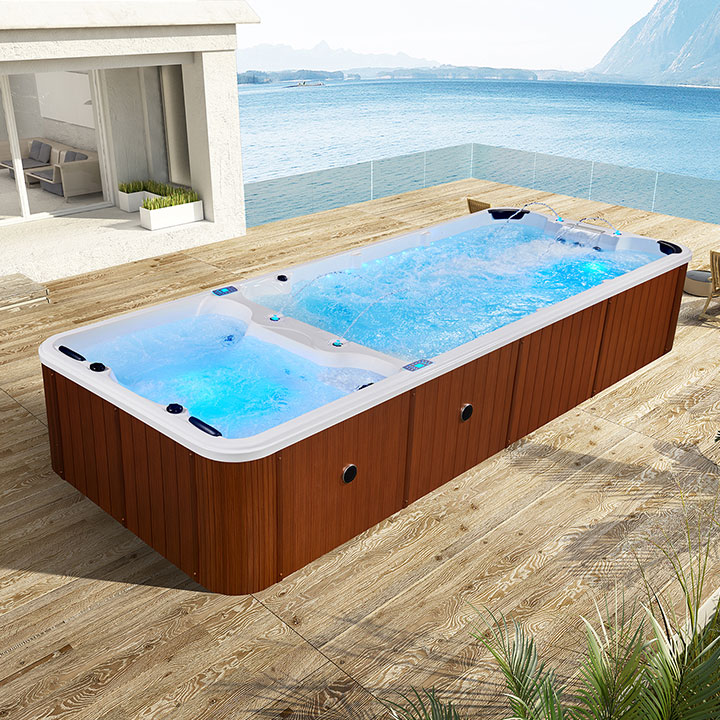
Dual-temperature units divide the chassis into two separate water reservoirs, allowing a cool exercise tank on one side and a hot soaking tub on the other.
Dual-temperature setups generally require longer frames. In a single-compartment 14-foot footprint, hydrotherapy seats and swimming space share the same body of water, making interior spatial efficiency paramount.
Seating, Massage Jets, and User Priorities
Jet count alone should not serve as the primary proxy for therapeutic quality. Verify the specific model’s jet layout, pump configuration, and seat contour, and try the hydrotherapy settings in person when possible. The geometry of the molded seat matters as much as the water pressure pushing through it.
When exploring multi-seat vessels, examine the depth of each recliner relative to the operational water level. Ergonomic hydrotherapy seats should position adult shoulders beneath the surface to prevent chilly air exposure during winter hydrotherapy sessions. Integrated armrests, textured footwell wells, and curved cervical headrests turn an ordinary cool-down swim into a restorative musculoskeletal recovery experience.
Dimensions, Site Planning, and Delivery Access
Measure the Spa Footprint and Service Clearances
Planning your site requires accounting for perimeter space beyond the physical cabinet dimensions. Swim spa equipment panels hide high-amperage electronic controller boxes, plumbing manifolds, drain valves, and primary pump arrays. Technicians need unobstructed access to these compartments for seasonal maintenance or repairs without dismantling outdoor decking.
Check the installation manual for service-clearance requirements, especially at the equipment access panel, and confirm the planned layout with the dealer or installer.
Confirm the clearance needed for insulated hardcovers, especially if installing mechanical fold-back lifters that swing open over the ends.
Verify overhead space to ensure tree branches, roof gutters, or low-hanging utility cables do not interfere with safe entry and exit.
Design surrounding patio pavers or timber decking with removable hatch panels if you intend to install the unit semi-recessed below grade.
Check the Route from Delivery Point to Installation Site
Moving an unyielding fiberglass structure across residential terrain presents unique spatial obstacles. Due to structural rigidity, a fourteen-foot chassis cannot bend around house corners or tilt past tight exterior air conditioning compressors. Some difficult sites require a crane, while accessible sites may be serviced with specialized spa dollies. Confirm the delivery method with the installer after a route survey.
Survey the road access for flatbed staging, street parking permissions, and overhead utility lines before ordering. If your landscape allows rolling the spa on specialized dollies along the side yard, ensure that gates, gas meters, downspouts, and fence lines maintain continuous width. The ground route must remain flat and dry to support the concentrated rolling weight safely.
Plan a Suitable Support Surface
A filled aquatic exercise vessel exerts massive weight across its foundation footprint. Water weighs roughly 8.34 pounds per gallon, meaning that a 1,500-gallon spa holds more than 12,500 pounds of water alone, excluding the weight of internal framing and bathers. Placing a unit on uncompacted soil, loose pavers, or standard patio decking risks structural sagging, pipe cracking, and shell warping.
Many manufacturers require a level, load-bearing foundation, but the required thickness, reinforcement, and allowable materials vary. Follow the selected model’s installation manual and have local professionals verify the design. Proper site preparation also incorporates surface grading to channel natural rain runoff away from sensitive electrical access doors.
Electrical, Water, and Installation Checks
Confirm the Model’s Electrical Requirements
Swim spas draw significant electrical current to run continuous multi-pump arrays, digital control boxes, and integrated heating elements simultaneously. Unlike standard plug-and-play patio hot tubs that operate on 120-volt circuits, many large fitness spas use dedicated 240-volt electrical service connected through a weatherproof outdoor disconnect box. Exact voltage, amperage, wiring method, and GFCI arrangement depend on the model and local jurisdiction.
For example, Cal Spas models use 240-volt configurations, but breaker and amperage requirements must be confirmed from the exact model’s electrical documentation. Commercial-style multi-pump models might demand 60-amp or dual-feed subpanels to power water heating elements while running three high-output pumps at maximum flow. Always hire a licensed electrician to verify panel capacity and pull required municipal permits.
Understand Filling, Drainage, and Equipment Access
Operational routines involve filling the acrylic basin with fresh water using an ordinary garden hose equipped with an inline sediment pre-filter. Fill time depends on your site’s water flow rate; follow the selected model’s manual for water-level markings, startup sequences, and pump priming procedures. Never energize pumps before completing the manufacturer’s initial startup steps, as running pumps dry can cause immediate mechanical damage.
Draining takes place through an integrated bottom drain fitting or an external submersible pump. Local environmental regulations often prohibit releasing treated chlorinated water directly into stormwater drains, requiring you to discharge water into sewer cleanouts or allow sanitizer levels to neutralize before irrigating turf. Keep service valves reachable without crawling into muddy trenches.
Ask for the Installation Manual Before Purchase
Never finalize site prep work based purely on glossy retail brochures or showroom sales pitches. Technical design cut-sheets change between production runs, altering the precise location of structural conduit knockouts, electrical terminals, and plumbing drains. Requesting an authorized installation manual directly from the manufacturer ensures concrete contractors align electrical conduit stubs accurately.
Reviewing engineering schematics ahead of time prevents expensive slab core-drilling after delivery. It also confirms manufacturer warranty terms regarding structural support criteria. Many warranties are voided if the shell develops stress fractures due to installation on an unapproved gravel bed or an uneven timber platform.
Water Care, Heating, and Day-to-Day Ownership
Filtration and Disinfection Need Regular Attention
Maintaining pristine water quality requires disciplined chemical testing and clean mechanical filtration. High-capacity filter cartridges trap dead skin flakes, lint, and wind-blown dust. Inspect and rinse filters according to the manufacturer’s schedule, increasing service when flow drops or the spa is used heavily. Use only cleaning methods approved for the cartridge. Dirty filters restrict water flow, triggering electronic flow-switch error codes on the main display.
According to CDC recreational water health guidelines, maintaining water safety in hot tubs and hydrotherapy systems requires continuous sanitizer residuals. Operators must maintain free chlorine at a minimum of 3 parts per million (ppm) or bromine between 4 and 8 ppm, alongside balanced pH between 7.0 and 7.8. Multi-stage purification setups like ozone and ultraviolet sanitizers reduce organic loading, but they do not eliminate the necessity of routine chemical testing.
Heating and Energy Use Depend on Real-World Conditions
Thermal efficiency determines how much you will pay each month to keep several thousand liters of water ready for immediate exercise. Swim spas feature electric heating modules rated between 3,000 and 5,500 watts that cycle automatically based on thermostat settings. In colder climates, heating costs escalate rapidly if the perimeter cabinet lacks dense perimeter insulation.
To control standby heat loss, owners must use heavy-duty tapered marine vinyl covers fitted with dense foam cores and perimeter vapor seals. For exercise, consider a cooler setting and adjust it to personal comfort and the manufacturer’s guidance. Cranking temperatures up to hot tub levels should be reserved for evening recovery soaking.
Safe Use of Warm Water
Elevated water temperatures place real physiological demands on the human cardiovascular system during exercise. The CDC strongly advises that water temperatures in hot tubs and hydrotherapy spas should never exceed 104°F (40°C), as excessive heat can lead to dizziness, fainting, and heat exhaustion. This safety threshold becomes doubly important when performing strenuous aquatic workouts.
Athletes should keep water distinctly cooler during intensive swimming intervals than during static hydrotherapy sessions. If multiple household members use the spa for different purposes, programming user temperature presets makes transitioning between active training and restful soaking smooth. Keep water bottles poolside to maintain hydration during prolonged warm water workouts.
A Near-14-Foot Example: Victoria Star M-400
Published Dimensions and Configuration
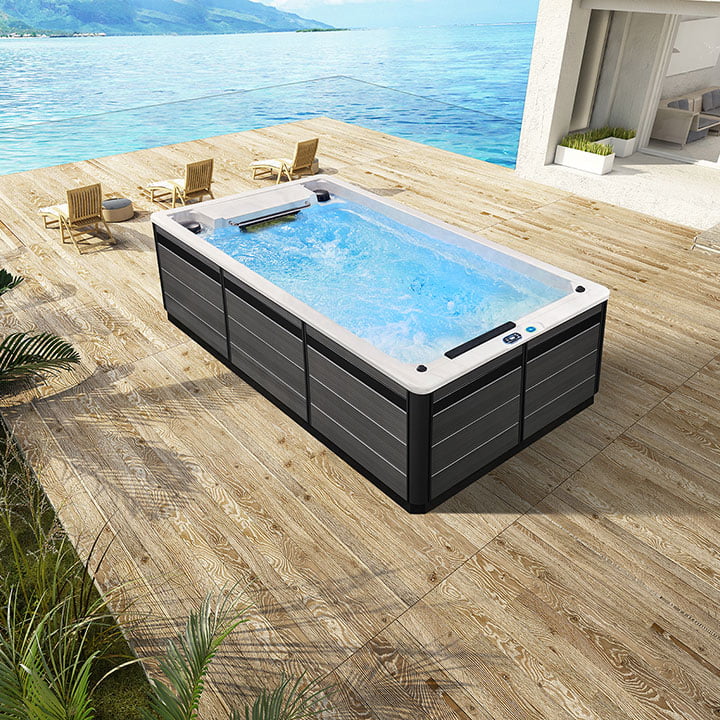
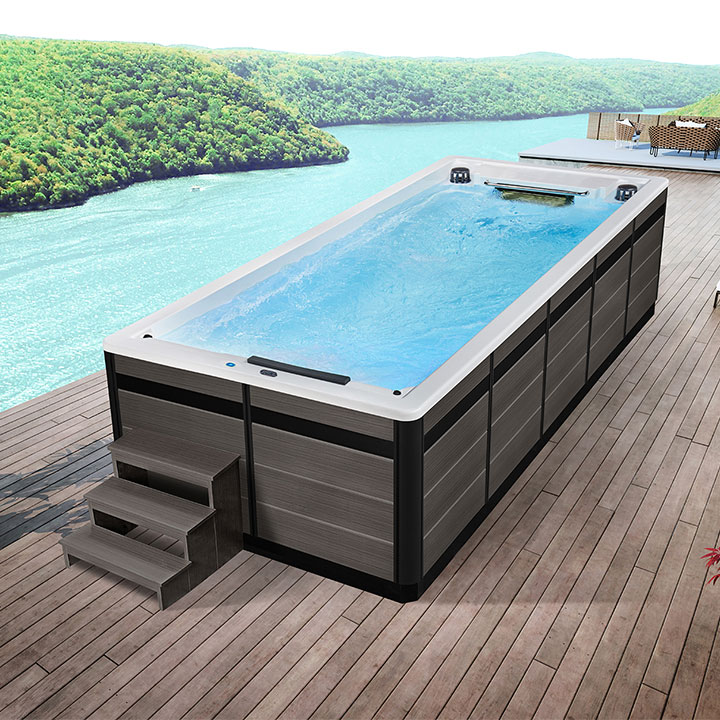
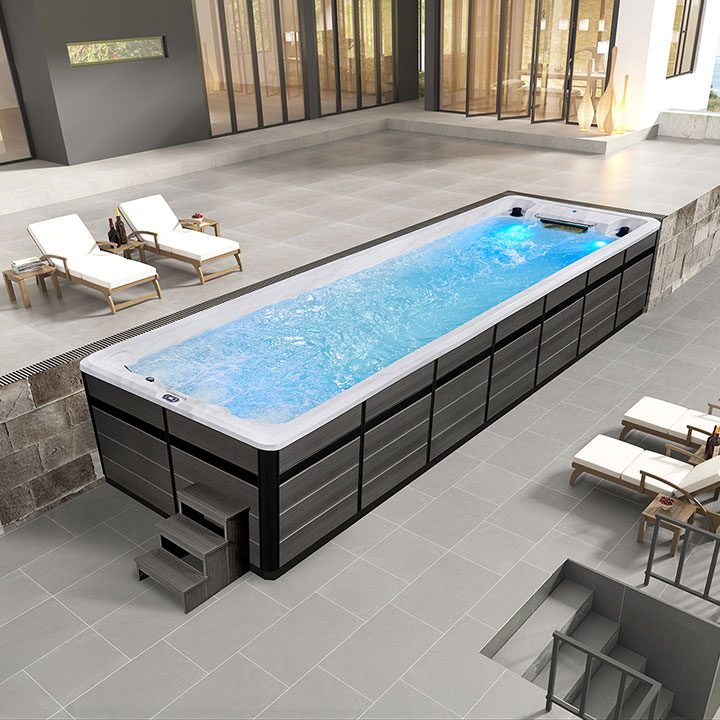
Buyers evaluating the 14-foot category often find that slightly shorter designs maximize patio efficiency while meeting fitness needs. The Victoria Star M-400 serves as a relevant example of a 13-foot class performance vessel. Based on manufacturer specifications, this model measures 13 feet in length by 90 inches wide and 50 inches deep (4020 mm by 2280 mm by 1260 mm), packaging a 6,000-liter water capacity inside an accessible footprint.
Internally, the M-400 integrates a countercurrent swim lane with three dedicated ergonomic seats and 56 targeted massage jets. At Victoria Star, manufactured by Foshan Gaoming Shiyi Sanitary Ware Technology Co., Ltd., designing high-end swim spas involves balancing molding precision, production craftsmanship, and long-term wellness functionality. The M-400 is listed with a Porcelain shell and Platinum or Midnight cabinet color options.
Features to Verify with the Seller
When evaluating a configuration like the M-400, verify the mechanical layout against your specific electrical and physical requirements. Manufacturer data lists a substantial high-output pump configuration comprising three 3-horsepower water pumps and one 2-horsepower pump for countercurrent propulsion, paired with a dedicated 1-horsepower circulation pump. The aggregate electrical load lists a total power demand of 12.55 kW, which requires careful assessment by a licensed electrical contractor.
Water heating relies on a 3,000-watt electric heater controlled through an integrated KL2020BT digital touchscreen interface. The sanitation array combines multi-stage mechanical cartridge filtration with ultraviolet (UV) and ozone disinfection units. Inquiring about replacement part schedules, local filter cartridge availability, and specific panel wiring diagrams ensures smooth long-term ownership.
Who Might Consider This Configuration?
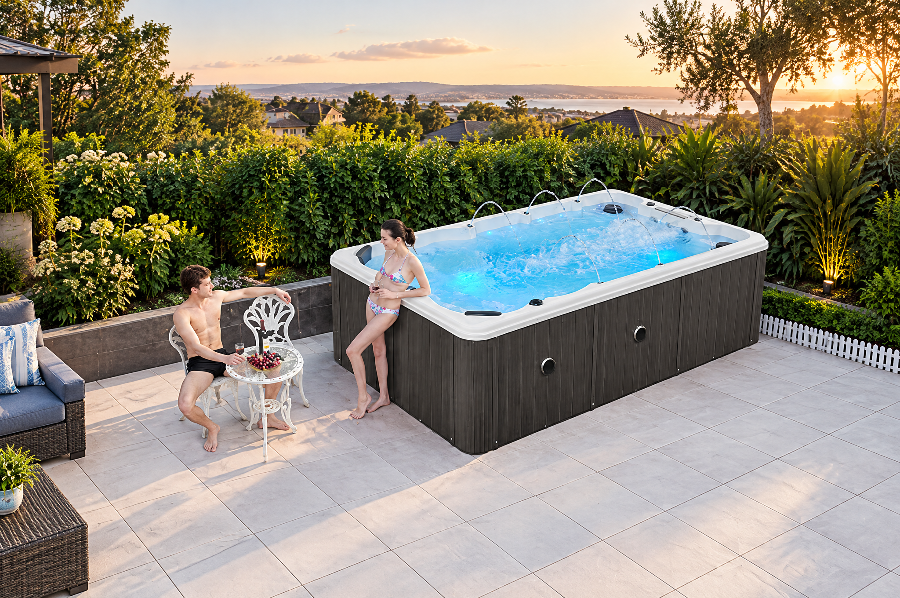
The M-400 configuration appeals to households seeking a compact hybrid vessel for low-impact aquatic cross-training and evening family relaxation. Having three sculpted hydrotherapy seats allows swimmers to complete their resistance laps and transition directly into targeted hydrotherapy massage. The inclusion of laminar fountain jets and perimeter LED illumination also makes the installation visually striking for outdoor entertaining.
A 13-foot model may suit a site where length is the limiting dimension, but verify the complete footprint, delivery route, and installation clearances. It is marketed for year-round countercurrent exercise and hydrotherapy, offering fitness capability without swallowing your entire garden footprint.
14-Foot Swim Spa Comparison Checklist
Compare Like-for-Like Specifications
Comparing swim spa specifications requires setting aside marketing terms and examining standardized structural metrics. A side-by-side technical evaluation helps you assess whether a prospective model delivers the water volume and electrical balance needed for your home. The following illustrative comparison demonstrates how dimensions, features, and systems vary even within a similar size category.
Specification Feature
Victoria Star M-400 (Client Data)
American Whirlpool RL4 (Public Spec)
Exterior Dimensions
13′ × 90″ × 50″ (156″ × 90″ × 50″)
168″ × 90″ × 50″
Water Volume
6,000 Liters
~5,867 Liters (~1,550 Gallons)
Seating Count
3 Dedicated Seats
3 Seats (Open Lane Design)
Hydrotherapy Jets
56 Targeted Jets
Varies by Configuration
Pump Arrangement
3 × 3 HP, 1 × 2 HP + 1 HP Circ
High-Volume Swim Pump Array
Sanitation System
Multi-Stage Filter + UV + Ozone
CleanZone or CleanZone Ultra Options
Control System
KL2020BT Touchscreen Panel
Digital Programmable Topsheet
Questions to Ask Before You Request a Quote
Before signing a retail sales contract or paying a delivery deposit, walk through a structured list of questions with your dealer. Clear answers help confirm the installation budget and timeline.
Does the quoted retail price include localized backyard placement, or does delivery stop at the curbside?
Can the manufacturer provide certified electrical wiring diagrams showing breaker sizes and conduit entry points?
What specific brand of electronic topside controller is installed, and how easy are replacement parts to source locally?
What concrete pad thickness and reinforcement schedule does the warranty require to prevent chassis structural voiding?
Does the water filtration system utilize open commercial cartridge sizes or proprietary brand-specific filters?
What are the step-by-step winterizing procedures if the swim spa is taken offline during freezing weather?
FAQs About 14-Foot Swim Spas
Is a 14-Foot Swim Spa Exactly 14 Feet Long?
Not necessarily. In the aquatic industry, fourteen feet is generally a nominal category classification. An actual shell might measure anywhere between 156 inches (thirteen feet) and 172 inches (over fourteen feet) depending on acrylic lip designs, exterior composite trim styles, and corner radius molding.
Can You Swim Continuously in a 14-Foot Swim Spa?
Yes, provided the countercurrent system generates sufficient stream volume to match your physical stroke pace. Because you swim in place against the water resistance, overall pool length is less important than smooth, steady water flow and an unobstructed kick zone.
How Much Space Should You Leave Around a Swim Spa?
Refer to the selected model’s installation manual for side-by-side access and cover-lifter clearances. Manufacturer installation instructions differ, and service-clearance requirements vary by model. Confirm the planned layout with the dealer or installer to ensure technicians can access equipment panels and you can handle covers safely.
Does a Swim Spa Need a Special Electrical Connection?
Many large swim spas use dedicated 240-volt service, but requirements vary by model. Confirm the nameplate and installation manual, then use a qualified electrician and the required GFCI protection. Installation must always be completed by a licensed electrician following the specific model’s electrical documentation and local code.
Does UV or Ozone Eliminate the Need for Water Testing?
No, supplemental sanitation systems do not eliminate standard chemical management. While ultraviolet light and ozone breakdown organic contaminants, they leave no residual sanitizer in the water. As outlined by public health agencies like the CDC, you must maintain regular free chlorine or bromine levels and balance water pH.
Is the Victoria Star M-400 a 14-Foot Swim Spa?
Technically, the M-400 is cataloged as a 13-foot model with outer dimensions of 156 by 90 by 50 inches. However, because it provides a 6,000-liter water basin, an integrated swim lane, and 56 targeted massage jets, it competes directly in the same class as traditional 14-foot models while offering a slightly tighter footprint.
Conclusion
Selecting the right 14 ft swim spa comes down to balancing internal swim space against your available backyard patio dimensions. Rather than focusing solely on nominal exterior shell measurements, prioritize steady countercurrent adjustability, supportive ergonomic hydrotherapy seating, and realistic delivery logistics. Reviewing technical specs, verifying concrete foundation engineering, and confirming electrical readiness ahead of time can support countercurrent exercise and hydrotherapy when the model and installation suit your needs.
Victoria Star Swim Spa offers the perfect balance between exercise and relaxation, whether you want to swim for fitness or relax in the spacious seating.
Victoria Star Swim Spa offers the perfect balance between exercise and relaxation, whether you want to swim for fitness or relax in the spacious seating.