120 Volt Hot Tub Guide: Electrical Realities, Thermal Trade-Offs, and Compact Spa Selection
Home / News / 120 Volt Hot Tub Guide: Electrical Realities, Thermal Trade-Offs, and Compact Spa Selection
October 26, 2026
Shopping for a 120 volt hot tub often starts with a simple promise: skip the electrician, plug a cord into a patio wall outlet, and soak by dinner time. While a 120 volt plug and play hot tub eliminates heavy trenching and subpanel installations, household electrical physics impose strict limits on water heating and jet pressure. Understanding how a 120 volt hot tub manages amperage helps homeowners decide when a standard wall-outlet unit suffices and when a higher-output compact 4-person spa delivers steadier year-round hydrotherapy.
What Defines a 120 Volt Hot Tub and How Plug-and-Play Systems Work
Homeowners exploring compact spas frequently wonder why entry-level units behave differently from hardwired residential models once the insulated cover comes off. The distinction comes down to the electrical ceiling of a standard North American household receptacle and how internal control packs ration power between heating and water movement.
Standard Household Amperage Limits and the Continuous Load Rule
A standard household circuit provides 120 volts at either 15 amps or 20 amps, which acts like a narrow garden hose for electrical current. Because electrical safety codes restrict continuous appliances to roughly 80 percent of a breaker’s rated capacity, a 15-amp plug-and-play circuit safely delivers only about 12 amps, or 1,440 watts of continuous power.
Even when connected to a dedicated 20-amp weather-resistant outlet, available power peaks near 1,920 watts. That modest wattage budget must simultaneously feed the digital control board, underwater LED lights, water pump motor, and electric heating element, and drawing more current than the circuit can handle will trip its breaker. The cord’s built-in ground-fault circuit interrupter (GFCI) serves a different purpose: it protects against ground-fault current, such as a short to water or a damaged component, rather than against simple overload.
Alternating Load Logic: Why Heaters Pause During High-Speed Jet Operation
To stay under that strict wattage ceiling, a 120 volt hot tub relies on an alternating load relay inside its control pack. When the primary two-speed pump runs on low speed for routine filtration, the motor draws minimal current, leaving just enough headroom for a 1.0 kW to 1.5 kW heater element to warm the water.
The moment you press the jet button to activate high-speed massage, the pump motor demands the majority of the circuit’s available amperage. Consequently, the control board automatically shuts off the heater until the jets return to low speed, meaning the water can begin losing heat to the surrounding air while you use the massage jets.
Why Higher-Capacity Heaters Need a Different Electrical Supply
A 3 kW heater element draws roughly 25 amps at 120 volts, which is well beyond what a standard 15-amp or 20-amp household circuit can carry. That is one reason higher-output spa heaters are typically paired with a higher-voltage electrical supply rather than a standard wall outlet, and it is worth understanding before assuming any compact spa can simply be plugged in like a small appliance.
The Comfort Series VS-401C Small 4 Person Hot Tub, for example, lists a 3 kW heater alongside a 2 HP water pump, a 0.35 HP circulation pump, and a 4.5 kW total power supply specification in the manufacturer’s data. The supplied specifications do not state the exact supply voltage or required breaker amperage for this configuration, and they do not confirm whether the heater and high-speed jets can run at the same time. Buyers should confirm the required voltage, circuit rating, and simultaneous-operation behavior directly with the manufacturer or installer before planning an electrical hookup.
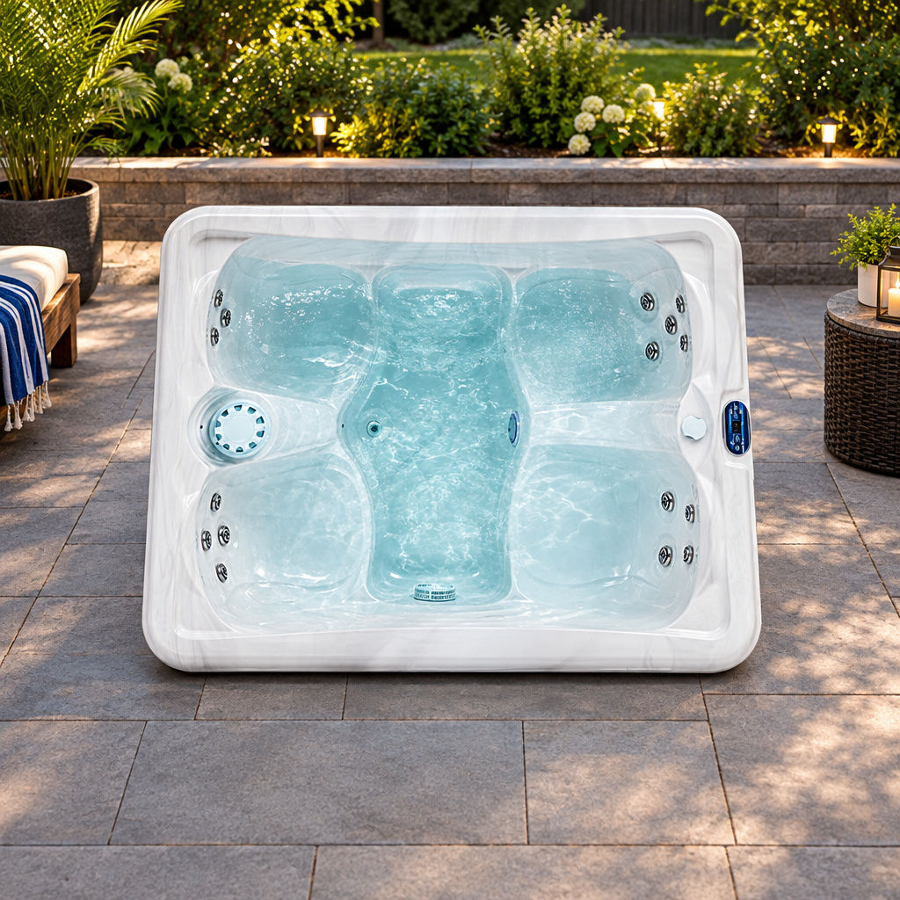
What the dimensions do make clear is that a compact footprint does not have to mean a low-wattage heater. The VS-401C measures 1900 mm by 1500 mm by 865 mm (approximately 75 inches by 59 inches by 34 inches), showing that a spa sized for a balcony or courtyard can still carry higher-output heating hardware than a typical plug-and-play unit, provided the electrical supply is sized to match it.
120 Volt Hot Tub vs. Higher-Output Compact Spas: Performance and Cost Comparison
Evaluating a 120 volt hot tub against a higher-output compact spa requires looking past the initial delivery day to examine daily thermal recovery, seasonal climate tolerance, and long-term electricity bills. The table below outlines the core technical differences between standard 120V plug-and-play setups, 240V hardwired conversions, and the compact VS-401C specification according to the manufacturer’s data; voltage and circuit requirements for the VS-401C should be confirmed with the manufacturer before purchase, and the heating rates shown are illustrative estimates rather than guaranteed figures, since actual performance depends on water volume, ambient temperature, cover use, and other heat-loss factors.
Technical Parameter
Standard 120 Volt Hot Tub (Plug-and-Play)
Converted 240 Volt Hardwired Spa
Compact High-Output Spa (VS-401C Reference)
Electrical Supply
120V, 15A or 20A dedicated GFCI outlet
240V, 40A to 50A hardwired subpanel
4.5 kW total power supply specification; exact voltage and circuit requirements to be confirmed with manufacturer
Heater Output
1.0 kW to 1.5 kW
4.0 kW to 5.5 kW
3.0 kW electric heater per manufacturer specifications
Estimated Heating Rate
Illustrative estimate of 1°F to 2°F (0.5°C to 1°C) per hour under typical conditions; actual rate varies with water volume and heat loss
Illustrative estimate of 4°F to 6°F (2°C to 3.3°C) per hour under typical conditions; actual rate varies with water volume and heat loss
No verified recovery rate supplied by the manufacturer; a 3 kW element would be expected to recover heat faster than a 1 kW element in comparable conditions
Simultaneous Heat & High Jets
No (heater disables on high pump speed)
Yes (simultaneous heating and massage)
Not confirmed in supplied specifications; verify with manufacturer
Pump Configuration
Single 1.0 HP to 1.5 HP two-speed pump
Single or dual pumps depending on chassis
1 x 2 HP water pump plus 1 x 0.35 HP dedicated circulation pump
Initial Heat-Up Rates and Ambient Heat Loss in Cold Climates
Water has an exceptionally high specific heat capacity, meaning it absorbs substantial thermal energy before its temperature rises by a single degree. In a 120 volt hot tub equipped with a 1.0 kW heater, raising freshly filled tap water from 55°F to 102°F is commonly cited as taking roughly 24 to 48 hours of uninterrupted operation with the insulated cover closed, though the actual time depends on starting water temperature, ambient air temperature, water volume, and insulation quality.
Once you fold back the cover on a brisk evening, evaporative cooling and wind across the water surface pull heat away from the surface. Because a 120 volt plug and play hot tub disables its heater during high-speed jet use, water temperature can drift downward during that window, and the exact rate of loss varies with air temperature, wind, water volume, and how long the jets run, so it is best treated as a variable rather than a fixed number.
Debunking the Monthly Electricity Bill Myth
A widespread misconception suggests that a 120 volt hot tub costs less to operate each month simply because it draws fewer watts at any given moment. Thermodynamics dictates otherwise: replacing a given amount of lost heat in a set volume of water requires roughly the same number of kilowatt-hours regardless of whether the heater is rated at 1 kW or 3 kW.
Like trying to boil a kettle over a candle in a drafty room, a low-wattage heater must run far longer to recover temperature after an evening soak. During those extended recovery hours, the circulation pump also continues drawing electricity, which can cause a poorly insulated 120V unit to consume more monthly power than a well-insulated, higher-output compact spa.
Hydrotherapy Jet Pressure and Dedicated Circulation Architecture
Another counterintuitive point is that converting a convertible spa from 120V to 240V does not necessarily increase jet pressure on its own. If a convertible plug-and-play model uses a 120V pump motor, flipping the jumper on the circuit board mainly increases available power to the heater element, while the pump’s mechanical output stays tied to its original motor rating.
Hydrotherapy force depends heavily on dedicated pump horsepower and low-friction manifold plumbing rather than voltage conversion alone. In the VS-401C architecture, a dedicated 2 HP water pump drives 16 targeted massage jets positioned for muscle relief, while a separate 0.35 HP circulation pump handles quieter, lower-wattage daily filtration, per the manufacturer’s specifications.
Inside Compact Spa Engineering: Overcoming Small-Space Thermal and Hygiene Limits
Whether a homeowner selects a 120 volt hot tub for a covered porch or installs a higher-output compact spa on a rooftop terrace, small-footprint vessels face unique physical challenges. Less water volume means faster heat transfer through the cabinet walls and higher bather-to-water ratios that call for proactive sanitation.
Multi-Layer Cabinet Insulation and Acrylic Shell Thermal Retention
Many entry-level 120 volt hot tub models use single-wall rotomolded polyethylene shells that radiate heat outward into cold patio air. Without dense thermal barriers between the basin and the exterior skirt, the heater cycles continuously just to maintain standby temperature overnight.
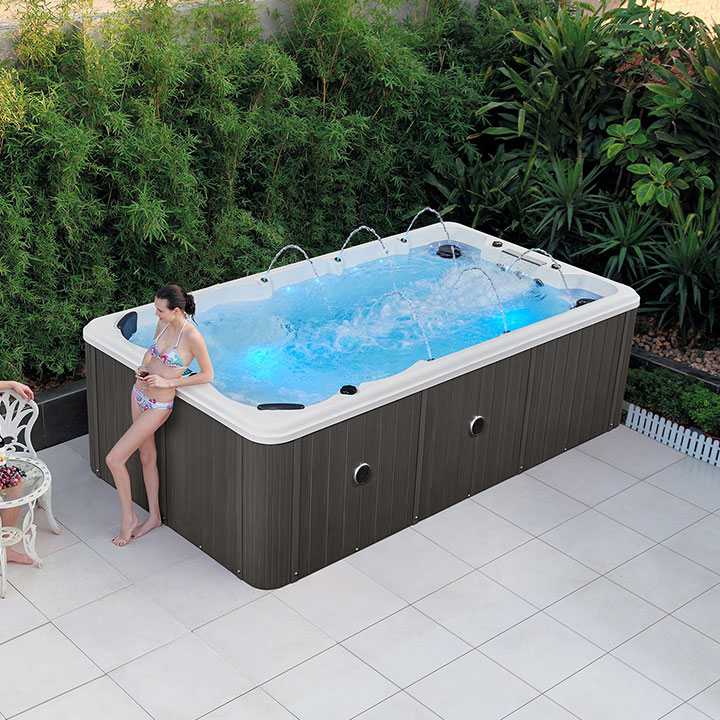
To help limit conductive heat loss, Foshan Gaoming Shiyi Sanitary Ware Technology Co., Ltd. developed our brand Victoria Star around close manufacturing control, from mold forming to cabinet assembly. In our VS-401C model, a smooth Porcelain molded acrylic shell pairs with a durable aluminum-plastic skirt in Platinum or Midnight finishes to help contain ambient equipment heat inside the cabinet.
Ergonomic Contour Seating and Jet Distribution in a 75-Inch Footprint
Fitting four adults into a basin roughly 75 inches by 59 inches without creating cramped footwells requires deliberate interior geometry. Open-bench plug-and-play tubs often cause bathers to float upward or slide out of position once the aeration valves open and turbulent water fills the basin.
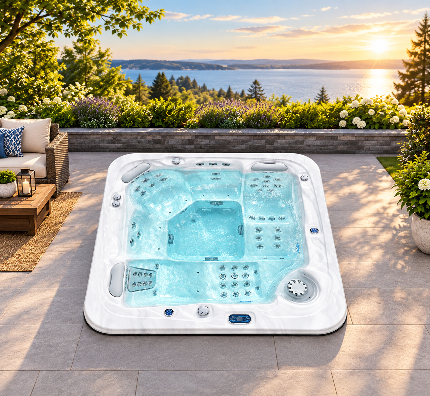
By molding four distinct ergonomic contour bucket seats into the Porcelain acrylic basin, the VS-401C positions each bather against 16 strategically placed chrome nozzles, according to the manufacturer’s specifications. Its 865 mm (34-inch) height is one factor in planning delivery, but doorway, stairwell, and elevator clearance depend on the full access route, door and cab opening dimensions, and handling orientation, so measure the entire delivery path and confirm clearance with the manufacturer or installer rather than relying on height alone.
Automated Water Purification and Smart Digital Controls
In a compact four-person spa, body oils and lotions concentrate more quickly than in an eight-person backyard vessel, making filtration efficiency important. Inadequate or imbalanced water care, such as skipping routine sanitizer and pH testing, can contribute to odor, skin irritation, and cloudy water, particularly in smaller water volumes where contaminants concentrate faster.
Multi-Stage Water Purification: The VS-401C combines physical multi-stage filtration with an integrated ozone generator and UV light sanitization chamber designed, according to the manufacturer’s specifications, to help reduce bacteria and organic impurities and lessen reliance on added chemicals. Ozone and UV systems are a supplement to, not a replacement for, an appropriate sanitizer; owners should still test and maintain chlorine or another sanitizer level and overall water balance as directed in the spa manual and general public health guidance for home hot tubs.
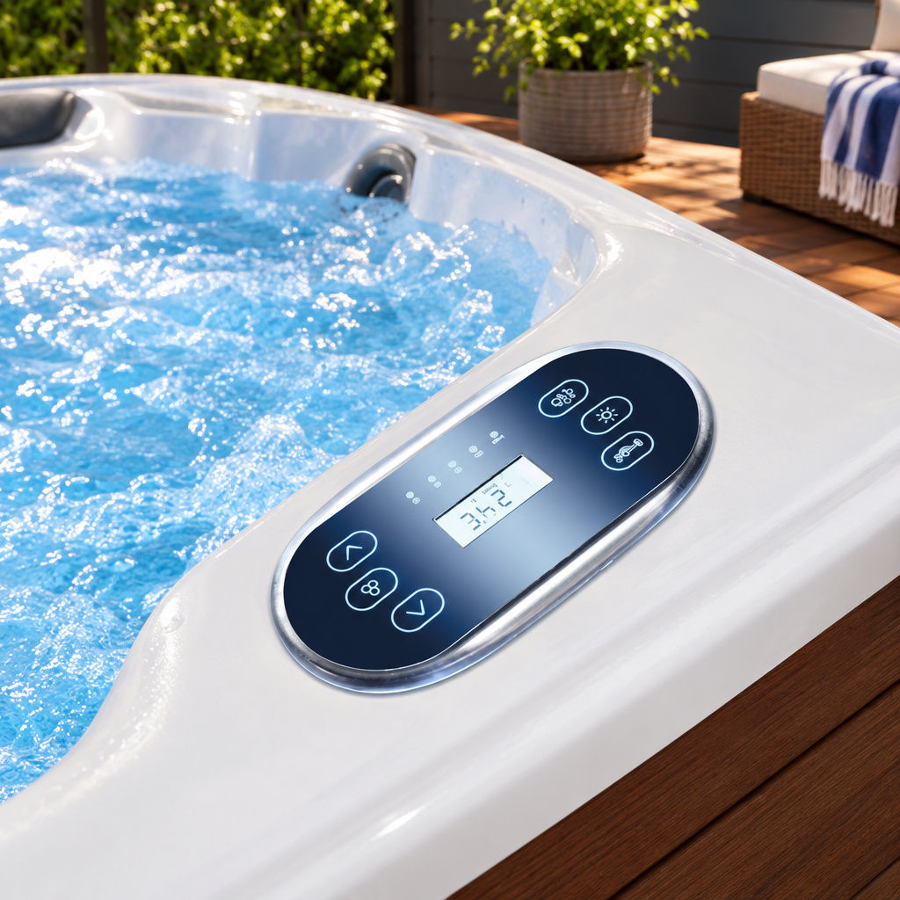
Smart Touchscreen Management: According to the manufacturer’s specifications, a flush-mounted, backlit KL2022 digital keypad provides single-touch control over water temperature, hydrotherapy massage jets, lighting, and entertainment system functions.
Integrated Bluetooth Audio: Built-in waterproof speakers pair directly with smartphones via Bluetooth, reducing the need to keep portable electronics plugged in near splashing water.
Pre-Installation Checklist: How to Evaluate Your Space and Electrical Setup
Before ordering either a 120 volt hot tub or a higher-output compact spa, buyers should audit their property’s electrical circuits and structural load capacity. Skipping these site checks is a common cause of nuisance breaker trips, strained circulation pumps, and delayed installations.
Auditing Your Dedicated Circuit, GFCI Protection, and Wire Gauge
The phrase "plug and play" misleads many homeowners into plugging a 120 volt hot tub into an exterior outlet that already powers landscape transformers, string lights, or a garage refrigerator. When the spa heater and pump run alongside a refrigerator compressor on a shared 15-amp line, the breaker can trip almost immediately.
Furthermore, a 120 volt hot tub should plug directly into a dedicated, weather-resistant receptacle located within the reach of its factory GFCI cord, typically 10 to 15 feet. Avoid extension cords; the added length and connections introduce resistance and a voltage drop across the line, which can overheat the pump motor windings and degrade plug connections over time. Always follow the spa manual’s electrical requirements, and have the dedicated circuit installed or inspected by a qualified, licensed electrician before use.
Structural Load Assessment for Balconies, Decks, and Indoor Bathrooms
Compact spas are well suited to raised timber decks, rooftop terraces, and private indoor spa rooms, where concentrated floor loading matters just as much as electrical supply. While an empty four-person acrylic spa is relatively light, water weighs approximately 8.34 pounds per US gallon (1 kilogram per liter).
When filled with water and occupied by four adults, the combined live and dead load spreads across the 1900 mm by 1500 mm footprint and adds up quickly. Always verify that your deck joists, balcony slab, or indoor subfloor are engineered to support the combined weight of the cabinet, water, and bathers.
Step-by-Step Decision Framework for Buyers
Use the following five-step decision process to determine whether a standard 120 volt hot tub or a higher-output compact spa fits your household:
Confirm Property Ownership and Tenure: If you are renting a home short-term and cannot modify the electrical panel, choose a true 120V, 15A plug-and-play unit on a verified dedicated outlet.
Evaluate Minimum Winter Temperatures: If you live where evening temperatures regularly dip below 45°F (7°C) and plan to soak year-round, a higher-output heater system like the VS-401C’s 3 kW heater may recover temperature faster than a 1.0 kW plug-and-play heater, subject to confirming the required electrical supply with the manufacturer.
Measure Access Pathways and Final Footprint: Check the full delivery route, including gates, stairwells, doorways, and elevators, against the VS-401C’s 865 mm (34-inch) height and 1900 mm by 1500 mm (approximately 75-inch by 59-inch) footprint, and confirm clearance and handling needs with the manufacturer or installer.
Assess Typical Soaking Duration: If your household takes quick 15-minute warm soaks with the jets on low, a 120V unit works well; if you want longer deep-tissue sessions with all 16 jets running, a higher-output system is better matched to that use.
Inspect Main Panel Capacity: Have a licensed electrician check your main breaker box and confirm, based on the spa manufacturer’s documentation, whether a dedicated 120V, 20A circuit or a higher-voltage circuit is required and practical for your home.
Frequently Asked Questions About 120 Volt Hot Tubs and Compact Spas
Can You Use a Heavy-Duty Extension Cord With a 120 Volt Hot Tub?
No, you should avoid using any extension cord, even a heavy-gauge contractor cord, with a 120 volt hot tub. Continuous 12-amp to 16-amp draws across extra cord length and connections create electrical resistance and voltage drop, which can starve the pump motor of voltage and overheat the wall receptacle or plug connections over time. Follow the spa manual and have the required dedicated circuit installed or checked by a qualified electrician instead of relying on an extension cord.
How Long Does a 120 Volt Hot Tub Take to Heat Up From Cold Tap Water?
A standard 120 volt hot tub heats water at an illustrative estimated rate of 1°F to 2°F (0.5°C to 1°C) per hour under an insulated cover, though the real rate depends on water volume, starting temperature, and insulation quality.
Depending on starting tap water temperature and ambient outdoor air, initial heat-up commonly takes between 24 and 48 hours for that type of unit, whereas a compact spa with a higher-output heater such as the VS-401C’s 3 kW element would be expected to reach target temperature faster than a 1 kW heater in comparable conditions, though the manufacturer has not published a verified recovery time.
Can a 120 Volt Plug-and-Play Hot Tub Be Converted to 240 Volts Later?
Only models explicitly built with a convertible control pack and heater can be converted from 120V to 240V, and the exact conversion steps vary by spa model and production year rather than following one universal procedure. A licensed electrician should always work from that specific unit’s manual and manufacturer-approved conversion instructions, which typically involve modifying the factory cord and control board configuration, before hardwiring it to a 240V GFCI subpanel. Doing so can unlock higher-wattage heating alongside high-speed jets without changing the pump’s native horsepower, but only when the manufacturer confirms the model supports that upgrade path.
Are 120 Volt Hot Tubs Suitable for Freezing Winter Climates?
While a well-insulated 120 volt hot tub can help prevent water from freezing while the cover remains closed, its 1.0 kW to 1.5 kW heater struggles during active winter use.
In freezing air, uncovering the water causes heat loss that a paused 120V heater cannot quickly counteract, which is why many owners in cold climates consider a higher-output, well-insulated spa for more reliable winter hydrotherapy.
Conclusion: Matching Electrical Capacity to Your Long-Term Wellness Goals
Choosing between a basic 120 volt hot tub and a dedicated compact spa ultimately comes down to how and where you plan to soak, and what electrical supply your property can support. A 120 volt plug and play hot tub serves admirably for mild-weather patios or temporary rental properties where panel modifications are off the table. Homeowners seeking more consistent water temperatures, reduced reliance on added sanitizer through supplemental ozone and UV treatment, and steadier jet pressure in a small space may find greater long-term value in a purpose-built four-person model like the VS-401C, provided the required voltage and circuit are confirmed and installed by a qualified electrician.
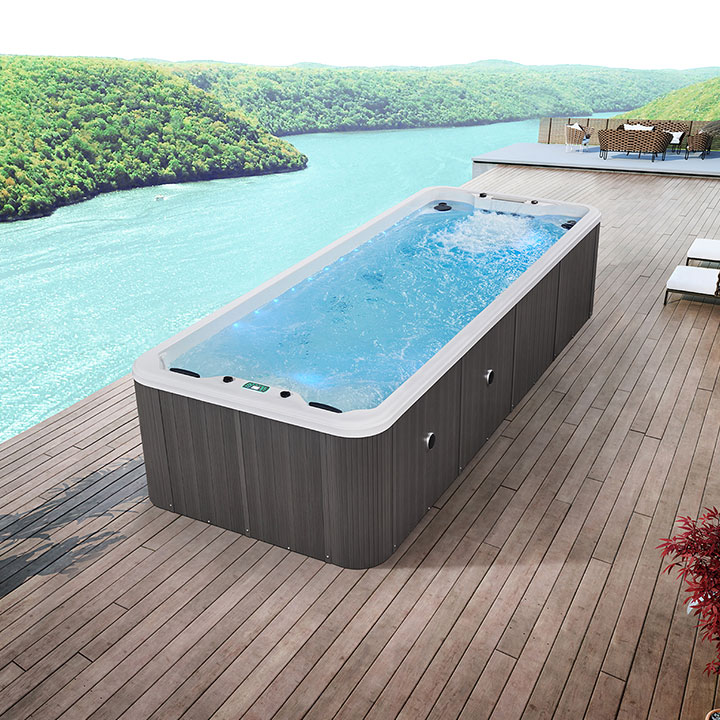
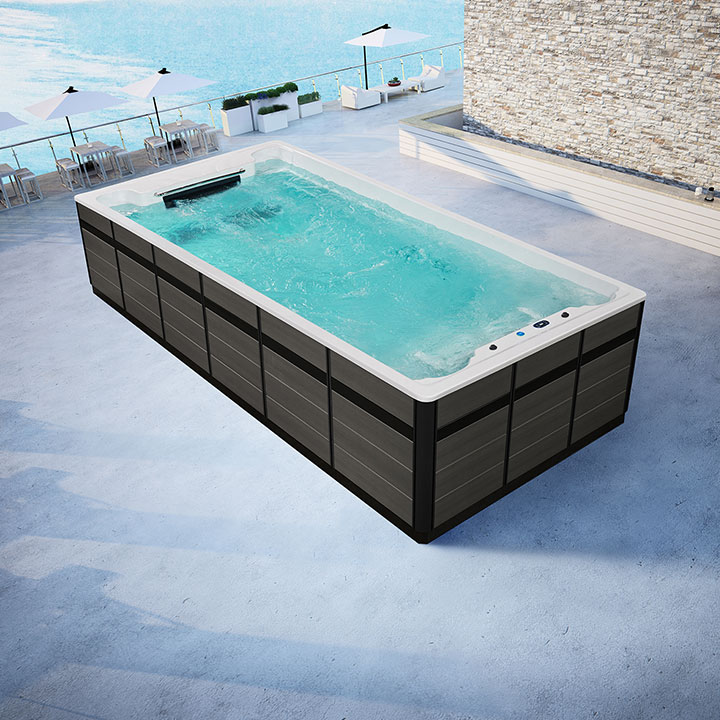
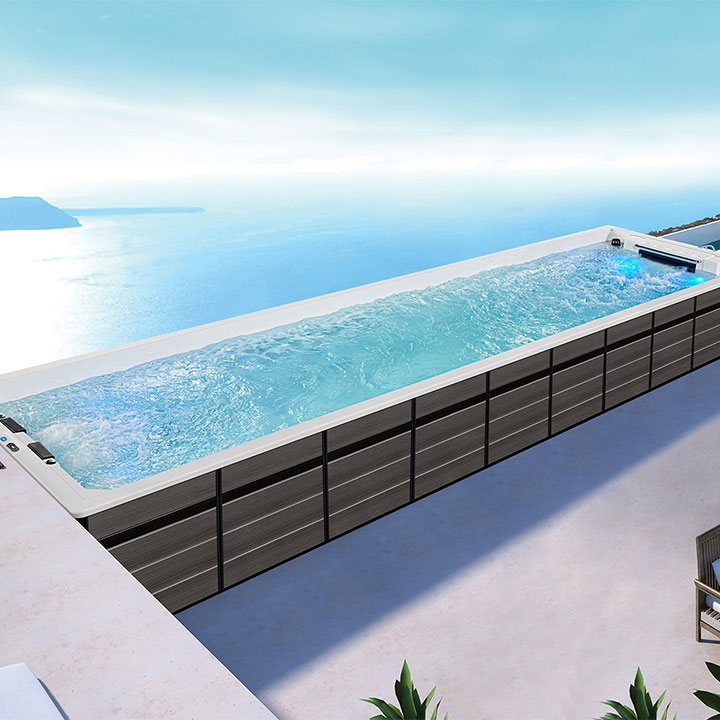
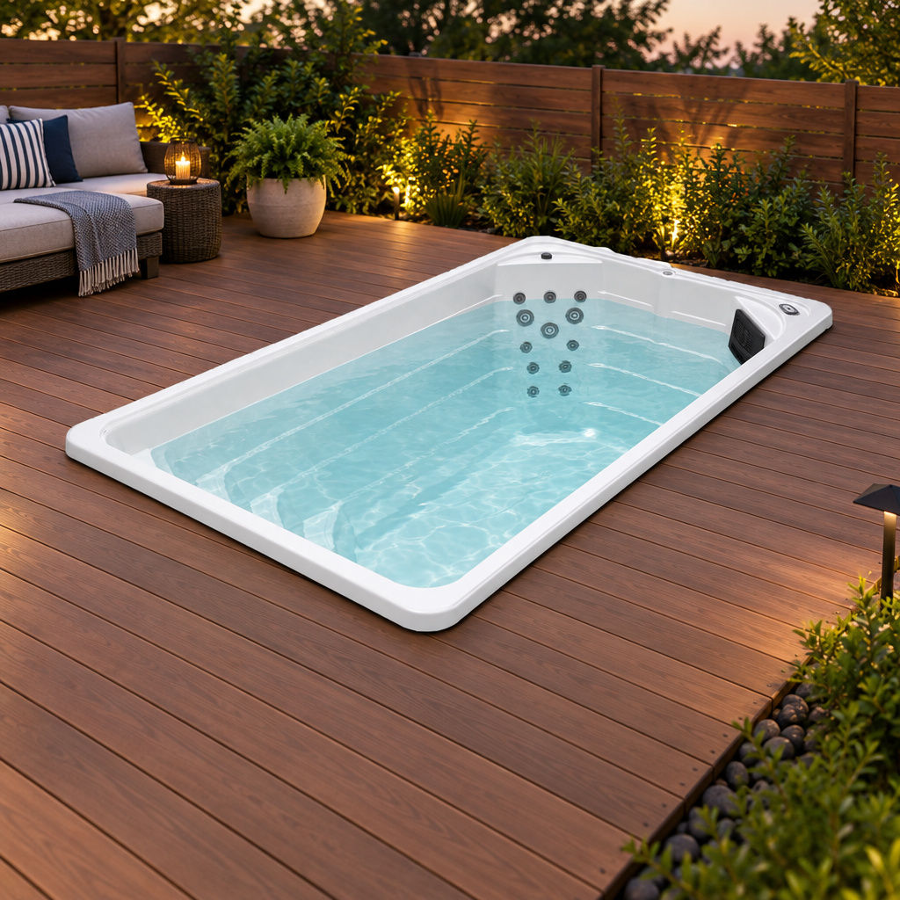
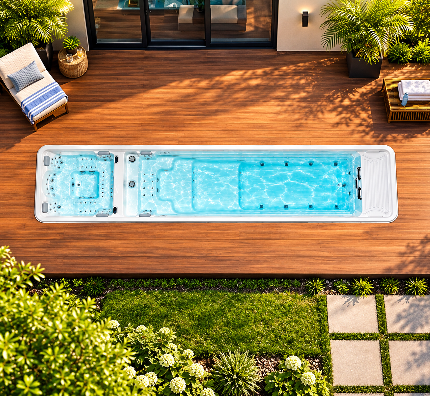
Victoria Star Swim Spa offers the perfect balance between exercise and relaxation, whether you want to swim for fitness or relax in the spacious seating.
Victoria Star Swim Spa offers the perfect balance between exercise and relaxation, whether you want to swim for fitness or relax in the spacious seating.